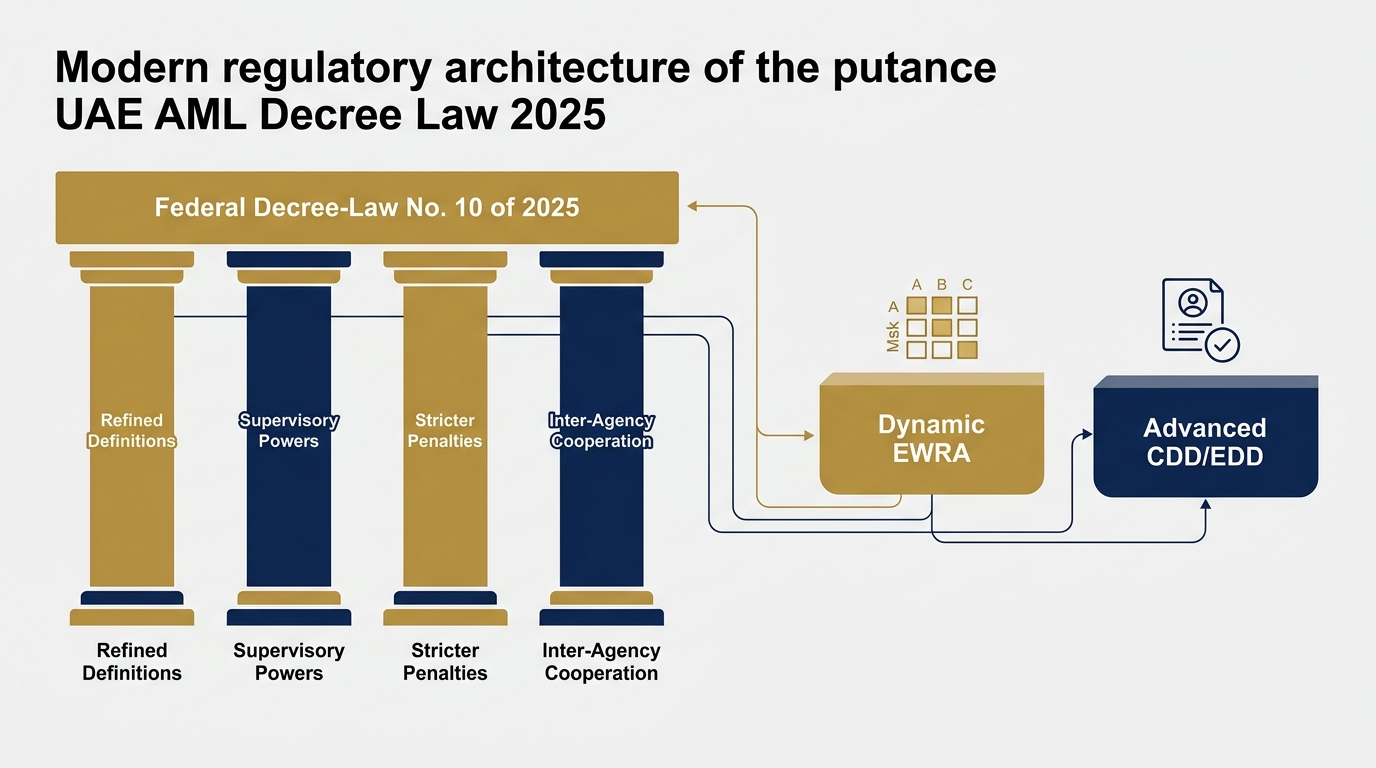

The United Arab Emirates (UAE) continues to fortify its position as a premier global financial hub by maintaining a robust, transparent, and highly resilient regulatory environment. In line with this commitment, the UAE government has enacted Federal Decree-Law No. 10 of 2025, which introduces pivotal amendments to the existing Anti-Money Laundering and Combating the Financing of Terrorism (AML/CFT) legislative framework. This new legislative update, commonly referred to as the UAE AML decree law 2025, builds upon the foundation laid by Federal Decree-Law No. 20 of 2018, introducing stricter compliance mandates, refined definitions, and enhanced enforcement mechanisms across all financial and non-financial sectors.
For compliance officers, risk managers, real estate firms, and Corporate Service Providers (CSPs) operating in Dubai and the wider UAE, understanding these legislative shifts is not merely a matter of regulatory adherence—it is a strategic necessity. The 2025 decree law aligns the UAE even closer with the international standards set by the Financial Action Task Force (FATF), ensuring that the nation remains at the forefront of global financial crime prevention. This comprehensive guide provides an in-depth analysis of the key changes introduced by the UAE AML decree law 2025, their practical implications, and the steps businesses must take to remain fully compliant.
The Evolution of the UAE AML Legislative Framework
To appreciate the significance of the UAE AML decree law 2025, it is essential to understand the trajectory of the country’s regulatory evolution. The cornerstone of the UAE’s anti-financial crime regime has been Federal Decree-Law No. 20 of 2018. Over the years, this law has been supplemented by various cabinet decisions, regulatory circulars, and executive regulations designed to address emerging risks, such as virtual assets, complex corporate structures, and geopolitical shifts.
The introduction of Federal Decree-Law No. 10 of 2025 represents a major milestone in this evolutionary process. Following the UAE’s successful exit from the FATF “grey list” in early 2024, regulatory authorities have shifted their focus from structural establishment to rigorous, sustained enforcement and qualitative compliance. The 2025 decree law is designed to close remaining regulatory gaps, enhance inter-agency cooperation, and provide supervisory authorities with broader powers to detect, investigate, and penalize financial misconduct.
Key Legislative Changes in Federal Decree-Law No. 10 of 2025
The UAE AML decree law 2025 introduces several critical amendments that refine the operational and legal boundaries of financial crime prevention. Below is a detailed breakdown of the most significant changes:
1. Refined Definitions of Financial Crime and Predicate Offenses
The 2025 decree broadens and clarifies the definitions of money laundering, predicate offenses, and illicit funds. It explicitly integrates modern financial methodologies, including decentralized finance (DeFi), virtual asset transactions, and complex cross-border trade-based money laundering (TBML) schemes, into the core definition of illicit activities. This ensures that prosecutors and regulatory bodies have a clear legal basis to target sophisticated financial crime networks.
2. Enhanced Powers for Supervisory Authorities
Under the new decree, supervisory authorities—including the Central Bank of the UAE (CBUAE), the Ministry of Economy (MoE), and the Dubai Financial Services Authority (DFSA)—are granted expanded oversight capabilities. These bodies now possess enhanced powers to conduct unannounced on-site inspections, demand real-time data access from regulated entities, and mandate immediate corrective actions without prior judicial intervention.
3. Stricter Penalties and Administrative Sanctions
The UAE AML decree law 2025 substantially escalates the financial and administrative penalties for non-compliance. Administrative fines for serious compliance failures have been revised upward, and the legal liability of senior management, board members, and designated AML Compliance Officers has been reinforced. Under the new provisions, individuals who knowingly overlook or facilitate money laundering activities face severe personal criminal liability alongside corporate penalties.
4. Streamlined Inter-Agency and International Cooperation
Recognizing that financial crime is inherently global, the 2025 decree establishes a more streamlined protocol for information sharing between domestic agencies—such as the Financial Intelligence Unit (FIU), the Executive Office for Control and Non-Proliferation, and local law enforcement—and international regulatory counterparts. This facilitates rapid asset tracing, freezing orders, and extradition processes.
Impact on Designated Non-Financial Businesses and Professions (DNFBPs)
Designated Non-Financial Businesses and Professions (DNFBPs) remain a primary focus of the UAE’s regulatory scrutiny. The UAE AML decree law 2025 imposes heightened responsibilities on these sectors, which have historically been identified as highly vulnerable to exploitation by illicit actors.
| DNFBP Sector | Key Vulnerabilities Addressed | New Compliance Mandates under the 2025 Decree |
|---|---|---|
| Real Estate Agents & Brokers | High-value cash transactions, anonymous buyers, third-party payments. | Mandatory reporting of all cash transactions exceeding specified thresholds; rigorous verification of source of funds for foreign buyers. |
| Corporate Service Providers (CSPs) | Complex shell companies, nominee arrangements, opaque ownership structures. | Strict Ultimate Beneficial Ownership (UBO) verification; ongoing monitoring of corporate structures; mandatory registration of trust arrangements. |
| Dealers in Precious Metals & Stones (DPMS) | High liquidity, physical transport of wealth, cash-based trading. | Integration with the goAML portal for suspicious transaction reporting; enhanced customer due diligence for walk-in cash buyers. |
| Legal & Accounting Professionals | Creation of complex legal entities, management of client bank accounts. | Strict separation of client funds; mandatory reporting of suspicious activities without breaching professional privilege in non-litigation matters. |
Real Estate Sector Compliance
The Dubai real estate market is a vital engine of the UAE economy, making its protection from financial crime a top priority. Under the UAE AML decree law 2025, real estate developers, brokers, and agents must implement advanced Customer Due Diligence (CDD) measures. This includes verifying the identity of all parties involved in a transaction, identifying the Ultimate Beneficial Owner (UBO), and conducting thorough Source of Wealth (SoW) and Source of Funds (SoF) checks, particularly for high-risk transactions involving politically exposed persons (PEPs) or high-risk jurisdictions.
Corporate Service Providers (CSPs) and Trust Services
CSPs are on the front lines of corporate transparency. The 2025 decree demands that CSPs maintain real-time, accurate registers of UBOs and shareholding structures. Any changes in ownership must be updated instantly on the national economic register. CSPs are also required to conduct deeper risk assessments of the business activities of the entities they incorporate, ensuring that corporate vehicles are not used to obscure illicit financial flows.
Enhanced Operational Compliance Obligations
To align with the UAE AML decree law 2025, businesses must elevate their internal compliance programs from basic check-box exercises to dynamic, risk-based frameworks. The decree emphasizes several core operational areas:
1. Dynamic Enterprise-Wide Risk Assessments (EWRA)
An Enterprise-Wide Risk Assessment (EWRA) is no longer a static document updated annually. The 2025 decree mandates that businesses continuously update their EWRA to reflect changes in their product offerings, customer demographics, geographic reach, and delivery channels. The assessment must explicitly account for new risk vectors introduced by digital onboarding and virtual assets.
2. Advanced Customer Due Diligence (CDD) and Enhanced Due Diligence (EDD)
Standard Customer Due Diligence is no longer sufficient for clients presenting elevated risk profiles. The 2025 decree outlines specific triggers that mandate immediate Enhanced Due Diligence (EDD). These triggers include transactions involving high-risk third countries, complex or unusually large transactions, and transactions with no apparent economic or visible lawful purpose. EDD measures must include obtaining additional information on the customer, the intended nature of the business relationship, and the source of wealth.
3. Real-Time Transaction Monitoring and Sanctions Screening
Regulated entities must deploy robust, automated transaction monitoring systems capable of detecting anomalous patterns in real time. Furthermore, daily screening against updated local and international sanctions lists (including the UAE Local Terrorist List and the UN Security Council Consolidated List) is mandatory. Any match or suspicious activity must be reported immediately through the goAML portal without alerting the client (avoiding “tipping-off”).
Supervisory Enforcement and the Cost of Non-Compliance
The UAE government has made it clear that compliance is non-negotiable. The UAE AML decree law 2025 provides regulatory bodies with a comprehensive toolkit to enforce compliance and penalize violators. Administrative sanctions under the new framework can include:
- Written warnings and mandatory corrective action plans.
- Substantial financial penalties scaled to the severity and frequency of the violation.
- Restrictions on business operations, including the suspension of specific licenses or activities.
- The removal or de-registration of compliance officers, board members, or executive management.
- Full revocation of the commercial license and forced liquidation of the entity.
In addition to administrative penalties, criminal prosecution remains a significant risk for entities and individuals found to be complicit in money laundering or terrorism financing. The 2025 decree strengthens the legal mechanisms for asset confiscation, ensuring that the proceeds of crime are systematically seized by the state.
A Practical Roadmap for Compliance Officers in 2025
Adapting to the UAE AML decree law 2025 requires a structured, proactive approach. Compliance officers and business leaders should implement the following roadmap to ensure seamless transition and compliance:
Step 1: Conduct a Gap Analysis
Review your existing AML/CFT policies, procedures, and controls against the updated requirements of Federal Decree-Law No. 10 of 2025. Identify areas where your current framework falls short, particularly regarding UBO transparency, transaction monitoring thresholds, and EDD triggers.
Step 2: Update the Enterprise-Wide Risk Assessment (EWRA)
Revise your EWRA to incorporate the new risk categories and definitions introduced by the 2025 decree. Ensure that your risk rating methodology is logically aligned with the specific vulnerabilities of your sector and geographic operations.
Step 3: Enhance Technology and Screening Systems
Invest in robust AML compliance software that supports real-time sanctions screening, PEP identification, and transaction monitoring. Ensure that your systems are integrated with the goAML portal and are capable of generating accurate, timely reports.
Step 4: Implement Comprehensive Staff Training
Your compliance framework is only as strong as the people operating it. Conduct regular, targeted training sessions for all employees, from front-line sales staff to board members. Training should focus on recognizing red flags, understanding the new reporting thresholds, and adhering to strict anti-tipping-off protocols.
Step 5: Engage Independent AML Audits
Regular, independent AML compliance audits are essential to verify the effectiveness of your controls. An external audit provides an objective assessment of your compliance posture, helping you identify and remediate vulnerabilities before they are flagged by regulatory inspectors.
How Tareq Badarin & Farahat & Co. Can Assist Your Business
Navigating the complexities of the UAE AML decree law 2025 requires specialized expertise and deep local regulatory knowledge. As an AML Compliance Specialist and Senior Compliance Analyst working within the framework of Farahat & Co., Tareq Badarin provides tailored, end-to-end compliance solutions designed to protect your business from financial crime risks and regulatory penalties.
Our comprehensive suite of services includes:
- Regulatory Advisory & Consultation: Helping businesses interpret and align with the latest UAE AML laws and international standards.
- KYC & CDD Optimization: Designing and implementing robust customer onboarding and due diligence workflows.
- Enterprise-Wide Risk Assessments (EWRA): Developing customized risk assessment frameworks tailored to your specific business model.
- Transaction Monitoring & Sanctions Screening: Implementing and tuning automated screening systems to minimize false positives and ensure compliance.
- Independent AML Compliance Audits: Conducting rigorous, independent evaluations of your compliance program to ensure regulatory readiness.
- Certification and Training Programs: Equipping your team with the knowledge and skills required to maintain a culture of compliance.
Whether you are a real estate firm in Dubai, a Corporate Service Provider, or a financial institution, our team is committed to delivering practical, risk-based solutions that safeguard your reputation and support your business growth in the UAE.
Frequently Asked Questions
What is the UAE AML Decree Law of 2025?
The UAE AML Decree Law of 2025 (Federal Decree-Law No. 10 of 2025) is a legislative update that amends previous anti-money laundering laws to strengthen the UAE's regulatory framework, enhance supervisory powers, and align closely with international FATF standards.
How does the 2025 decree law affect DNFBPs in Dubai?
DNFBPs, including real estate agents, corporate service providers, and legal professionals, face stricter Customer Due Diligence (CDD), mandatory UBO transparency, and enhanced reporting requirements for high-value cash transactions.
What are the penalties for non-compliance under the new decree?
Penalties include substantial administrative fines, suspension or revocation of commercial licenses, removal of compliance officers, and potential criminal prosecution and asset confiscation for serious violations.
What is the role of goAML in the updated framework?
The goAML portal remains the primary platform for reporting suspicious transactions (STRs) and activity reports (SARs). The 2025 decree mandates faster, more integrated reporting protocols for all regulated entities.