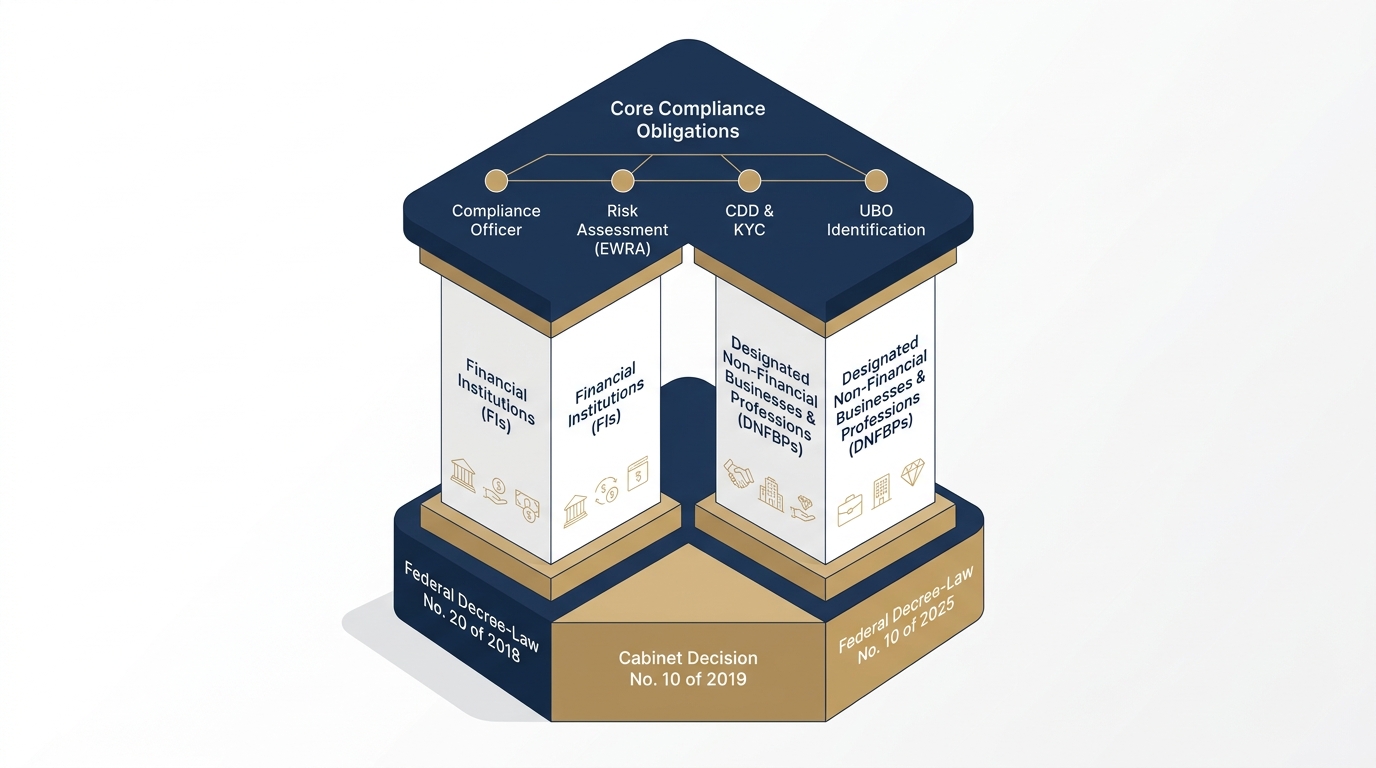

The United Arab Emirates (UAE) has established one of the most robust and dynamic regulatory frameworks in the Middle East to combat financial crime. As a global financial hub bridging East and West, the country has aligned its domestic legislation with international standards, particularly those set by the Financial Action Task Force (FATF). For businesses operating in Dubai, Abu Dhabi, and the wider Emirates, understanding the anti money laundering laws UAE enforce is not merely a matter of legal compliance—it is a fundamental pillar of operational sustainability, financial stability, and reputational integrity.
This comprehensive guide provides an in-depth analysis of the UAE’s anti-money laundering (AML) and countering the financing of terrorism (CFT) legal framework. It outlines the core legislative decrees, the obligations of Financial Institutions (FIs) and Designated Non-Financial Businesses and Professions (DNFBPs), the role of supervisory authorities, and practical steps for establishing an airtight compliance program.
The Legislative Foundation: Key Anti Money Laundering Laws in the UAE
The UAE’s fight against financial crime is built upon a comprehensive suite of federal laws, cabinet decisions, and regulatory circulars. To understand your compliance obligations, you must first understand the primary legislation that governs the jurisdiction.
Federal Decree-Law No. 20 of 2018
The cornerstone of the UAE’s AML/CFT regime is Federal Decree-Law No. 20 of 2018 on Anti-Money Laundering and Countering the Financing of Terrorism and Financing of Illegal Organisations. This landmark legislation modernized the UAE’s legal approach to financial crime by:
- Defining the specific crimes of money laundering, terrorist financing, and financing of illegal organizations.
- Establishing the National Committee for Combating Money Laundering and Financing of Terrorism and Illegal Organisations.
- Mandating the creation of the Financial Intelligence Unit (FIU) to receive and analyze suspicious transaction reports.
- Imposing strict Know Your Customer (KYC) and Customer Due Diligence (CDD) requirements on both financial and non-financial sectors.
Cabinet Decision No. 10 of 2019
Serving as the implementing regulation for the 2018 Decree-Law, Cabinet Decision No. 10 of 2019 provides the operational details required for compliance. It outlines the specific procedures for identifying customers, assessing risks, conducting ongoing monitoring, and reporting suspicious activities to the authorities.
Recent Legislative Evolution: Federal Decree-Law No. 10 of 2025
Reflecting the UAE’s commitment to continuous improvement, recent legislative updates, including Federal Decree-Law No. 10 of 2025, have further refined the national standards. These updates place a heightened emphasis on digital identity verification, beneficial ownership transparency, and increased penalties for non-compliance, ensuring the UAE remains ahead of evolving financial crime typologies.
Scope of Application: Who is Governed by UAE AML Laws?
The anti money laundering laws UAE enforces apply broadly across two primary categories of business entities: Financial Institutions (FIs) and Designated Non-Financial Businesses and Professions (DNFBPs). Understanding which category your business falls under is critical for determining your specific regulatory supervisor and compliance mandates.
1. Financial Institutions (FIs)
This category includes traditional banks, exchange houses, finance companies, insurance firms, and investment advisors. FIs are supervised primarily by the Central Bank of the UAE (CBUAE) or, within financial free zones, by the Dubai Financial Services Authority (DFSA) in the DIFC, and the Financial Services Regulatory Authority (FSRA) in the ADGM.
2. Designated Non-Financial Businesses and Professions (DNFBPs)
DNFBPs are non-financial sectors that are highly vulnerable to being exploited for money laundering. Under UAE law, the following sectors are classified as DNFBPs:
- Real Estate Agents and Brokers: Specifically when involved in transactions concerning the buying and selling of real estate for their clients.
- Dealers in Precious Metals and Stones (DPMS): Anyone carrying out single or multiple cash transactions equal to or exceeding AED 55,000.
- Independent Legal Professionals and Accountants: When preparing, executing, or conducting transactions for clients relating to buying/selling real estate, managing client money/assets, or creating/operating companies.
- Corporate Service Providers (CSPs) and Trust Services: Entities providing company formation, directorship, or registered office services.
DNFBPs operating in the mainland and commercial free zones are supervised by the Ministry of Economy (MoE), while those in the financial free zones fall under the jurisdiction of the DFSA or FSRA.
Core Compliance Obligations for UAE Businesses
To comply with the anti money laundering laws UAE mandates, covered entities must implement a structured, risk-based AML/CFT compliance program. Below are the essential pillars of an effective compliance framework.
1. Appointment of a Qualified Compliance Officer
Every FI and DNFBP must appoint a dedicated Compliance Officer or Money Laundering Reporting Officer (MLRO). This individual must possess the appropriate qualifications, experience, and authority to oversee the AML program, liaise with regulatory bodies, and file suspicious reports.
2. Enterprise-Wide Risk Assessment (EWRA)
Businesses must conduct a comprehensive Enterprise-Wide Risk Assessment to identify, assess, and understand their specific money laundering and terrorist financing risks. This assessment must consider factors such as:
- Customer demographics and risk profiles.
- Geographic areas of operation.
- Products, services, and transaction channels.
- Delivery channels and technology utilized.
3. Customer Due Diligence (CDD) and Know Your Customer (KYC)
An effective CDD process is vital for verifying the identity of clients before establishing a business relationship. The law requires different levels of due diligence based on the assessed risk level:
| Due Diligence Level | Applicability | Required Actions |
|---|---|---|
| Simplified Due Diligence (SDD) | Low-risk customers (e.g., publicly listed companies, government entities). | Basic identity verification; simplified ongoing monitoring. |
| Standard Due Diligence (CDD) | Medium-risk customers (standard business relationships). | Verification of identity, understanding the nature of business, and identifying the Ultimate Beneficial Owner (UBO). |
| Enhanced Due Diligence (EDD) | High-risk customers (e.g., Politically Exposed Persons (PEPs), high-risk jurisdictions). | Sourcing wealth/funds verification, senior management approval, and intensive transaction monitoring. |
4. Ultimate Beneficial Ownership (UBO) Identification
Under UAE regulations, businesses must identify and verify the identity of the Ultimate Beneficial Owner (UBO)—the natural person who ultimately owns or controls 25% or more of the legal entity’s share capital, or who exercises ultimate control over the entity.
5. Transaction Monitoring and Sanctions Screening
Entities must continuously monitor transactions to ensure they align with the customer’s known profile, business activities, and risk level. Additionally, businesses must screen all clients, beneficial owners, and transactions against the UAE Local Terrorist List and the UN Security Council Consolidated List to comply with Targeted Financial Sanctions (TFS).
The Role of the goAML Portal
The goAML portal is an integrated software application developed by the United Nations Office on Drugs and Crime (UNODC) and utilized by the UAE Financial Intelligence Unit (FIU). Registration on the goAML portal is mandatory for all FIs and DNFBPs in the UAE.
The portal serves as the primary communication channel between reporting entities and the FIU. Through goAML, businesses must submit critical reports, including:
- Suspicious Transaction Reports (STRs): Filed when there are reasonable grounds to suspect that funds are the proceeds of criminal activity or linked to terrorist financing.
- Suspicious Activity Reports (SARs): Filed when a transaction is attempted but not completed, or when general behavior raises suspicion without a specific transaction.
- High-Risk Country Reports (HRCs): Filed for transactions involving jurisdictions designated as high-risk by the FATF or national authorities.
Failure to register on the goAML portal or failure to report suspicious activities constitutes a severe violation of UAE federal law and can lead to significant penalties.
Penalties and Enforcement for Non-Compliance
The UAE authorities have significantly intensified their enforcement actions, conducting regular audits and imposing strict penalties on non-compliant businesses. The consequences of violating anti money laundering laws UAE regulations include:
- Administrative Fines: Ranging from AED 50,000 to AED 5,000,000 per violation, depending on the severity and nature of the infraction.
- Operational Restrictions: Suspension of business licenses, restriction of specific business activities, or the removal of board members and compliance officers.
- Criminal Prosecution: Imprisonment and substantial personal fines for individuals knowingly involved in money laundering activities or failing to report them.
- Reputational Damage: Public naming of non-compliant firms by supervisory authorities, which can lead to loss of banking relationships and client trust.
How to Build an Effective AML Compliance Program
To safeguard your business and ensure full compliance with the UAE’s regulatory expectations, consider implementing the following structured approach:
- Draft Robust AML Policies and Procedures: Develop a comprehensive, customized AML/CFT manual that reflects your specific business operations, risk appetite, and the latest UAE legislative requirements.
- Implement Regular Staff Training: Conduct ongoing training programs to ensure all employees—from frontline staff to senior management—understand AML risks, red flags, and their individual reporting obligations.
- Conduct Independent AML Audits: Regularly engage an independent compliance expert to review and test the effectiveness of your AML controls, transaction monitoring systems, and reporting mechanisms.
- Leverage Compliance Technology: Utilize specialized software for automated KYC verification, sanctions screening, and transaction monitoring to reduce human error and increase efficiency.
Deep Dive: Sector-Specific AML Challenges and Best Practices
While the core principles of the anti money laundering laws UAE enforces remain consistent across all sectors, different industries face unique vulnerabilities. Understanding these sector-specific challenges is essential for designing targeted controls that satisfy regulatory auditors.
Real Estate Sector Vulnerabilities
The Dubai and Abu Dhabi real estate markets are highly attractive to global investors, making them prime targets for illicit funds. Common typologies include buying properties with large amounts of physical cash, utilizing complex corporate structures to hide beneficial ownership, or executing rapid successive sales (property flipping) to obscure the origin of funds.
To mitigate these risks, real estate brokers and developers must:
- Verify the identity of all buyers and sellers, including any representatives acting under a Power of Attorney (POA).
- Identify and verify the Ultimate Beneficial Owners (UBOs) when properties are purchased by corporate entities or trusts.
- Submit a Real Estate Activity Report (REAR) via the goAML portal for transactions involving cash payments equal to or exceeding AED 55,000, or when virtual assets are used as a payment method.
Corporate Service Providers (CSPs) and Trust Services
CSPs are often targeted by bad actors seeking to establish shell companies or complex multi-jurisdictional structures to mask illicit financial flows. The primary risk lies in the creation of legal entities without a clear commercial purpose.
Best practices for CSPs include:
- Conducting rigorous background checks on the founders, directors, and shareholders of any entity being incorporated.
- Obtaining detailed information on the proposed business activity, source of wealth, and expected transaction volumes.
- Refusing to provide registered office or nominee director services if the client’s identity or business purpose cannot be fully verified.
Dealers in Precious Metals and Stones (DPMS)
Gold, diamonds, and other high-value commodities are highly liquid and can be easily transported across borders, making them highly vulnerable to money laundering. Under UAE law, DPMS must register on the goAML portal and implement strict compliance measures if they engage in cash transactions equal to or exceeding AED 55,000.
Key requirements for DPMS include:
- Conducting Customer Due Diligence (CDD) for all high-value cash transactions.
- Maintaining detailed records of all purchases and sales, including the identity of the counterparty and the origin of the precious metals or stones.
- Filing a Dealers in Precious Metals and Stones Report (DPMSR) via the goAML portal for any transaction meeting or exceeding the regulatory threshold.
The Importance of the Enterprise-Wide Risk Assessment (EWRA)
An Enterprise-Wide Risk Assessment (EWRA) is not a one-time exercise; it is the foundation upon which your entire AML/CFT compliance program is built. Regulatory authorities in the UAE, including the Ministry of Economy and the Central Bank, expect businesses to conduct a comprehensive EWRA annually or whenever there are significant changes to their business model, products, or operating environment.
Steps to Conduct an Effective EWRA
To conduct a robust EWRA that aligns with the anti money laundering laws UAE enforces, businesses should follow these steps:
- Identify Inherent Risks: Assess the risks inherent to your business before applying any controls. This includes analyzing your customer base (e.g., percentage of high-risk or non-resident clients), geographic exposure (e.g., operating in or receiving funds from high-risk jurisdictions), and delivery channels (e.g., face-to-face vs. non-face-to-face interactions).
- Evaluate Control Effectiveness: Assess the strength and effectiveness of your existing AML controls, including your KYC procedures, transaction monitoring systems, staff training, and independent audit functions.
- Determine Residual Risk: Calculate your residual risk—the risk that remains after applying your controls. If the residual risk exceeds your business’s risk appetite, you must implement additional mitigating measures.
- Document and Approve: Document the entire EWRA process, findings, and action plans in a formal report. This report must be reviewed and approved by senior management and made available to regulatory auditors upon request.
Navigating the Regulatory Audit Process
Supervisory authorities in the UAE regularly conduct onsite and offsite inspections to ensure compliance with national AML/CFT regulations. Being prepared for a regulatory audit is critical to avoiding administrative fines and operational restrictions.
What Auditors Look For
During an AML audit, inspectors will typically review the following documents and processes:
- Your written AML/CFT policies, procedures, and controls manual.
- Your latest Enterprise-Wide Risk Assessment (EWRA) report.
- Evidence of registration and active use of the goAML portal.
- Customer files to verify that KYC, CDD, and UBO identification have been performed correctly.
- Records of transaction monitoring and evidence of screening against sanctions lists.
- Documentation of any Suspicious Transaction Reports (STRs) or Suspicious Activity Reports (SARs) filed.
- Evidence of regular AML training provided to all employees, including board members and senior management.
- The report and findings of your latest independent AML audit.
By proactively addressing these areas and maintaining organized, easily accessible records, you can demonstrate a strong compliance culture and navigate the audit process with confidence.
Partner with a Dubai-Based AML Compliance Specialist
Navigating the complexities of the anti money laundering laws UAE enforces requires specialized expertise and localized regulatory knowledge. As an AML Compliance Specialist and Senior Compliance Analyst working within the framework of Farahat & Co., Tareq Badarin provides comprehensive compliance solutions tailored to the unique needs of Dubai’s business ecosystem.
Whether you are a real estate firm, a corporate service provider, or a financial institution, we offer expert guidance in:
- Regulatory Advisory & Consultation
- KYC & CDD Optimization
- Transaction Monitoring & Sanctions Screening
- Enterprise-Wide Risk Assessments (EWRA)
- Independent AML Compliance Audits
- Customized Certification and Training Programs