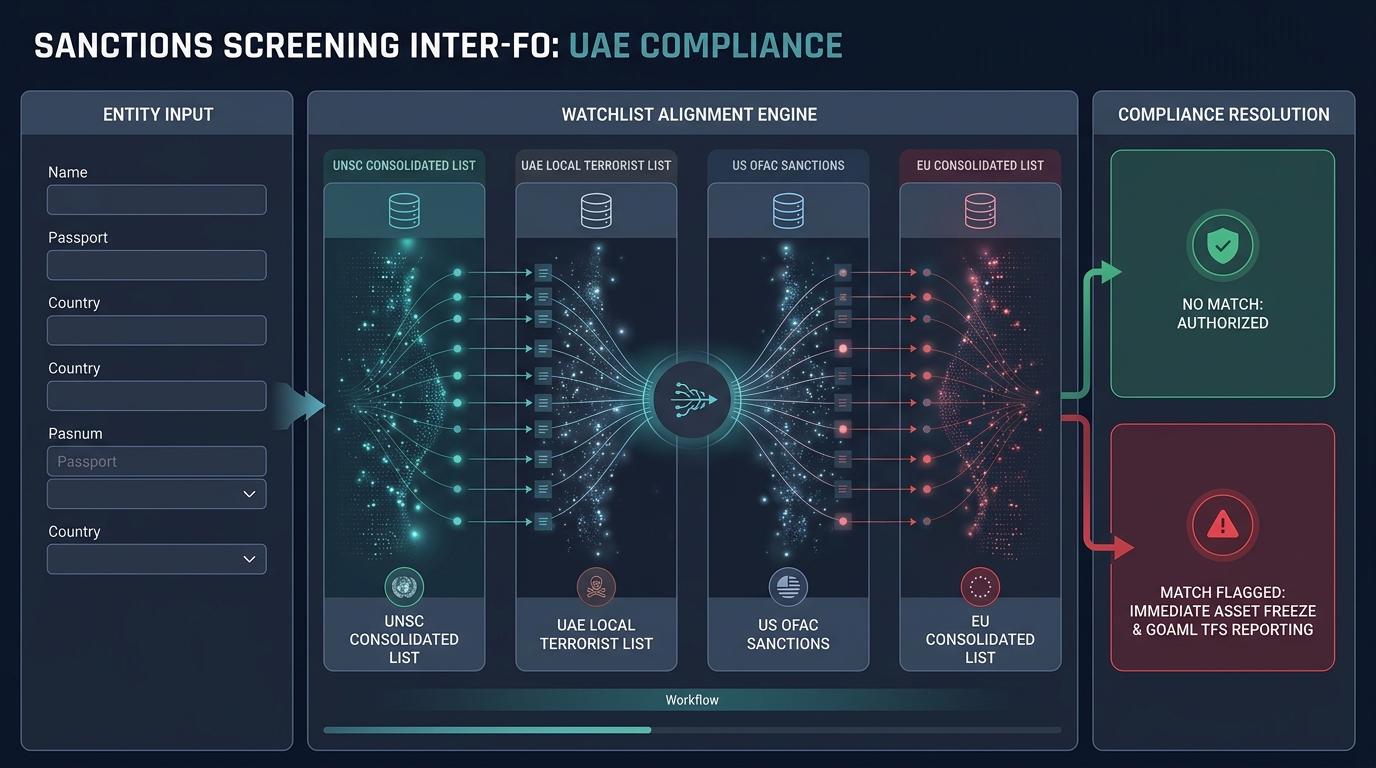
In the rapidly evolving global financial landscape, the United Arab Emirates (UAE) has established itself as a premier hub for international trade, real estate, and corporate services. However, this prominent position brings significant regulatory responsibilities. For businesses operating within the UAE—particularly Designated Non-Financial Businesses and Professions (DNFBPs) and financial institutions—implementing a robust sanctions screening UAE framework is no longer optional; it is a critical legal and operational mandate.
Failing to identify sanctioned individuals, entities, or jurisdictions can lead to severe consequences, including multi-million dirham fines, reputational damage, and the potential revocation of business licenses. To safeguard your organization, compliance frameworks must align seamlessly with both domestic directives and international watchlists, including the United Nations Security Council (UNSC), the European Union (EU), and the United States Office of Foreign Assets Control (OFAC).
This comprehensive guide explores the mechanics of sanctions screening in the UAE, the regulatory expectations of supervisory authorities, and how businesses can implement effective screening protocols to mitigate financial crime risks.
Understanding Sanctions Screening in the UAE
Sanctions screening is a control mechanism used by organizations to detect, prevent, and manage sanctions risk. It involves comparing the names of customers, beneficial owners, transactions, and business partners against official watchlists of restricted individuals, entities, vessels, and countries.
In the UAE, the Executive Office for Control and Non-Proliferation (EOCN) oversees the implementation of Targeted Financial Sanctions (TFS). The UAE regulatory framework requires all licensed entities to screen their databases and transactions against both local and international lists immediately upon any update.
The Legal Framework for UAE Sanctions Compliance
The UAE’s commitment to combating financial crime is anchored in robust federal legislation. The primary laws governing sanctions compliance include:
- Federal Decree-Law No. 20 of 2018 on Anti-Money Laundering and Combating the Financing of Terrorism and Financing of Illegal Organisations.
- Cabinet Decision No. 74 of 2020 regarding the UAE’s local terrorist list and the implementation of United Nations Security Council resolutions on preventing and suppressing the financing of terrorism and proliferation.
- Subsequent regulatory circulars issued by supervisory authorities such as the Central Bank of the UAE (CBUAE), the Ministry of Economy (MoE), and the Dubai Financial Services Authority (DFSA).
Under these regulations, businesses must perform real-time screening, freeze assets of designated entities without delay (typically within 24 hours), and submit reports via the FIU’s goAML portal.
Key Sanctions Lists: UN, EU, and OFAC Alignment
While domestic compliance focuses heavily on the UAE Local Terrorist List and the UN Security Council Consolidated List, international business operations necessitate a multi-jurisdictional approach. Aligning with global watchlists ensures that cross-border transactions remain uninterrupted and compliant.
| Sanctions List | Issuing Authority | Scope & Relevance in the UAE |
|---|---|---|
| UN Security Council Consolidated List | United Nations (UN) | Mandatory for all UAE entities. Covers global terrorism, non-proliferation, and conflict zones. |
| UAE Local Terrorist List | UAE Cabinet / EOCN | Mandatory domestic list. Focuses on national security and regional threats. |
| OFAC Sanctions Lists | US Department of the Treasury | Extraterritorial reach. Crucial for any transaction involving US Dollars, US persons, or US-origin goods. |
| EU Consolidated List | European Union (EU) | Essential for businesses dealing with European counterparties, currencies, or European subsidiaries. |
1. United Nations Security Council (UNSC) Sanctions
As a member state of the United Nations, the UAE is legally bound to implement UNSC resolutions. When the UNSC adds or amends a listing, UAE businesses must apply Targeted Financial Sanctions immediately. This includes freezing funds and ensuring that no financial services or resources are made available directly or indirectly to the designated parties.
2. The UAE Local Terrorist List
The UAE Cabinet publishes and updates its own local list of individuals and entities classified as terrorists or supporters of terrorism. Screening against this list is a fundamental requirement for all local businesses, including real estate brokers, corporate service providers, and precious metal dealers.
3. US OFAC Sanctions
The Office of Foreign Assets Control (OFAC) administers and enforces economic and trade sanctions based on US foreign policy and national security goals. Even if a business is based entirely in Dubai or Abu Dhabi, OFAC sanctions can apply if transactions touch the US financial system (such as clearing USD payments) or involve US citizens. Non-compliance can lead to secondary sanctions, cutting the UAE business off from the global financial system.
4. European Union (EU) Sanctions
EU sanctions apply within the jurisdiction of the EU, to EU citizens, and to entities incorporated under the law of an EU member state. For UAE firms with European clients, branches, or investment partners, screening against the EU Consolidated List is vital to prevent regulatory breaches in European jurisdictions.
The Critical Importance of Sanctions Screening for UAE Sectors
Different sectors within the UAE economy face varying levels of exposure to sanctions risks. Understanding these sector-specific vulnerabilities is essential for designing a risk-based compliance program.
Real Estate Sector in Dubai and the Wider UAE
The UAE real estate market, particularly in Dubai, is a major destination for foreign investment. This high volume of international transactions makes the sector highly vulnerable to illicit financial flows. Real estate developers, brokers, and agents are classified as DNFBPs and are subject to strict AML/CFT regulations.
In the real estate sector, sanctions screening must be integrated at multiple stages of the transaction:
- Onboarding: Screening buyers, sellers, and their ultimate beneficial owners (UBOs) before executing any agreements.
- Payment Processing: Screening the origin of funds, including the names of bank account holders and any third-party payers.
- Post-Transaction: Continuous screening of existing client databases against updated sanctions lists to identify any post-transaction listings.
Failure to conduct proper screening in real estate transactions can lead to severe penalties, including substantial fines and criminal prosecution for facilitating money laundering or sanctions evasion.
Corporate Service Providers (CSPs)
Corporate Service Providers (CSPs) play a critical role in the formation and management of companies in the UAE. They often act as the gatekeepers to the financial system, assisting clients with company registration, providing nominee services, and managing corporate bank accounts.
CSPs must implement rigorous sanctions screening protocols to ensure they do not facilitate the establishment of corporate structures for sanctioned individuals or entities. This involves:
- UBO Identification: Conducting deep-dive due diligence to identify the natural persons who ultimately own or control the corporate client.
- Intermediary Screening: Screening all intermediaries, professional advisors, and authorized signatories associated with the client entity.
- Ongoing Monitoring: Regularly screening the corporate registry and client database to detect any changes in ownership or control that may trigger sanctions alerts.
Financial Institutions
Banks, exchange houses, and other financial institutions in the UAE operate under the direct supervision of the Central Bank of the UAE (CBUAE). They are subject to the most stringent sanctions screening requirements, given their role in processing high volumes of domestic and international transactions.
Financial institutions must employ advanced transaction monitoring and screening systems capable of analyzing payment messages (such as SWIFT messages) in real-time. These systems must be calibrated to detect not only direct matches but also indirect connections to sanctioned jurisdictions, vessels, or entities.
Step-by-Step Implementation of Sanctions Screening
Establishing an effective sanctions screening program requires a structured approach that integrates technology, clear policies, and trained personnel. Below are the essential steps to build a compliant screening workflow:
Step 1: Conduct an Enterprise-Wide Risk Assessment (EWRA)
Before deploying screening tools, you must understand your organization’s specific risk exposure. An Enterprise-Wide Risk Assessment (EWRA) is a regulatory requirement in the UAE and serves as the foundation of a risk-based compliance program. Assess your client base, geographic footprint, delivery channels, and the types of products or services offered.
For example, a real estate firm dealing with high-net-worth foreign buyers faces different sanctions risks compared to a local retail business. The EWRA helps you identify high-risk areas and allocate compliance resources effectively.
Step 2: Define Screening Rules and Fuzzy Matching Thresholds
Names are rarely spelled the same way across different databases. Variations in transliteration (e.g., Arabic to English), spelling errors, and deliberate aliases require the use of “fuzzy matching” technology. Your screening software must be calibrated to detect close matches without generating an overwhelming volume of false positives.
Fuzzy matching algorithms analyze name variations based on factors such as phonetics, character insertion/deletion, and name transposition. Setting the right threshold is a balance that requires expert compliance oversight to ensure that potential matches are not missed while keeping operational noise manageable.
Step 3: Establish a Clear Escalation Protocol
When a potential match (alert) is identified, your team must follow a structured review process:
- Initial Review: Compare secondary identifiers (date of birth, nationality, passport number, address) to determine if the alert is a “false positive” or a “potential hit.”
- Investigation: Gather additional Know Your Customer (KYC) information if details are incomplete.
- Escalation: If the match cannot be ruled out, escalate the alert to the Money Laundering Reporting Officer (MLRO) or Compliance Officer.
- Action: If a positive match is confirmed, freeze the assets immediately and file a Fund Freeze Report (FFR) or Partial Name Match Report (PNMR) via the goAML portal.
Step 4: Maintain Detailed Audit Trails
Regulators do not just want to know that you screen; they want proof. Maintain comprehensive logs of all screening activities, including the date and time of screening, the lists used, the alerts generated, and the written justification for clearing or escalating each alert. These records must be kept for at least five years and be readily accessible for regulatory inspections.
Common Challenges in Sanctions Screening and How to Overcome Them
Implementing sanctions screening is rarely straightforward. Compliance officers in the UAE frequently encounter several operational hurdles:
Managing False Positives
A false positive occurs when a non-sanctioned individual triggers an alert because their name is similar to a sanctioned entity. High volumes of false positives can overwhelm compliance teams, leading to alert fatigue and delayed transactions. To mitigate this, businesses should optimize their screening software, utilize high-quality KYC data, and implement secondary identifier matching rules.
Real-Time Screening vs. Batch Screening
Batch screening (screening your entire database periodically) is useful for identifying newly sanctioned entities within your existing client base. However, it is insufficient for transaction monitoring. Real-time screening must be integrated into your onboarding process and transaction workflows to stop prohibited funds before they are processed.
Data Quality Issues
Screening tools are only as good as the data fed into them. Incomplete client profiles, missing dates of birth, or poorly transliterated names increase the likelihood of both false positives and false negatives (failing to identify a true match). Prioritizing data quality during the Customer Due Diligence (CDD) phase is critical.
The Role of goAML and TFS Reporting
The Financial Intelligence Unit (FIU) of the UAE utilizes the goAML portal as the primary platform for regulatory reporting. Under the Targeted Financial Sanctions (TFS) framework, DNFBPs and financial institutions must register on the goAML portal and actively monitor notifications from the EOCN.
If your screening process identifies a confirmed match or a highly suspicious connection to a sanctioned entity, you must submit the appropriate report:
- Fund Freeze Report (FFR): Submitted when an institution identifies and freezes funds, assets, or economic resources belonging to a listed individual or entity. This action must be taken immediately and without prior notice to the customer.
- Partial Name Match Report (PNMR): Submitted when there is a partial match or suspicion, but insufficient data to confirm or fully rule out the match, allowing the FIU to provide guidance.
These reports must be submitted within the tight timelines prescribed by the UAE authorities to avoid non-compliance penalties. Timely reporting is a critical indicator of an effective compliance program during regulatory audits.
Regulatory Audits and Enforcement in the UAE
UAE supervisory authorities, including the Ministry of Economy and the Central Bank, conduct regular onsite and offsite inspections to assess compliance with AML/CFT and sanctions regulations. During these audits, inspectors will review your sanctions screening policies, system calibration, alert resolution logs, and goAML reporting history.
Non-compliance can result in severe enforcement actions, including:
- Significant financial penalties ranging from tens of thousands to millions of dirhams.
- Suspension or revocation of business licenses.
- Public disclosure of the enforcement action, leading to severe reputational damage.
- Criminal prosecution of the company’s directors, compliance officers, or MLROs in cases of willful negligence or complicity.
To prepare for regulatory audits, businesses should conduct regular independent AML compliance audits to identify and remediate any gaps in their sanctions screening frameworks.
How Professional Compliance Advisory Can Help
Navigating the complexities of international sanctions lists, fuzzy matching algorithms, and goAML reporting requires specialized expertise. As an AML Compliance Specialist operating in the UAE, I assist businesses in designing, implementing, and auditing their sanctions screening frameworks.
Through tailored advisory services, we ensure your business remains fully aligned with the Ministry of Economy, CBUAE, and international standards, protecting your operations from regulatory friction and financial crime exposure.
Whether you need to select and calibrate a screening tool, draft robust compliance policies, or conduct an independent audit of your existing systems, professional guidance ensures your compliance program is both effective and commercially viable.
Secure Your Compliance Framework Today
Do not wait for a regulatory audit or a transaction block to discover weaknesses in your compliance systems. Contact us today to evaluate your sanctions screening protocols, optimize your KYC/CDD workflows, and ensure your business is fully aligned with UN, EU, and OFAC requirements in the UAE.
Frequently Asked Questions
Are UAE businesses required to screen against US OFAC lists?
While OFAC is a US regulatory body, its sanctions have extraterritorial reach. Any UAE business processing transactions in US Dollars, dealing with US citizens, or using US-origin goods must screen against OFAC lists to avoid secondary sanctions and loss of clearing bank access.
What is the timeframe for freezing assets of a sanctioned entity in the UAE?
Under UAE Cabinet Decision No. 74 of 2020, listed entities' funds and assets must be frozen immediately and without prior notice, typically within 24 hours of the publication of the listing on the local or UN sanctions lists.
What is the difference between a Fund Freeze Report (FFR) and a Partial Name Match Report (PNMR)?
An FFR is submitted when you have confirmed a match and successfully frozen the assets of a sanctioned entity. A PNMR is used when there is a close name match but you lack sufficient identifying information to confirm or rule out the match, prompting guidance from the FIU.
How often should a UAE company update its sanctions screening database?
Screening databases must be updated in real-time or immediately upon the release of any updates by the Executive Office for Control and Non-Proliferation (EOCN) or the UN Security Council.