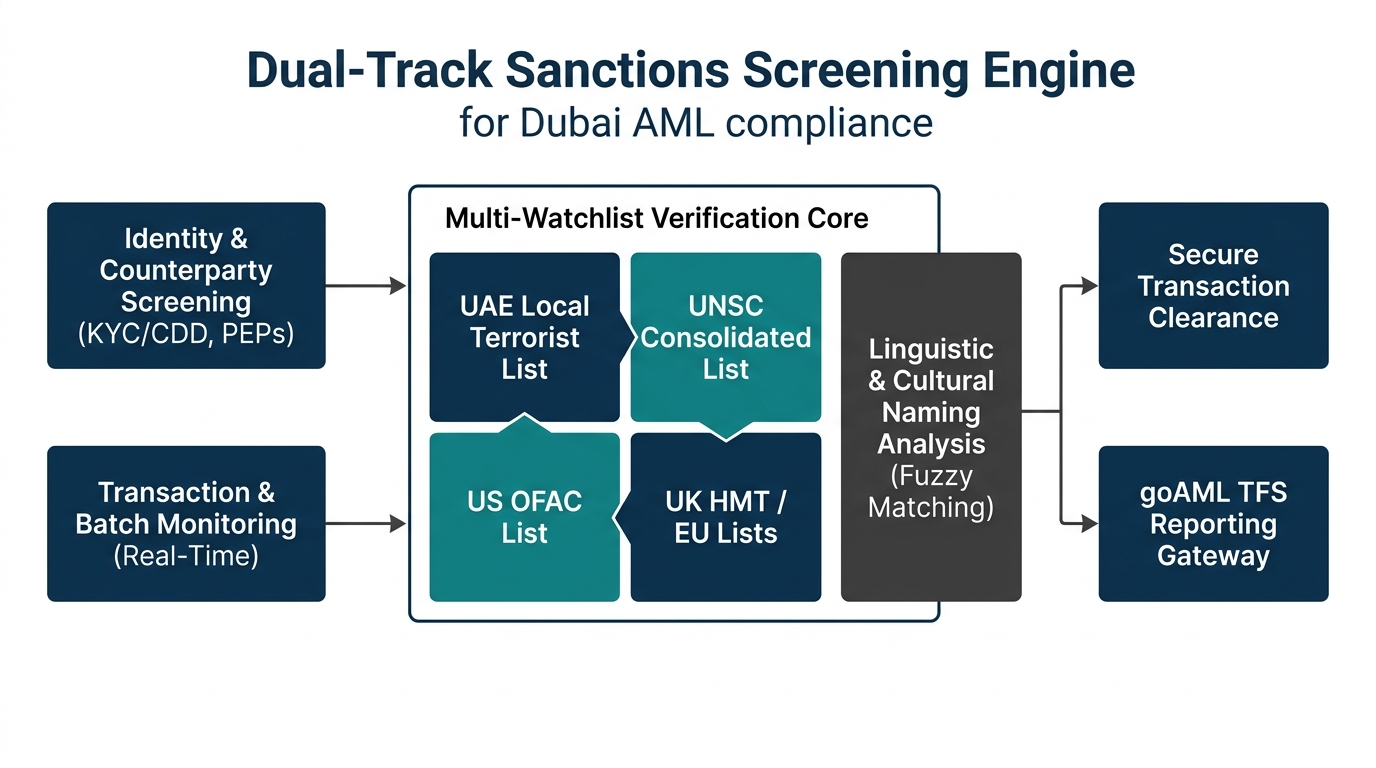
In the rapidly evolving global financial landscape, Dubai has firmly established itself as a premier international hub for trade, real estate, and financial services. However, this status brings significant regulatory scrutiny. To safeguard the integrity of its financial system, the United Arab Emirates (UAE) has implemented a stringent Anti-Money Laundering (AML) and Countering the Financing of Terrorism (CFT) framework. At the core of this framework lies the absolute obligation for businesses to implement robust sanctions screening processes.
For Designated Non-Financial Businesses and Professions (DNFBPs)—including real estate brokers, corporate service providers (CSPs), legal consultants, and precious metals dealers—as well as financial institutions, compliance is no longer optional. Failing to identify a sanctioned individual, entity, or vessel can lead to catastrophic consequences, including severe financial penalties, license revocation, and criminal prosecution. Utilizing professional sanctions screening services Dubai is the most effective way to navigate these complex regulatory waters, protect your business reputation, and ensure uninterrupted operations.
Understanding Sanctions Screening in the UAE Regulatory Context
Sanctions screening is the process of vetting individuals, entities, transactions, and vessels against official watchlists issued by national and international regulatory bodies. The primary objective is to prevent sanctioned parties from accessing the financial system or engaging in commercial transactions within the UAE.
In Dubai, the regulatory framework governing sanctions is primarily overseen by the Executive Office for Control and Non-Proliferation (EOCN) and the Central Bank of the UAE (CBUAE). Under Cabinet Decision No. (74) of 2020, all natural and legal persons in the UAE must implement Targeted Financial Sanctions (TFS). This mandate requires immediate action when a match is identified on any applicable sanctions list.
The Critical Sanctions Watchlists
An effective sanctions screening program in Dubai must screen against multiple local and international databases simultaneously. These include:
- The UAE Local Terrorist List: Issued and updated by the UAE Cabinet, containing individuals and entities identified as threats to national security.
- The United Nations Security Council Consolidated List (UNSC): Mandatory for all UN member states, targeting global terrorist networks, proliferators of weapons of mass destruction, and human rights violators.
- The US Office of Foreign Assets Control (OFAC) List: Highly influential globally, OFAC sanctions apply to US citizens, permanent residents, entities organized under US law, and any transactions involving US dollars or US-origin goods.
- The UK HM Treasury (HMT) and European Union (EU) Sanctions Lists: Crucial for businesses engaging in trade or financial transactions with European partners.
Failing to screen against any of these lists can expose a Dubai-based business to cross-border regulatory enforcement and secondary sanctions, which can effectively cut off the business from the global financial system.
Regulatory Oversight and Enforcement Bodies
The regulatory landscape in Dubai is multi-layered, requiring businesses to understand which supervisory authority governs their specific sector:
- Ministry of Economy (MoE): Supervises DNFBPs operating in the mainland and non-financial free zones, including real estate agents, precious metals dealers, auditors, and corporate service providers.
- Dubai Financial Services Authority (DFSA): Regulates financial institutions and ancillary service providers operating within the Dubai International Financial Centre (DIFC).
- Financial Services Regulatory Authority (FSRA): Oversees entities within the Abu Dhabi Global Market (ADGM), maintaining strict alignment with international standards.
- Central Bank of the UAE (CBUAE): Directly supervises banks, exchange houses, and other licensed financial institutions across the Emirates.
Key Components of a Robust Sanctions Screening Framework
Implementing professional sanctions screening services in Dubai involves more than just purchasing software and running names through a search bar. A compliant, risk-based screening framework must be integrated into the daily operations of the business and consist of several core components:
1. Customer and Counterparty Screening (KYC/CDD)
Screening must occur at the onboarding stage (Know Your Customer / Customer Due Diligence) before any business relationship is established. This includes screening:
- Individual clients and corporate entities.
- Ultimate Beneficial Owners (UBOs) holding 25% or more of the shares or voting rights.
- Authorized signatories, directors, and key management personnel.
- Third-party representatives or power of attorney holders.
2. Transaction Screening and Monitoring
For financial institutions and high-value sectors like real estate, screening must occur in real-time before transactions are processed. This prevents the movement of funds or transfer of assets associated with sanctioned parties. Transaction screening analyzes payment instructions, sender and receiver details, intermediary banks, and maritime shipping data (such as vessel names and ports of call).
3. Ongoing and Batch Screening
Sanctions lists are dynamic and can change multiple times a day. A client who was cleared during onboarding last month may be added to a sanctions list today. Therefore, businesses must conduct regular, automated batch screening of their entire customer database against updated watchlists to ensure continuous compliance.
4. Politically Exposed Persons (PEPs) and Adverse Media Screening
While distinct from sanctions screening, PEP and adverse media screening are vital components of a comprehensive risk management strategy. Identifying PEPs (individuals entrusted with prominent public functions) and monitoring negative news helps businesses assess the overall risk profile of their clients and apply Enhanced Due Diligence (EDD) where necessary.
The Unique Challenges of Sanctions Screening in Dubai
Operating a business in Dubai presents unique operational challenges when it comes to compliance. A one-size-fits-all screening tool often falls short due to several regional factors:
| Challenge | Impact on Compliance | How Professional Services Resolve It |
|---|---|---|
| Arabic Name Transliteration | Names translated from Arabic to English can have multiple spelling variations, leading to missed matches. | Advanced fuzzy matching algorithms designed specifically for Arabic linguistic variations and naming conventions. |
| High Volume of False Positives | Common names can trigger thousands of false alerts, overwhelming compliance teams and delaying business transactions. | Customized screening thresholds, secondary identifier matching (date of birth, passport number), and expert analyst review. |
| Complex Corporate Structures | Sanctioned individuals often hide behind shell companies, offshore entities, and complex ownership layers. | Deep-dive UBO verification and corporate registry screening integrated into the compliance workflow. |
| Real-Time Transaction Demands | Real estate and trade transactions move quickly; manual screening delays can cause deals to fall through. | Automated, API-driven screening solutions that deliver instant results without compromising accuracy. |
Addressing Linguistic Nuances and Cultural Naming Conventions
In the Middle East, naming conventions present a significant challenge for automated screening systems. The use of patronymics (where an individual’s middle names are derived from their father and grandfather) often results in long, complex names that can be written in dozens of different ways when transliterated into Latin scripts. For example, names containing “Abdul” or “Mohammad” can have multiple spellings (e.g., “Abdel”, “Abdullah”, “Muhammad”, “Mohammed”). Professional screening services utilize advanced natural language processing (NLP) and phonetic algorithms (such as Double Metaphone or custom Arabic-specific matchers) to ensure that spelling variations do not result in missed matches (false negatives) or an unmanageable volume of false positives.
The Consequences of Non-Compliance in the UAE
The UAE authorities have adopted a zero-tolerance policy toward AML/CFT and TFS violations. The Ministry of Economy (MoE), the Dubai Financial Services Authority (DFSA), and other supervisory bodies regularly conduct audits and impose severe penalties on non-compliant firms.
The consequences of failing to implement adequate sanctions screening services in Dubai include:
- Substantial Financial Fines: Administrative penalties can range from AED 50,000 to millions of Dirhams depending on the severity of the violation.
- Operational Restrictions: Suspension of business licenses, restriction of commercial activities, or closure of bank accounts.
- Reputational Damage: Public disclosure of enforcement actions by regulatory authorities, destroying trust with clients, partners, and banking institutions.
- Criminal Liability: Imprisonment and personal criminal prosecution for compliance officers, directors, and business owners who willfully ignore TFS obligations.
The Cost of Business Disruption
Beyond regulatory fines, the operational cost of a compliance failure can be devastating. When a business is flagged for a potential sanctions violation, its corporate bank accounts are often frozen immediately by correspondent banks. This halts all business operations, prevents payroll processing, and damages relationships with legitimate suppliers and clients. Rebuilding trust with banking institutions after a compliance breach is an uphill battle that many businesses do not survive.
How Professional Sanctions Screening Services Protect Your Business
Partnering with an experienced AML compliance specialist like Tareq Badarin, in collaboration with Farahat & Co., ensures that your business implements a screening program that is both legally compliant and operationally efficient. Professional services provide several key advantages:
Tailored Risk-Based Configuration
Not every business faces the same level of risk. A boutique real estate agency has a different risk profile compared to a multinational corporate service provider. Professional advisory services help you configure your screening software’s “fuzzy matching” thresholds to align with your specific risk appetite, minimizing false positives while ensuring no genuine matches are missed.
Clear Alert Escalation and Resolution Protocols
When a screening tool generates an alert, your team must know exactly how to handle it. Professional services establish clear, step-by-step Standard Operating Procedures (SOPs) for investigating alerts, distinguishing between false positives and true matches, and escalating confirmed matches to the appropriate authorities via the goAML portal.
Independent Audit and System Testing
Regulators require businesses to periodically test and audit their compliance systems. An independent review of your sanctions screening processes verifies that your software is functioning correctly, your watchlists are up to date, and your staff is properly trained to handle alerts.
Step-by-Step Guide to Handling a Sanctions Match in Dubai
If your sanctions screening system identifies a potential match, your compliance team must follow a strict, legally mandated protocol:
- Freeze Immediately: If the match is confirmed as a “true match” against the UAE Local Terrorist List or the UN Security Council List, you must immediately freeze all funds, financial assets, or economic resources belonging to the designated party without prior notice.
- Refuse Service: Do not provide any financial services, real estate transactions, or corporate services to the sanctioned individual or entity.
- Report via goAML: File a Fund Freezing Report (FFR) or a Partial Name Match Report (PNMR) through the FIU’s goAML portal within 24 hours of identifying the match.
- Maintain Confidentiality: Do not “tip off” the client or any third party about the investigation or the report filed with the authorities.
Understanding the goAML Portal Reporting Requirements
The goAML portal, developed by the United Nations Office on Drugs and Crime (UNODC) and implemented by the UAE Financial Intelligence Unit (FIU), is the central platform for submitting regulatory reports. When filing a report, compliance officers must provide comprehensive documentation, including:
- The exact match details from the screening software.
- Full identification documents of the subject (passports, corporate registry documents).
- A detailed narrative explaining the relationship or transaction history.
- Evidence of the freezing action taken or the transaction suspension.
Errors or delays in submitting these reports can lead to regulatory penalties for the compliance officer and the institution alike.
Best Practices for Implementing Sanctions Screening in Dubai
To build a resilient compliance framework, businesses should adopt the following industry best practices:
1. Conduct an Enterprise-Wide Risk Assessment (EWRA)
Before selecting a screening tool, you must understand your business’s specific risk exposure. An EWRA evaluates your customer base, geographic reach, products, services, and delivery channels to identify where sanctions risks are highest. This assessment forms the foundation of your risk-based approach.
2. Establish a Dual-Control Review Process
To prevent human error, implement a “four-eyes” principle for alert resolution. While a junior compliance analyst can perform the initial review and discount obvious false positives, any potential true matches or complex cases should be escalated to a senior compliance officer or the Money Laundering Reporting Officer (MLRO) for final sign-off.
3. Maintain Comprehensive Audit Trails
Regulators do not just want to see that you screen; they want proof of how you resolved every single alert. Your screening system must maintain immutable logs of all searches, alerts generated, and the specific rationale used by analysts to clear or escalate those alerts. These records must be kept for at least five years under UAE law.
4. Invest in Continuous Staff Training
Compliance is not solely the responsibility of the compliance department. Front-line staff, sales agents, and relationship managers must understand the importance of sanctions screening and be trained to spot red flags, such as clients providing incomplete identification or attempting to use third-party intermediaries without justification.
Why Choose Tareq Badarin for Your Compliance Needs in Dubai
Navigating the complexities of Targeted Financial Sanctions and transaction monitoring requires specialized expertise. As a dedicated AML Compliance Specialist in Dubai, working within the framework of Farahat & Co., Tareq Badarin provides comprehensive, end-to-end compliance solutions tailored to the unique needs of Dubai’s business community.
Our services include:
- Regulatory Advisory: Aligning your business with CBUAE, Ministry of Economy, and EOCN compliance standards.
- Screening System Integration: Helping you select, configure, and optimize advanced sanctions screening and transaction monitoring software.
- UBO and CDD Optimization: Designing robust onboarding procedures to uncover hidden risks and identify ultimate beneficial owners.
- Staff Training and Capacity Building: Equipping your compliance officers and front-line staff with the knowledge to handle alerts and navigate the goAML portal.
- Enterprise-Wide Risk Assessments (EWRA): Identifying and mitigating your business’s specific exposure to financial crime and sanctions evasion.
Protect your business from regulatory penalties and reputational harm. Contact Tareq Badarin today to secure your operations with professional sanctions screening services in Dubai.
Frequently Asked Questions
What is Targeted Financial Sanctions (TFS) compliance in the UAE?
TFS compliance in the UAE refers to the legal obligation of all individuals and businesses to implement measures to prevent the financing of terrorism and proliferation. This includes immediately freezing funds and assets of individuals or entities listed on the UAE Local Terrorist List or the UN Security Council Consolidated List, and reporting these actions to the Executive Office for Control and Non-Proliferation (EOCN).
Who is required to perform sanctions screening in Dubai?
All financial institutions, virtual asset service providers (VASPs), and Designated Non-Financial Businesses and Professions (DNFBPs) in Dubai—including real estate brokers, corporate service providers, lawyers, auditors, and dealers in precious metals and stones—are legally required to perform sanctions screening.
How often should my business update and run sanctions screening?
Sanctions screening must be performed at the time of customer onboarding (before establishing a business relationship) and in real-time before executing any transactions. Additionally, businesses must conduct ongoing batch screening of their entire customer database whenever there are updates to the UAE Local Terrorist List or the UN Security Council Consolidated List.
What should I do if my screening tool identifies a potential sanctions match?
If a potential match is identified, you must immediately suspend the transaction or relationship and conduct an internal investigation. If it is confirmed as a 'true match', you must freeze any associated assets immediately without prior notice and file a Fund Freezing Report (FFR) or Partial Name Match Report (PNMR) on the goAML portal within 24 hours.