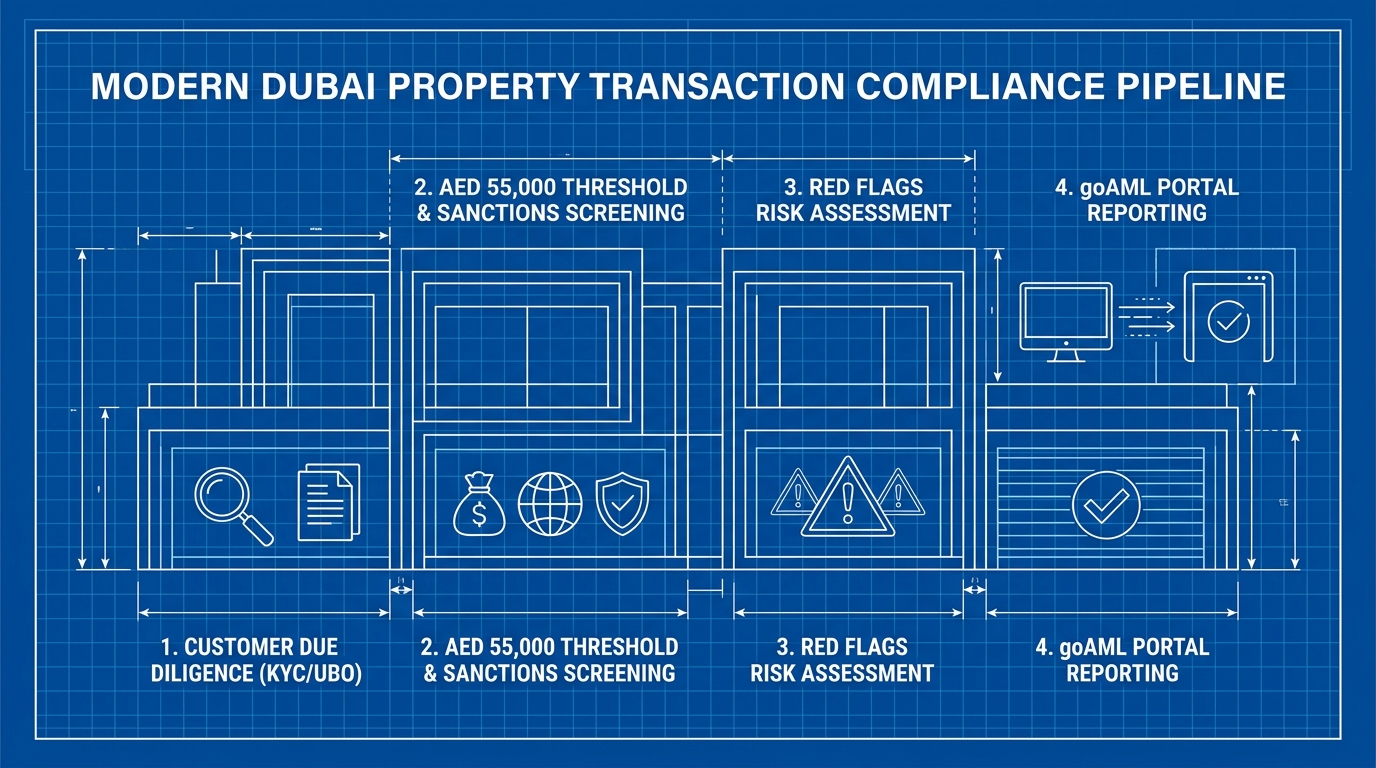
Dubai’s real estate sector is a cornerstone of the United Arab Emirates’ economic dynamism, attracting billions of dirhams in foreign and domestic investment annually. However, the high value of transactions and the global nature of property markets make this sector a primary target for illicit financial activities. To safeguard the integrity of its financial system, the UAE has established a robust regulatory framework. Understanding and implementing the real estate AML guidelines Dubai enforces is not just a legal necessity but a critical operational requirement for all brokers, agents, and developers operating in the emirate.
As Designated Non-Financial Businesses and Professions (DNFBPs), real estate professionals are subject to strict oversight by the Ministry of Economy (MoE) and the UAE Financial Intelligence Unit (FIU). This comprehensive guide provides an in-depth analysis of the essential anti-money laundering (AML) and countering the financing of terrorism (CFT) guidelines, offering actionable insights to ensure your business remains fully compliant and secure.
The Regulatory Framework Governing Dubai Real Estate
The legal foundation for AML compliance in the UAE is built upon several key legislative instruments. These laws establish the obligations of DNFBPs and define the powers of regulatory authorities to monitor, audit, and penalize non-compliant entities.
- Federal Decree-Law No. 20 of 2018 on Anti-Money Laundering and Combating the Financing of Terrorism and Financing of Illegal Organisations.
- Cabinet Decision No. 10 of 2019 concerning the Implementing Regulation of Federal Decree-Law No. 20 of 2018.
- Federal Decree-Law No. 10 of 2025, which further strengthens the national AML/CFT standards and aligns UAE regulations with the latest international best practices.
- Cabinet Decision No. 58 of 2020 regarding the regulation of Ultimate Beneficial Owner (UBO) procedures.
Under this legislative umbrella, the Ministry of Economy acts as the supervisory authority for the real estate sector. Real estate brokers, agents, and developers must implement comprehensive internal controls to detect, prevent, and report suspicious transactions.
Core AML Compliance Obligations for Real Estate Professionals
To achieve full compliance with the real estate AML guidelines Dubai mandates, businesses must establish a structured AML/CFT compliance program. This program must be integrated into daily operations and supported by senior management. The core pillars of this framework include the following essential requirements:
1. Mandatory Registration on the goAML Portal
The goAML portal, developed by the United Nations Office on Drugs and Crime (UNODC), is the primary platform used by the UAE Financial Intelligence Unit (FIU) to collect and analyze suspicious transaction reports. Registration on goAML is a mandatory first step for all real estate brokers and developers in Dubai. Failure to register can result in immediate administrative penalties. The portal is used to submit Suspicious Transaction Reports (STRs), Suspicious Activity Reports (SARs), and other mandatory transaction reports.
2. Appointment of a Qualified Compliance Officer
Every real estate firm must appoint a dedicated AML Compliance Officer. This individual is responsible for overseeing the day-to-day implementation of the AML program, conducting risk assessments, training staff, and acting as the primary liaison with the Ministry of Economy and the FIU. The Compliance Officer must possess the appropriate qualifications, experience, and authority within the organization to make independent decisions regarding suspicious activities.
3. Customer Due Diligence (CDD) and Know Your Customer (KYC)
Real estate firms must verify the identity of all clients—both buyers and sellers—before establishing a business relationship or executing any transaction. Customer Due Diligence (CDD) involves collecting and verifying official identification documents. The depth of the due diligence process depends on the risk profile of the client:
- Standard Due Diligence: Applied to low-to-medium risk clients. This requires obtaining valid passports, Emirates IDs (for UAE residents), trade licenses (for corporate entities), and verifying the legal status of the entity.
- Simplified Due Diligence (SDD): Permitted only in specific low-risk scenarios defined by the regulations, such as transactions involving government entities or publicly listed companies.
- Enhanced Due Diligence (EDD): Mandatory for high-risk clients, including Politically Exposed Persons (PEPs), clients from high-risk jurisdictions, or transactions with complex, non-transparent ownership structures. EDD requires establishing the source of wealth (SoW) and source of funds (SoF) of the client.
4. Ultimate Beneficial Owner (UBO) Identification
When dealing with corporate clients, trusts, or partnerships, real estate firms must look through the corporate layers to identify the Ultimate Beneficial Owner (UBO). A UBO is any natural person who ultimately owns or controls, directly or indirectly, 25% or more of the legal entity’s capital or voting rights, or who exercises control over the entity through other means. Real estate firms must document the ownership structure and obtain identification documents for all identified UBOs.
5. Sanctions Screening and Targeted Financial Sanctions (TFS)
Real estate brokers and developers must screen all clients, beneficial owners, and counter-parties against the UAE Local Terrorist List and the United Nations Security Council Consolidated List. This screening must occur prior to onboarding and must be updated continuously. If a match is identified, the firm must immediately freeze any associated funds or transactions, refrain from providing any services, and submit a Fund Freezing Report (FFR) or Partial Name Match Report (PNMR) via the goAML portal.
The AED 55,000 Reporting Threshold for Real Estate Transactions
In 2022, the Ministry of Economy, in collaboration with the Ministry of Justice, introduced specific reporting requirements for certain real estate transactions. This measure is designed to limit the use of cash and virtual assets in the property sector, which are historically high-risk channels for money laundering.
Real estate brokers, agents, and developers must submit a Real Estate Activity Report (REAR) via the goAML portal for any purchase or sale of freehold real estate that involves any of the following payment methods, provided the value meets or exceeds AED 55,000 (individually or collectively):
| Payment Method | Reporting Threshold | Required Action |
|---|---|---|
| Physical Cash Payments | AED 55,000 or more | Submit REAR via goAML within the designated timeframe |
| Virtual Assets / Cryptocurrencies | Any amount equivalent to AED 55,000 or more | Verify source of virtual assets and submit REAR |
| Funds Derived from Virtual Assets | Any amount equivalent to AED 55,000 or more | Conduct enhanced due diligence and submit REAR |
This reporting requirement applies even if the transaction is split into multiple smaller payments that collectively reach the AED 55,000 threshold. Compliance officers must closely monitor payment structures to identify structured payments designed to evade this reporting trigger.
Identifying Red Flags in Dubai Real Estate Transactions
A crucial component of a risk-based AML approach is the ability to recognize suspicious behaviors and transaction patterns. Real estate professionals must train their front-line staff to identify “red flags” that may indicate money laundering or terrorist financing. When a red flag is identified, the transaction must be subjected to closer scrutiny, and a Suspicious Activity Report (SAR) or Suspicious Transaction Report (STR) must be filed if the suspicion cannot be reasonably dispelled.
Common real estate red flags include:
- Unusual Transaction Patterns: A client purchasing multiple properties in a short period without a clear economic or personal rationale, or buying properties without viewing them.
- Obfuscated Ownership: Clients who attempt to hide their identity by using shell companies, complex offshore trusts, or third-party nominees (such as relatives or associates) to purchase property.
- Atypical Funding Sources: Payments originating from high-risk jurisdictions, offshore financial centers, or third parties who have no apparent connection to the buyer.
- Price Discrepancies: Transactions where the purchase price is significantly higher or lower than the market value of the property, which may indicate an attempt to move illicit funds or under-report transaction values.
- Reluctance to Provide Information: Clients who hesitate, delay, or refuse to provide standard KYC documentation, UBO declarations, or proof of the source of their funds.
- Frequent Cancellations: A buyer who deposits a large sum of money for a property purchase and then quickly cancels the transaction, requesting the refund to be paid to a different bank account or a third party.
Step-by-Step AML Compliance Checklist for Dubai Real Estate Firms
To ensure systematic compliance with the Ministry of Economy guidelines, real estate firms should implement the following operational checklist:
- Register on goAML: Ensure your firm is registered on the FIU’s goAML portal and that access credentials are kept secure and updated.
- Appoint and Train a Compliance Officer: Designate a qualified individual to manage the AML program and provide regular training to all employees on identifying red flags and executing CDD procedures.
- Conduct an Enterprise-Wide Risk Assessment (EWRA): Assess the specific money laundering risks your firm faces based on your client base, geographic reach, transaction volumes, and types of properties sold.
- Implement a Written AML Policy: Develop a comprehensive, written AML/CFT policy manual that outlines your firm’s procedures for CDD, EDD, sanctions screening, record-keeping, and reporting.
- Perform Client Screening: Screen every client, UBO, and authorized representative against local and international sanctions lists before executing any contract.
- Collect and Verify KYC Documents: Obtain valid identification, proof of address, and corporate registration documents. Identify and verify all UBOs holding 25% or more of corporate clients.
- Monitor Transactions and Payments: Track all payments, paying specific attention to cash or virtual asset transactions that meet or exceed the AED 55,000 threshold.
- File Timely Reports: Submit REARs, STRs, or SARs via the goAML portal whenever a transaction meets the reporting criteria or raises unresolved suspicions.
- Maintain Records: Retain all KYC documents, transaction records, screening logs, and internal compliance assessments for a minimum of five years from the date of the transaction or the termination of the business relationship.
Penalties for Non-Compliance in the UAE
The UAE authorities maintain a zero-tolerance policy toward money laundering and financial crime. The Ministry of Economy conducts regular on-site and off-site audits of real estate brokers and developers to verify compliance. Non-compliance with real estate AML guidelines Dubai enforces can result in severe administrative and criminal penalties, including:
- Financial Fines: Administrative fines ranging from AED 50,000 to AED 5,000,000 per violation, depending on the severity of the infraction.
- Operational Sanctions: Suspension or revocation of the firm’s commercial license, halting all business operations.
- Reputational Damage: Public blacklisting of non-compliant firms by regulatory authorities, which can permanently damage business relationships and investor trust.
- Criminal Prosecution: In cases of deliberate complicity or gross negligence, compliance officers, managers, and business owners may face criminal prosecution, including imprisonment and asset confiscation.
How Tareq Badarin Can Assist Your Real Estate Firm
Navigating the complex and evolving landscape of AML compliance in Dubai requires specialized expertise. As a dedicated AML Compliance Specialist and Senior Compliance Analyst working within the framework of Farahat & Co., Tareq Badarin provides comprehensive, practical compliance solutions tailored to the unique needs of Dubai’s real estate brokers and developers.
Our services are designed to protect your business from regulatory penalties and financial crime risks, allowing you to focus on growth with confidence. We offer:
- Regulatory Advisory & Consultation: Expert guidance on aligning your operations with the latest UAE AML laws, including Federal Decree-Law No. 10 of 2025.
- goAML Registration & Reporting Support: Assisting your firm with goAML portal setup, system readiness, and the accurate filing of REARs, STRs, and SARs.
- KYC & CDD Optimization: Designing efficient client onboarding workflows that ensure thorough verification without compromising the client experience.
- Enterprise-Wide Risk Assessments (EWRA): Conducting detailed risk assessments to identify vulnerabilities in your business model and implement targeted mitigation strategies.
- AML Compliance Audits: Performing independent audits of your compliance framework to ensure audit readiness for Ministry of Economy inspections.
- Bespoke Training Programs: Providing practical, real-world training for your compliance officers and sales agents to ensure they can confidently identify red flags and execute compliance protocols.
Partnering with an experienced specialist ensures that your compliance framework is robust, up-to-date, and fully aligned with the expectations of UAE regulatory authorities. Contact Tareq Badarin today to secure your business and maintain the highest standards of regulatory integrity in Dubai’s dynamic real estate market.
Frequently Asked Questions
Who regulates AML compliance for real estate in Dubai?
AML compliance for the real estate sector in Dubai is regulated and supervised by the UAE Ministry of Economy (MoE), with suspicious transactions and mandatory reports being submitted directly to the UAE Financial Intelligence Unit (FIU) via the goAML portal.
What is the cash transaction reporting threshold for Dubai real estate?
Real estate brokers and developers must report any transaction involving physical cash, virtual assets (cryptocurrency), or funds derived from virtual assets that equal or exceed AED 55,000. This is reported via a Real Estate Activity Report (REAR) on the goAML portal.
What is the role of a Compliance Officer in a Dubai real estate firm?
The Compliance Officer is responsible for implementing the firm's AML/CFT policies, conducting risk assessments, performing client due diligence, screening against sanctions lists, training staff, and filing suspicious transaction reports (STRs/SARs) on the goAML portal.
What are the penalties for non-compliance with AML guidelines in Dubai?
Penalties for non-compliance can be severe, including administrative fines ranging from AED 50,000 to AED 5,000,000, suspension or revocation of the commercial business license, public blacklisting, and potential criminal prosecution for severe violations.