Dubai’s real estate sector remains a cornerstone of the United Arab Emirates’ economic growth, attracting substantial foreign direct investment and driving large-scale urban development. However, the high value of transactions and the global nature of property buyers make the sector a primary target for illicit financial activities. To safeguard the integrity of its financial system, the UAE has established a rigorous regulatory environment. Under this framework, real estate developers in Dubai are classified as Designated Non-Financial Businesses and Professions (DNFBPs) and are subject to strict oversight by the Ministry of Economy (MoE) and the Financial Intelligence Unit (FIU).
Implementing a robust framework for AML compliance for developers Dubai is no longer optional; it is a critical operational mandate. Developers must navigate complex regulatory requirements, including comprehensive customer verification, transaction monitoring, and mandatory reporting through the goAML portal. Failure to comply can result in severe financial penalties, license suspension, and criminal prosecution. This guide provides an in-depth analysis of the compliance obligations, risk mitigation strategies, and operational frameworks required for real estate developers to maintain full compliance with UAE laws.
The Regulatory Landscape for Dubai Developers
The legal foundation for anti-money laundering and combating the financing of terrorism (AML/CFT) in the UAE is built upon Federal Decree-Law No. 20 of 2018 on Anti-Money Laundering and Combating the Financing of Terrorism and Illegal Organisations, and its subsequent amendments, including Federal Decree-Law No. 10 of 2025. These laws align the UAE with international standards set by the Financial Action Task Force (FATF).
For real estate developers Dubai, the primary supervisory authority is the Ministry of Economy. The Ministry is responsible for monitoring compliance, conducting inspections, and enforcing penalties. Developers must understand that their obligations extend across all phases of property transactions, including off-plan sales, secondary market transactions, and leasing arrangements that meet specific thresholds. The regulatory framework demands that developers actively prevent, detect, and report suspicious activities, shifting the burden of vigilance directly onto the corporate compliance infrastructure of the development firm.
Key Regulatory Authorities and Their Roles
To navigate the compliance landscape effectively, developers must understand the distinct roles of the regulatory bodies involved in the oversight process:
- Ministry of Economy (MoE): Acts as the primary supervisor for DNFBPs, including real estate developers and brokers. The MoE conducts on-site and off-site inspections, issues administrative fines, and updates sector-specific guidelines.
- Financial Intelligence Unit (FIU): The central agency responsible for receiving, analyzing, and distributing Suspicious Transaction Reports (STRs) and other financial intelligence to law enforcement authorities.
- Dubai Land Department (DLD) / Real Estate Regulatory Agency (RERA): Collaborates with the MoE to ensure that property registration processes align with national AML standards and that developers maintain valid licenses.
- Executive Office for Control and Non-Proliferation (EOCN): Oversees the implementation of Targeted Financial Sanctions (TFS) and maintains the UAE Local Terrorist List.
Why Real Estate is a High-Risk Sector
Real estate is inherently vulnerable to money laundering due to several unique characteristics. Understanding these vulnerabilities is essential for designing an effective risk-based AML compliance framework:
- High-Value Transactions: Large sums of money can be integrated into the legal financial system through a single property purchase, making it an efficient vehicle for laundering illicit funds.
- Use of Third Parties and Proxies: Criminals often attempt to obscure their identity by purchasing properties through family members, business associates, or complex corporate structures such as shell companies and trusts.
- International Buyers: Dubai’s status as a global hub attracts buyers from diverse jurisdictions, some of which may have weak AML controls or high levels of corruption.
- Off-Plan Sales and Flipping: The rapid buying and selling of off-plan properties can be used to layer funds, transferring ownership multiple times before a project is even completed.
By identifying these specific risk vectors, developers can tailor their Enterprise-Wide Risk Assessments (EWRA) to address the actual threats they face during daily operations.
Common Red Flags in Real Estate Transactions
Developers and their sales agents must remain vigilant for specific behavioral and transactional red flags that indicate potential money laundering:
- Unusual Payment Methods: Buyers insisting on paying large sums in physical cash, virtual assets, or via multiple third-party bank transfers without a clear commercial relationship.
- Obscured Ownership: Transactions involving complex corporate structures, offshore shell companies, or trusts where the client is reluctant to reveal the ultimate beneficial owners.
- Under or Over-Valuation: Transactions where the purchase price is significantly different from the market value of the property, suggesting potential collusion or tax evasion.
- Unexplained Urgency: Buyers who show no interest in the property details, location, or price negotiations, but are highly focused on completing the transaction rapidly.
- Frequent Cancellations: Buyers who purchase off-plan properties, pay the initial deposits, and then cancel the contract shortly after, requesting refunds to a different bank account or third party.
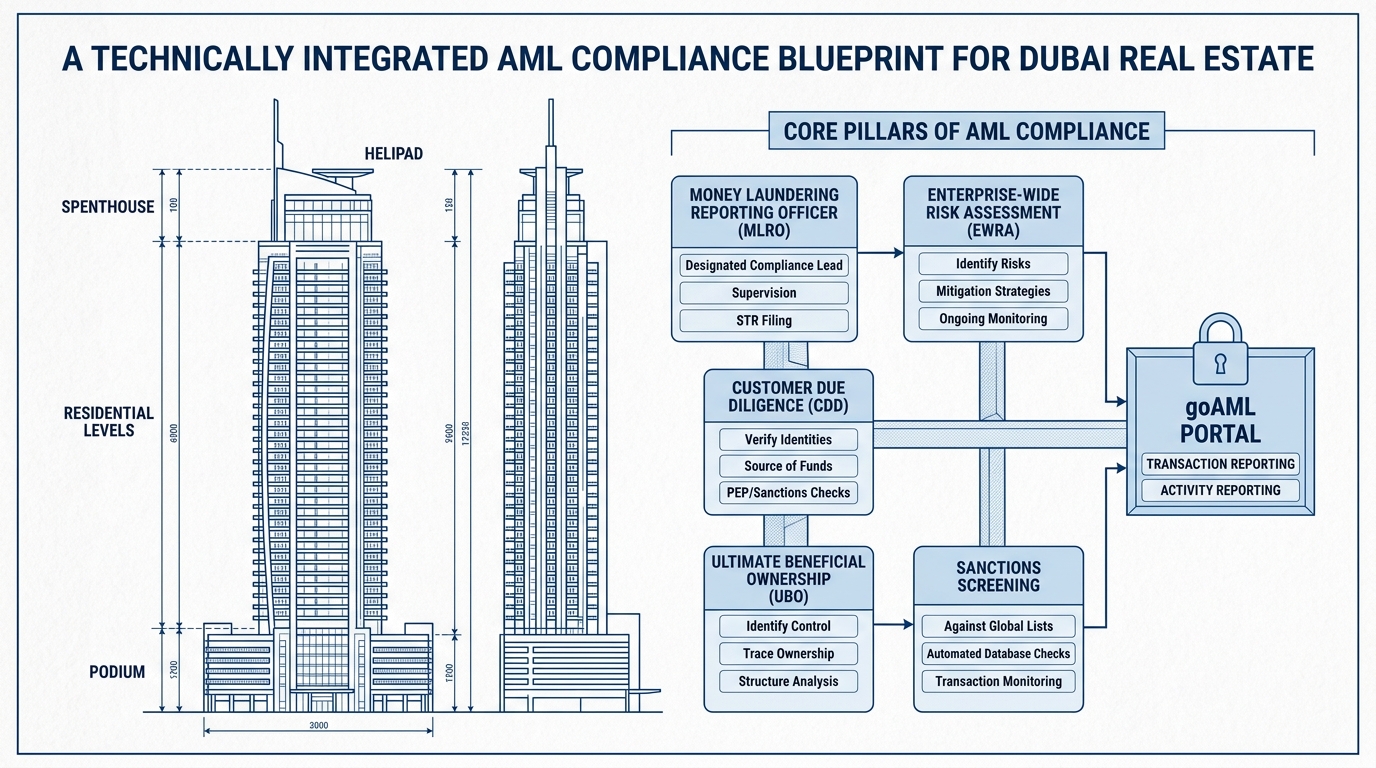
Core Pillars of an AML Compliance Framework
To meet the standards expected by the Ministry of Economy, real estate developers must establish a comprehensive compliance program. This program should be integrated into the developer’s corporate governance structure and supported by senior management.
1. Appointment of a Compliance Officer and MLRO
Every real estate developer must appoint a qualified Compliance Officer who also acts as the Money Laundering Reporting Officer (MLRO). The MLRO is responsible for overseeing the day-to-day operations of the AML program, ensuring staff training, and acting as the primary liaison with the Ministry of Economy and the FIU. The MLRO must possess the necessary authority, independence, and access to resources to perform their duties effectively, including the power to block suspicious transactions and submit reports directly to the authorities.
2. Enterprise-Wide Risk Assessment (EWRA)
An EWRA is the foundation of a risk-based approach. Developers must systematically identify, assess, and understand the money laundering and terrorism financing risks to which their business is exposed. This assessment must consider several risk factors:
- Customer Risk: Assessing the profile of buyers, including their country of origin, source of wealth, and whether they are Politically Exposed Persons (PEPs).
- Geographic Risk: Identifying transactions involving high-risk jurisdictions or countries subject to international sanctions.
- Product and Service Risk: Evaluating the risks associated with different property types, off-plan sales, or high-value cash transactions.
- Delivery Channel Risk: Assessing how transactions are initiated, such as through third-party brokers, online platforms, or direct sales.
The EWRA must be documented, approved by senior management, and updated regularly to reflect changes in the regulatory environment or the developer’s business model.
3. Customer Due Diligence (CDD) and Enhanced Due Diligence (EDD)
Developers must establish robust procedures for verifying the identity of their customers before establishing a business relationship or executing any transaction. This process involves collecting and verifying official identification documents, such as passports, Emirates IDs, and corporate registration certificates.
When a customer is identified as high-risk, developers must apply Enhanced Due Diligence (EDD). This includes obtaining additional information about the customer’s source of wealth and source of funds, conducting more detailed background checks, and obtaining senior management approval before proceeding with the transaction.
| Requirement | Customer Due Diligence (CDD) | Enhanced Due Diligence (EDD) |
|---|---|---|
| Applicability | Standard-risk customers and routine transactions. | High-risk customers, PEPs, and complex transactions. |
| Identity Verification | Passport, Emirates ID, corporate trade license. | Standard verification plus verification of corporate layers. |
| Source of Funds | Self-declaration or basic bank transfer details. | Independent verification (bank statements, audited accounts). |
| Source of Wealth | Not typically required unless risk level changes. | Detailed documentation of how the buyer accumulated wealth. |
| Management Approval | Standard operational sign-off. | Mandatory sign-off from senior management or the MLRO. |
4. Ultimate Beneficial Ownership (UBO) Identification
One of the most critical aspects of CDD is identifying the Ultimate Beneficial Owner (UBO) of corporate buyers. Developers must look through complex corporate structures, holding companies, and trusts to identify the natural persons who ultimately own or control 25% or more of the legal entity. Transactions must not proceed if the UBO cannot be clearly identified and verified.
5. Sanctions Screening
Developers must implement real-time sanctions screening processes to ensure they do not conduct business with individuals or entities listed on local or international sanctions lists. This includes the UAE Local Terrorist List and the United Nations Security Council Consolidated List, managed in coordination with the Executive Office for Control and Non-Proliferation. Screening must occur at the onboarding stage and continuously throughout the business relationship.
The goAML Portal and Mandatory Reporting
The Financial Intelligence Unit (FIU) of the UAE utilizes the goAML portal as the primary platform for receiving and analyzing suspicious activity reports. Registration on the goAML portal is a mandatory requirement for all real estate developers in Dubai.
Specific Reporting Requirements for Real Estate
The Ministry of Economy has established specific reporting thresholds and triggers for the real estate sector. Developers must submit a Real Estate Transaction Report (RESTR) through the goAML portal for any purchase or sale of real property that involves:
- Cash Payments: Any single cash transaction, or physical cash payments totaling AED 55,000 or more.
- Virtual Assets: Any transaction involving virtual assets (cryptocurrencies) for any portion of the property value.
- Funds Derived from Virtual Assets: Transactions where the funds used were converted from virtual assets.
In addition to RESTRs, developers must submit Suspicious Transaction Reports (STRs) or Suspicious Activity Reports (SARs) whenever they have reasonable grounds to suspect that funds are the proceeds of criminal activity or are linked to terrorism financing, regardless of the transaction value or payment method.
| Report Type | Triggering Event | Filing Timeline |
|---|---|---|
| RESTR (Real Estate Transaction Report) | Cash or virtual asset transactions of AED 55,000 or above. | Within the designated regulatory timeframe post-transaction. |
| STR (Suspicious Transaction Report) | Suspicion of money laundering or illicit source of funds. | Immediately upon identifying the suspicious indicators. |
| SAR (Suspicious Activity Report) | Suspicious behavior or inquiries without a completed transaction. | Immediately upon detection of suspicious activity. |
Step-by-Step Guide to Filing a RESTR
Filing a Real Estate Transaction Report requires precision and completeness. Developers should follow these operational steps to ensure compliance:
- Access the goAML Portal: Log in using the credentials provided during registration. Ensure that the MLRO or designated deputy is performing the submission.
- Select the Correct Report Type: Choose “RESTR” from the list of available reporting templates.
- Input Transaction Details: Enter the exact transaction date, total property value, and the specific payment methods used (e.g., cash, virtual assets, or bank transfers).
- Provide Party Information: Input complete details for all parties involved in the transaction, including the buyer, seller, and any intermediaries or brokers. This includes uploading verified identification documents and corporate registration files.
- Attach Supporting Documentation: Upload copies of the sales and purchase agreement (SPA), payment receipts, bank statements, and any KYC/CDD documentation collected during the onboarding process.
- Review and Submit: Conduct a final review of the entered data to ensure accuracy and eliminate typographical errors, then submit the report directly to the FIU.
Penalties for Non-Compliance
The UAE authorities maintain a zero-tolerance policy toward AML/CFT violations. The Ministry of Economy regularly conducts audits and inspections of DNFBPs, including real estate developers. Non-compliance can result in severe administrative and criminal penalties:
- Financial Fines: Administrative fines ranging from AED 50,000 to AED 5,000,000 per violation.
- Operational Sanctions: Suspension or revocation of the developer’s business license, or restriction of commercial activities.
- Criminal Prosecution: Imprisonment and substantial personal fines for compliance officers, board members, and senior executives found guilty of negligence or complicity.
- Reputational Damage: Public disclosure of non-compliant firms, leading to a loss of trust among investors, financial institutions, and business partners.
Common Compliance Pitfalls to Avoid
During regulatory audits, the Ministry of Economy frequently identifies specific operational gaps. Developers must proactively address these common pitfalls:
- Inadequate Record-Keeping: Failing to maintain complete records of CDD, transaction details, and risk assessments for the mandatory minimum period of five years.
- Delayed Reporting: Failing to submit RESTRs, STRs, or SARs within the designated regulatory timelines.
- Lack of Independent Audits: Neglecting to conduct regular, independent reviews of the AML compliance framework to verify its operational effectiveness.
- Insufficient Staff Training: Failing to provide continuous, updated training to sales agents and front-line staff regarding the identification of red flags and internal reporting procedures.
Implementing an Effective Compliance Program
To build an effective framework for AML compliance for developers Dubai, organizations should follow a structured implementation plan:
Step 1: Develop Comprehensive Policies and Procedures
Draft clear, written AML/CFT policies, controls, and procedures that are tailored to the developer’s specific operations. These documents must detail the processes for CDD, EDD, sanctions screening, transaction monitoring, and reporting, and must be aligned with the latest UAE laws.
Step 2: Conduct Regular Staff Training
Employees, particularly those in sales, finance, and legal departments, are the first line of defense. Developers must conduct regular training sessions to ensure staff can identify red flags, understand the internal reporting lines, and appreciate the importance of compliance.
Step 3: Establish an Independent Audit Function
An independent AML audit is a mandatory requirement under UAE regulations. Developers must arrange for regular, independent reviews of their AML compliance framework to assess its effectiveness, identify gaps, and recommend corrective actions. This audit should be conducted by qualified external professionals.
How Tareq Badarin & Farahat & Co. Support Developers
Navigating the complex landscape of AML compliance for developers Dubai requires specialized expertise and deep regulatory knowledge. Operating in collaboration with Farahat & Co., Tareq Badarin provides comprehensive advisory services designed specifically for the Dubai real estate sector.
Our services include conducting Enterprise-Wide Risk Assessments, designing and implementing tailored AML policies, optimizing KYC and CDD processes, and preparing developers for regulatory audits. By partnering with experienced compliance professionals, developers can ensure full compliance with the Ministry of Economy’s requirements, protect their business from financial crime risks, and focus on delivering world-class real estate projects in Dubai.
Operational Red Flags and Transaction Monitoring in Dubai Real Estate
Establishing a robust framework for AML compliance for developers Dubai requires more than just static identity checks. Real estate transactions are dynamic, and compliance officers must actively monitor transaction patterns to detect anomalies. Because real estate is a high-value asset class, it remains a prime target for integrating illicit funds. Developers must train their sales, finance, and legal teams to recognize specific operational red flags throughout the customer journey.
Key Transactional Red Flags
Red flags can emerge during initial negotiations, during the payment phase, or even after the sales agreement has been signed. Developers must establish clear internal protocols to flag and investigate the following scenarios:
- Unusual Payment Structures: Buyers attempting to make multiple structured payments just below the AED 55,000 reporting threshold using cash, or requesting to pay using multiple third-party bank accounts with no clear connection to the buyer.
- Reluctance to Provide Information: Customers who exhibit extreme reluctance during the Customer Due Diligence (CDD) process, fail to explain their source of wealth, or provide corporate structures that obscure the Ultimate Beneficial Owner (UBO).
- Abrupt Changes in Transaction Terms: Sudden requests to change the buyer’s name on the Sales and Purchase Agreement (SPA) to an unrelated third party just before registration, or requesting a rapid cancellation of the purchase with a refund directed to a different account.
- Under- or Over-Valuation: Transactions where the agreed purchase price is significantly different from the market value of the property, which may indicate an attempt to transfer value illicitly.
Implementing a Transaction Monitoring System
To systematically identify these red flags, developers should integrate a continuous transaction monitoring system. This involves setting up automated alerts within the developer’s Enterprise Resource Planning (ERP) or Customer Relationship Management (CRM) software to flag unusual payment velocities or mismatched sender details. When an alert is triggered, the Money Laundering Reporting Officer (MLRO) must conduct an internal investigation to determine whether a Suspicious Transaction Report (STR) or Suspicious Activity Report (SAR) is warranted.
Internal Escalation and Investigation Workflow
When a front-line sales agent or finance officer identifies a red flag, they must follow a structured internal escalation process to ensure the developer remains compliant with UAE regulations:
| Step | Action Item | Responsible Party | Documentation Required |
|---|---|---|---|
| 1 | Identify and Document | Front-line Staff / Sales Agent | Internal Red Flag Memo detailing the observed behavior or transaction anomaly. |
| 2 | Escalate to Compliance | Department Head / Manager | Submission of the internal memo and all associated customer KYC files to the MLRO. |
| 3 | Investigate and Analyze | MLRO / Compliance Team | Review of transaction history, source of funds verification, and external database screening. |
| 4 | Determination | MLRO | Written decision to either clear the transaction with justification or file a report via the goAML portal. |
By formalizing this workflow, developers can ensure that potential money laundering risks are intercepted before transactions are finalized, protecting the organization from regulatory penalties and reputational damage in Dubai’s competitive real estate market.
Frequently Asked Questions
Are real estate developers in Dubai required to register on the goAML portal?
Yes, all real estate developers in Dubai are classified as DNFBPs and are legally required to register on the goAML portal to report suspicious transactions and specific real estate transactions involving cash or virtual assets.
What is the cash transaction threshold for reporting in Dubai real estate?
Real estate developers must report any single physical cash transaction, or series of cash payments, that equal or exceed AED 55,000 through a Real Estate Transaction Report (RESTR) on the goAML portal.
What are the penalties for AML non-compliance for developers in the UAE?
Penalties include administrative fines ranging from AED 50,000 to AED 5,000,000, suspension or revocation of commercial licenses, and potential criminal prosecution for responsible individuals.
How often should a developer conduct an independent AML audit?
Real estate developers should conduct an independent AML audit annually to ensure their compliance framework remains effective and aligned with the latest regulatory updates from the Ministry of Economy.