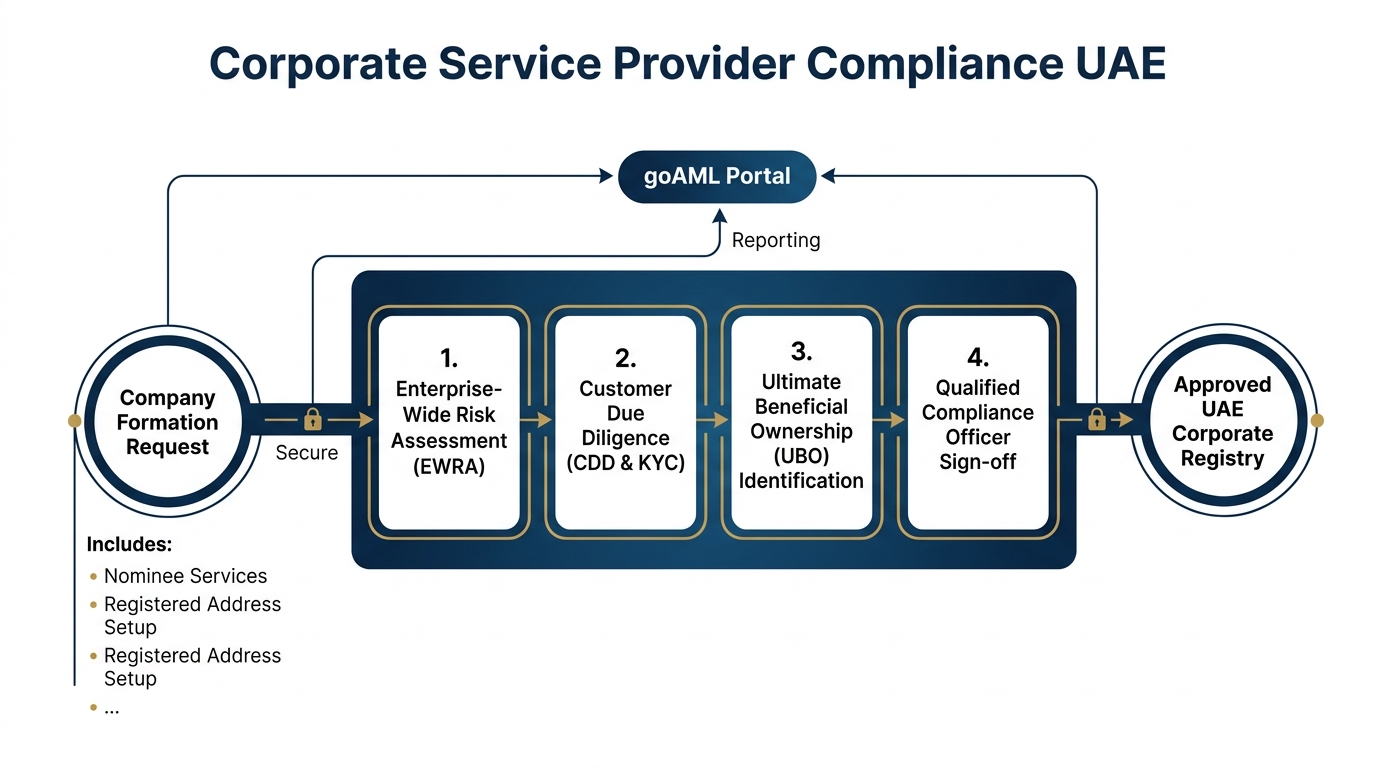
The United Arab Emirates (UAE) has established itself as a premier global hub for business setup, corporate structuring, and wealth management. As the volume of foreign direct investment and corporate formations continues to grow, regulatory oversight has intensified. Among the most heavily scrutinized entities are Corporate Service Providers (CSPs). Operating as Designated Non-Financial Businesses and Professions (DNFBPs), CSPs are subject to rigorous Anti-Money Laundering (AML) and Counter-Terrorism Financing (CFT) frameworks.
Achieving and maintaining robust corporate service provider compliance UAE is not merely a legal obligation; it is a fundamental pillar of operational resilience and reputational integrity. Because CSPs facilitate company formation, nominee services, and registered office addresses, they are uniquely positioned at the gateway of the UAE financial system. Consequently, regulatory bodies like the Ministry of Economy demand strict adherence to compliance protocols to prevent the misuse of legal entities.
Understanding the Regulatory Landscape for CSPs in the UAE
In the UAE, Corporate Service Providers are classified under the DNFBP umbrella. This classification subjects them to Federal Decree-Law No. 20 of 2018 on Anti-Money Laundering and Combating the Financing of Terrorism and Financing of Illegal Organisations, along with its subsequent amendments and executive regulations, including the landmark updates in 2025.
The primary regulatory authority overseeing CSPs in the mainland is the UAE Ministry of Economy. However, CSPs operating within free zones are subject to their respective financial services authorities, such as the Dubai Financial Services Authority (DFSA) in the Dubai International Financial Centre (DIFC) or the Financial Services Regulatory Authority (FSRA) in the Abu Dhabi Global Market (ADGM). Regardless of the jurisdiction, the core compliance mandates remain aligned with international standards set by the Financial Action Task Force (FATF).
Why CSPs are High-Risk Entities
CSPs are considered inherently high-risk by regulators due to the nature of the services they provide. These services often include:
- Acting as a formation agent of legal persons.
- Acting as (or arranging for another person to act as) a director or secretary of a company, a partner of a partnership, or a similar position in relation to other legal persons.
- Providing a registered office, business address, or accommodation, correspondence, or administrative address for a company, a partnership, or any other legal person or arrangement.
- Acting as (or arranging for another person to act as) a trustee of an express trust or performing the equivalent function for another form of legal arrangement.
- Acting as (or arranging for another person to act as) a nominee shareholder for another person.
Because these activities can potentially be exploited to obscure the true ownership of assets or disguise the origin of illicit funds, regulators demand comprehensive transparency and risk-mitigation measures.
Core Pillars of Corporate Service Provider Compliance UAE
To establish an effective compliance program, CSPs must implement a multi-layered framework that addresses risk identification, customer due diligence, transaction monitoring, and regulatory reporting. Below are the essential pillars of a compliant CSP operation in the UAE.
1. Enterprise-Wide Risk Assessment (EWRA)
Before onboarding clients, a CSP must conduct an Enterprise-Wide Risk Assessment. This assessment evaluates the specific risks the business faces based on its client base, geographic footprint, services offered, and delivery channels. The EWRA must be documented, approved by senior management, and updated regularly to reflect changes in the regulatory environment or business operations.
An effective EWRA must analyze several distinct risk categories:
- Customer Risk: Assessing the proportion of clients who are PEPs, operate in cash-intensive industries, or originate from high-risk jurisdictions.
- Geographic Risk: Evaluating the risk profile of the countries where the CSP’s clients reside, hold citizenship, or conduct their primary business activities.
- Product and Service Risk: Identifying which services (such as nominee arrangements or trust structures) carry a higher inherent risk of exploitation for money laundering.
- Delivery Channel Risk: Analyzing how services are delivered, such as non-face-to-face onboarding or transactions facilitated through third-party intermediaries.
2. Customer Due Diligence (CDD) and Know Your Customer (KYC)
CSPs must implement robust KYC and CDD procedures. This involves verifying the identity of the client, understanding the nature of their business, and identifying the source of their funds. CDD is not a one-time event; it requires ongoing monitoring throughout the business relationship.
When dealing with higher-risk clients, such as Politically Exposed Persons (PEPs) or entities from high-risk jurisdictions, CSPs must apply Enhanced Due Diligence (EDD). This includes obtaining senior management approval, conducting deeper background checks, and establishing a clear, verifiable source of wealth.
3. Ultimate Beneficial Ownership (UBO) Identification
Identifying the Ultimate Beneficial Owner (UBO) is a critical component of corporate service provider compliance UAE. Under UAE Cabinet Decision No. (109) of 2023 on regulating Beneficial Owner Procedures, CSPs must maintain accurate and up-to-date registers of UBOs, shareholders, and partners. A UBO is defined as any natural person who ultimately owns or controls, directly or indirectly, 25% or more of the company’s capital or voting rights, or who exercises control over the company through other means.
| Compliance Requirement | Standard Due Diligence (CDD) | Enhanced Due Diligence (EDD) |
|---|---|---|
| Applicability | Low to medium-risk clients. | High-risk clients, PEPs, high-risk jurisdictions. |
| UBO Verification | Identify and verify UBOs holding ≥25% ownership. | Deep verification of UBOs, including source of wealth. |
| Management Approval | Standard compliance officer sign-off. | Senior management or board-level approval required. |
| Monitoring Frequency | Periodic review (e.g., annually or biennially). | Continuous, real-time transaction and media monitoring. |
4. Appointment of a Qualified Compliance Officer
Every CSP in the UAE must appoint a dedicated Compliance Officer (or Money Laundering Reporting Officer – MLRO). This individual must possess the necessary qualifications, experience, and authority to oversee the compliance program, liaise with regulatory authorities, and file suspicious activity reports.
The Compliance Officer’s responsibilities include:
- Ensuring the CSP’s internal policies, procedures, systems, and controls are aligned with UAE AML/CFT laws.
- Reviewing internal unusual transaction reports and determining whether to escalate them to the Financial Intelligence Unit.
- Acting as the primary point of contact for the Ministry of Economy, free zone authorities, and the FIU.
- Organizing regular AML/CFT training sessions for all employees to ensure they understand their legal obligations and can identify red flags.
Regulatory Reporting and the goAML Portal
A cornerstone of the UAE’s AML/CFT framework is the goAML portal, developed by the United Nations Office on Drugs and Crime (UNODC) and implemented by the UAE Financial Intelligence Unit (FIU). All CSPs must register on the goAML portal and use it to fulfill their reporting obligations.
Types of Reports Filed on goAML
CSPs are legally obligated to report suspicious transactions and activities. Failure to do so can result in severe administrative and criminal penalties. The primary reports include:
- Suspicious Transaction Reports (STRs): Filed when there are reasonable grounds to suspect that funds are the proceeds of a crime or are linked to terrorism financing, regardless of the transaction value.
- Suspicious Activity Reports (SARs): Filed when a transaction has not occurred, but the client’s behavior, background, or inquiries raise suspicion of illicit activity.
- High-Risk Country Reports (HRCs): Filed when transactions or business relationships involve jurisdictions designated as high-risk by the National Anti-Money Laundering and Combating the Financing of Terrorism and Financing of Illegal Organisations Committee.
Step-by-Step Guide to goAML Registration and Reporting
To ensure seamless integration with the UAE Financial Intelligence Unit, CSPs must follow a structured approach to registration and reporting:
- Pre-Registration: Obtain the necessary corporate licenses and appoint a qualified Compliance Officer/MLRO who will act as the primary user of the portal.
- SACM Registration: Register on the Secure Application Container Management (SACM) system to obtain the required security credentials and access keys.
- goAML Portal Registration: Access the goAML portal, input the organization’s details, upload the MLRO’s passport, visa, Emirates ID, and the company’s commercial license, and submit the registration for FIU approval.
- System Integration: Configure internal transaction monitoring systems to generate XML files compatible with goAML reporting schemas for automated or bulk reporting.
- Filing Reports: When a suspicious transaction or activity is identified, the MLRO must log into the portal, complete the required fields (including detailed reasons for suspicion, client profiles, and transactional data), attach supporting documentation, and submit the report.
Common Compliance Pitfalls for CSPs and How to Avoid Them
Despite the clear regulatory guidelines, many CSPs struggle with implementation. Understanding these common pitfalls can help providers proactively strengthen their compliance posture.
Inadequate UBO Verification
Simply accepting a client’s declaration of ownership is insufficient. CSPs must independently verify UBO information using reliable, independent sources, such as official corporate registries, notarized documents, or trusted third-party databases. Failure to maintain an accurate UBO register is one of the most frequent findings during Ministry of Economy audits.
Treating Compliance as a Static Checklist
Many CSPs view compliance as a one-time onboarding hurdle. In reality, compliance is a dynamic, continuous process. A client who was classified as low-risk at onboarding may subsequently become a PEP, change their business activities to a high-risk sector, or begin transacting with sanctioned jurisdictions. Continuous transaction monitoring and periodic file reviews are essential to capture these shifts.
Inadequate Record-Keeping
Under UAE AML laws, CSPs must maintain all records, documents, and transaction data for a minimum of five years from the date of ending the business relationship or completing an occasional transaction. These records must be sufficiently detailed to permit reconstruction of individual transactions and must be made available to regulatory authorities upon request within specified timeframes.
Failure to Screen Against Sanctions Lists
CSPs must perform real-time screening of all clients, their UBOs, directors, and authorized signatories against local and international sanctions lists. This includes the UAE Local Terrorist List and the United Nations Security Council Consolidated List. Screening must occur at onboarding and continuously thereafter whenever lists are updated.
Designing an Effective AML Compliance Program for UAE CSPs
To mitigate risks and ensure full alignment with regulatory expectations, CSPs should structure their compliance programs around a clear operational lifecycle. This systematic approach ensures that no regulatory requirement is overlooked.
Step 1: Policy Formulation and Governance
The foundation of any compliance program is a comprehensive, written AML/CFT Policy Manual. This document must be tailored to the specific risk profile of the CSP (as determined by the EWRA) and must be formally approved by the board of directors or senior management. The manual should clearly outline roles and responsibilities, risk tolerance thresholds, escalation pathways, and the frequency of internal audits.
Step 2: Client Onboarding and Risk Rating
During onboarding, the CSP must collect all necessary corporate and individual identification documents. This includes trade licenses, certificates of incorporation, memorandum and articles of association, and identification documents for all directors, shareholders, and UBOs. Based on this information, the CSP must assign a risk rating (Low, Medium, High) using an objective, weighted risk-scoring methodology.
Step 3: Ongoing Monitoring and Detection
Once a client is onboarded, the CSP must monitor their activities to ensure they align with the established client profile. This includes reviewing corporate changes (such as changes in shareholding, directorship, or business activities) and monitoring any financial transactions facilitated by the CSP. Any deviation from the expected profile must trigger an immediate review by the Compliance Officer.
Step 4: Independent Audit and Review
CSPs must subject their compliance programs to regular, independent audits. This audit can be conducted by an qualified internal audit function or an external compliance consultant. The purpose of the audit is to test the operational effectiveness of the compliance controls, identify any gaps or weaknesses, and recommend corrective actions to senior management.
The Role of Technology in CSP Compliance
As the volume of regulatory requirements grows, manual compliance processes are becoming increasingly unsustainable. Modern CSPs must leverage technology to maintain efficiency and accuracy.
Automated KYC and Identity Verification
Automated KYC platforms can instantly verify the authenticity of identity documents, perform facial recognition and liveness checks, and extract data to streamline onboarding. This reduces human error and significantly accelerates the onboarding process for legitimate clients.
Sanctions and PEP Screening Software
Real-time screening software is essential for identifying PEPs and sanctioned individuals. These tools scan global databases and alert compliance officers to potential matches, allowing them to take immediate action before establishing a business relationship or facilitating a transaction.
Transaction Monitoring Systems
For CSPs that manage client accounts or facilitate financial transactions, automated transaction monitoring systems are critical. These systems analyze transaction patterns, identify anomalies (such as sudden spikes in transaction volume or transfers to high-risk jurisdictions), and automatically flag suspicious activities for review.
The Cost of Non-Compliance: Penalties and Reputational Damage
The UAE authorities have adopted a zero-tolerance approach to AML/CFT violations. Non-compliant CSPs face severe administrative, financial, and criminal penalties. These penalties are designed to deter illicit activity and maintain the integrity of the UAE’s financial system.
Administrative and Financial Penalties
The Ministry of Economy and other regulatory bodies can impose substantial fines on CSPs for compliance failures. Fines can range from AED 50,000 to several million dirhams, depending on the severity and frequency of the violation. Common infractions that attract fines include:
- Failure to register on the goAML portal.
- Failure to appoint a qualified Compliance Officer.
- Inadequate CDD or UBO verification procedures.
- Failure to report suspicious transactions or activities.
- Inadequate record-keeping practices.
Operational and Criminal Sanctions
In addition to financial penalties, regulators can impose operational sanctions, including suspending or revoking the CSP’s business license, restricting specific business activities, or removing senior management. In severe cases involving deliberate money laundering or terrorism financing, individuals can face criminal prosecution, leading to imprisonment and asset confiscation.
Reputational Damage
Beyond legal penalties, non-compliance can cause irreparable damage to a CSP’s reputation. Public disclosure of regulatory sanctions can lead to a loss of client trust, termination of banking relationships, and difficulty attracting new business, ultimately threatening the long-term viability of the firm.
How Professional Advisory Supports CSP Compliance
Navigating the complex and rapidly evolving regulatory landscape in the UAE requires specialized expertise. Many CSPs partner with professional compliance advisors to design, implement, and maintain their compliance programs.
Tailored Compliance Solutions
Professional advisors, such as Tareq Badarin, provide customized compliance solutions that address the unique risk profiles and operational needs of individual CSPs. This includes conducting EWRAs, drafting comprehensive policy manuals, and designing robust KYC/CDD workflows.
Independent Compliance Audits
An independent compliance audit provides an objective assessment of a CSP’s compliance posture. Advisors review internal controls, test transaction samples, and identify potential gaps, providing actionable recommendations to ensure full alignment with regulatory expectations.
Staff Training and Capacity Building
Continuous training is essential to ensure that all employees understand their compliance obligations and can identify potential red flags. Professional advisors deliver targeted training programs for compliance officers, senior management, and front-line staff, fostering a strong culture of compliance within the organization.
Conclusion
In an era of heightened regulatory scrutiny, robust compliance is no longer optional for Corporate Service Providers in the UAE; it is a critical business imperative. By establishing a comprehensive compliance framework—anchored by thorough risk assessments, rigorous customer due diligence, diligent UBO tracking, and proactive reporting—CSPs can protect their operations, preserve their reputations, and contribute to the integrity of the UAE’s financial ecosystem. Partnering with experienced compliance specialists ensures that CSPs remain resilient, compliant, and positioned for sustainable growth in a dynamic regulatory environment.
Frequently Asked Questions
What is a Corporate Service Provider (CSP) under UAE AML law?
Under UAE AML law, a Corporate Service Provider (CSP) is classified as a Designated Non-Financial Business and Profession (DNFBP) that provides services such as company formation, registered office addresses, nominee directorships, or trustee services to third parties.
What are the penalties for non-compliance for CSPs in the UAE?
Non-compliance can result in severe administrative penalties, including fines ranging from AED 50,000 to several million dirhams, suspension or revocation of the business license, and potential criminal prosecution for serious AML/CFT violations.
How often should a CSP update its Enterprise-Wide Risk Assessment (EWRA)?
A CSP should review and update its EWRA at least annually, or immediately following significant changes in its business model, target markets, regulatory requirements, or when introducing new services.
Is goAML registration mandatory for all CSPs in the UAE?
Yes, registration on the goAML portal is mandatory for all licensed CSPs operating in the UAE mainland and free zones. It is the primary channel for reporting suspicious transactions and activities to the Financial Intelligence Unit (FIU).