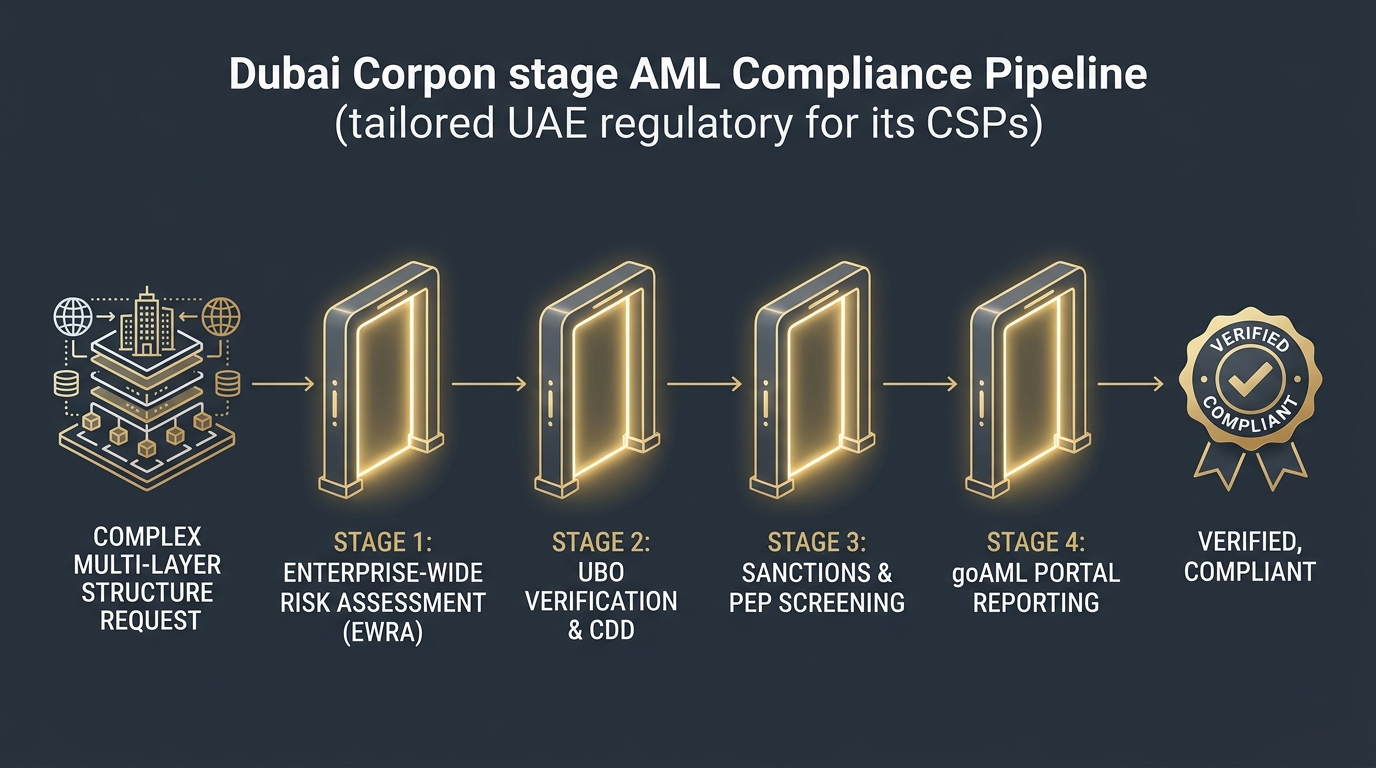
Introduction to AML Compliance for Corporate Service Providers in Dubai
Dubai has established itself as a premier global hub for business setup, attracting entrepreneurs, multinational corporations, and foreign investors from every corner of the world. At the heart of this thriving ecosystem are Corporate Service Providers (CSPs). These entities facilitate company formation, provide registered office addresses, offer nominee director services, and manage corporate administration. However, the very nature of these services makes CSPs highly attractive to illicit actors seeking to obscure the origins of wealth, establish shell companies, or layer financial transactions.
Under the UAE’s robust anti-money laundering regulatory regime, Corporate Service Providers are classified as Designated Non-Financial Businesses and Professions (DNFBPs). This classification places a significant legal and operational burden on CSPs to implement rigorous anti-money laundering (AML) and countering the financing of terrorism (CFT) measures. Achieving effective AML compliance for corporate service providers Dubai is not merely a matter of checking boxes; it requires a deep, tailored understanding of the unique risks inherent in corporate creation and management.
This comprehensive guide explores the regulatory expectations, risk exposures, and practical steps required to design and execute a bespoke AML compliance framework that protects your corporate service firm and ensures full alignment with UAE regulatory bodies, including the Ministry of Economy.
The Regulatory Landscape for CSPs in the UAE
The regulatory framework governing AML compliance in the United Arab Emirates is comprehensive, dynamic, and strictly enforced. For CSPs operating in Dubai, compliance is overseen primarily by the UAE Ministry of Economy, alongside free zone authorities such as the Dubai Multi Commodities Centre (DMCC), Dubai Development Authority (DDA), and the Dubai International Financial Centre (DIFC) Representative Office, depending on the jurisdiction of registration.
The foundational legislation includes:
- Federal Decree-Law No. 20 of 2018 on Anti-Money Laundering and Combating the Financing of Terrorism and Financing of Illegal Organisations.
- Cabinet Decision No. 10 of 2019 concerning the Implementing Regulations of Decree-Law No. 20 of 2018.
- Federal Decree-Law No. 10 of 2025, which further strengthens the UAE’s compliance standards, introducing enhanced penalties and refined definitions to align with international Financial Action Task Force (FATF) recommendations.
For corporate service providers AML UAE regulations mandate that firms must establish an independent compliance function, appoint a qualified Compliance Officer, register on the FIU’s goAML portal, and implement a risk-based approach to client onboarding and monitoring. Failure to comply with these regulations can result in severe administrative penalties, including substantial fines, suspension of business licenses, and criminal prosecution of management.
Why Generic AML Frameworks Fail Corporate Service Providers
Many compliance officers make the mistake of adopting generic AML templates designed for traditional financial institutions or retail businesses. These off-the-shelf frameworks often fail to address the specific operational realities of CSPs in Dubai AML environments. Unlike banks, which monitor high-velocity transactional flows daily, CSPs deal with structural risks. The primary threat to a CSP is not necessarily the movement of cash, but the creation of legal structures that can be exploited for money laundering, tax evasion, or sanctions circumvention.
A tailored framework must account for the specific services offered by the CSP, such as:
- Company incorporation and registration across various UAE jurisdictions (mainland, free zones, and offshore).
- Provision of registered office, business address, or correspondence address.
- Provision of nominee shareholders, directors, or secretarial services.
- Acting as a trustee or managing express trusts.
Each of these services carries distinct risk profiles that require specialized mitigation strategies, particularly regarding UBO verification Dubai and ongoing relationship monitoring.
Key AML Risk Exposures for Dubai CSPs
To build an effective compliance framework, CSPs must first understand their primary risk vectors. The UAE Ministry of Economy emphasizes a risk-based approach, meaning compliance resources should be allocated where the risks are highest. For CSPs, these risks typically fall into four categories:
1. Complex and Multi-Layered Corporate Structures
Clients seeking to obscure their identity often request the creation of complex corporate structures involving multiple layers of holding companies, offshore entities, and trusts. CSPs must be equipped to pierce these corporate veils to identify the natural persons who ultimately own or control the entities.
2. Nominee Services and Third-Party Control
Providing nominee directors or shareholders significantly elevates a CSP’s risk profile. Nominees can easily be used as frontmen for sanctioned individuals or politically exposed persons (PEPs). If a CSP provides nominee services, it must implement enhanced controls to monitor who is actually directing the company’s operations behind the scenes.
3. High-Risk Jurisdictions and Foreign Beneficial Owners
Dubai’s position as an international financial hub means CSPs frequently deal with non-resident clients. Onboarding clients from high-risk jurisdictions, conflict zones, or countries with weak AML controls requires immediate escalation to Enhanced Due Diligence (EDD) protocols.
4. Rapid Company Formation and Dissolution
Entities that are incorporated and then rapidly dissolved or transferred to new owners without clear commercial logic are classic red flags for money laundering. CSPs must monitor the lifecycle of the companies they manage to detect such patterns.
Designing a Tailored AML Compliance Framework: Step-by-Step
A robust AML compliance framework for a Dubai-based CSP must be integrated into the firm’s daily operations. Below is a structured approach to designing and implementing this framework.
Step 1: Enterprise-Wide Risk Assessment (EWRA)
The foundation of any compliant AML program is the Enterprise-Wide Risk Assessment. The EWRA requires the CSP to analyze its entire business model to identify vulnerabilities. This assessment must evaluate:
- Customer Risk: The types of clients served (e.g., PEPs, high-net-worth individuals, non-residents).
- Geographic Risk: The countries where clients are based or where they conduct their primary business.
- Services Risk: The specific services provided, such as nominee arrangements or trust administration.
- Delivery Channel Risk: How clients are onboarded (e.g., face-to-face versus digital/remote onboarding).
The EWRA must be documented, approved by senior management, and updated at least annually or whenever significant operational changes occur.
Step 2: Customer Due Diligence (CDD) and Enhanced Due Diligence (EDD)
CSPs must establish clear procedures for verifying the identity of their clients before establishing a business relationship. This process involves:
- Collecting official identification documents (passports, Emirates IDs) for all individual clients, directors, and authorized signatories.
- Verifying corporate documents (certificates of incorporation, memorandum and articles of association, registers of directors and shareholders).
- Conducting UBO verification Dubai to identify any natural person who directly or indirectly holds 25% or more of the company’s shares or voting rights, or who exercises control through other means.
If a client or transaction is deemed high-risk, Enhanced Due Diligence (EDD) must be applied. EDD requires obtaining additional information, such as the source of wealth (SoW) and source of funds (SoF) of the beneficial owners, and obtaining senior management approval before proceeding.
Step 3: Sanctions Screening and PEP Identification
CSPs must screen all clients, beneficial owners, directors, and authorized signatories against local and international sanctions lists. This includes the UAE Local Terrorist List, the UN Security Council Consolidated List, and other relevant international lists (such as OFAC, EU, and UK sanctions lists). Screening must occur at the time of onboarding and on an ongoing basis to account for daily updates to sanctions lists.
Additionally, CSPs must identify whether any client or beneficial owner is a Politically Exposed Person (PEP), an immediate family member of a PEP, or a close associate. PEP relationships require continuous monitoring and senior management sign-off.
Step 4: Transaction and Activity Monitoring
While CSPs may not process daily financial transactions in the same manner as banks, they must monitor the activities of the companies they administer. This includes:
- Reviewing changes in ownership, directorship, or business activities.
- Monitoring payments made to the CSP for its services (ensuring payments do not originate from unverified third parties or high-risk jurisdictions).
- Identifying unusual patterns, such as a sudden shift in the company’s line of business to an unrelated, high-risk sector.
Step 5: goAML Registration and Suspicious Activity Reporting
All CSPs in Dubai must complete their goAML registration CSPs requirements with the UAE Financial Intelligence Unit (FIU). The goAML portal is the primary platform used to submit Suspicious Activity Reports (SARs) and Suspicious Transaction Reports (STRs).
If a CSP suspects, or has reasonable grounds to suspect, that a client’s funds or proposed transactions are linked to money laundering, terrorist financing, or any other criminal activity, they must immediately file a report through the goAML portal. Under UAE law, failing to report suspicious activity is a criminal offense.
| Compliance Pillar | Key Requirement for CSPs | Regulatory Focus |
|---|---|---|
| Risk Assessment | Conduct and document an annual Enterprise-Wide Risk Assessment (EWRA). | Ministry of Economy inspection readiness. |
| UBO Verification | Identify and verify any natural person with ≥25% ownership or control. | Prevention of shell company abuse. |
| Sanctions Screening | Real-time screening against UAE Local List, UN, and international watchlists. | Combating terrorist financing and sanctions evasion. |
| Reporting | Register on goAML and submit SARs/STRs immediately upon suspicion. | Active cooperation with the UAE Financial Intelligence Unit (FIU). |
The Role of the Compliance Officer in a Dubai CSP
A tailored AML framework is only as effective as the person overseeing it. UAE regulations require CSPs to appoint a dedicated Compliance Officer (often acting as the Money Laundering Reporting Officer or MLRO). The Compliance Officer must possess the appropriate qualifications, experience, and authority within the organization to act independently.
The key responsibilities of the Compliance Officer include:
- Maintaining and updating the firm’s AML/CFT policies and procedures manual.
- Ensuring all staff members receive regular, documented AML training tailored to corporate services.
- Overseeing the client onboarding process and approving high-risk accounts.
- Investigating internal red flags and filing SARs/STRs via the goAML portal.
- Serving as the primary point of contact for the Ministry of Economy and other regulatory authorities during audits and inspections.
Common Pitfalls in CSP AML Compliance
Through our advisory work with corporate service providers in Dubai, we have identified several common compliance gaps that frequently attract regulatory penalties during Ministry of Economy audits:
1. Over-Reliance on Third-Party Introducers
Many CSPs onboard clients introduced by foreign agents or business setup consultants without conducting their own independent Customer Due Diligence. Under UAE law, the ultimate responsibility for compliance remains with the CSP. Relying blindly on third-party KYC documents without independent verification is a major compliance failure.
2. Incomplete or Outdated UBO Registers
CSPs are legally required to maintain an accurate and up-to-date UBO register for all companies they manage. Failing to update this register when ownership changes occur, or failing to submit UBO data to the relevant licensing authority, is one of the most common sources of administrative fines.
3. Failure to Document the Source of Wealth
When dealing with high-risk clients or PEPs, simply identifying the source of funds for a specific transaction is insufficient. CSPs must document the client’s overall Source of Wealth (SoW)—how they accumulated their total net worth. Failing to obtain supporting documentation (such as audited accounts, inheritance deeds, or property sale agreements) is a frequent audit finding.
How Tareq Badarin & Farahat & Co. Support Your Business
Navigating the complex and rapidly evolving regulatory landscape in Dubai requires specialized expertise. As an AML Compliance Specialist working within the framework of Farahat & Co., Tareq Badarin provides comprehensive, practical compliance solutions tailored specifically to the corporate services sector.
We assist Corporate Service Providers in Dubai with:
- Bespoke AML Policy Formulation: Designing customized AML/CFT policies, procedures, and controls that reflect your specific services and risk appetite.
- Enterprise-Wide Risk Assessments (EWRA): Conducting thorough risk assessments to identify and mitigate operational vulnerabilities.
- UBO and CDD Optimization: Streamlining your client onboarding processes to ensure rigorous compliance without compromising the client experience.
- goAML Registration and Support: Assisting with goAML portal setup, system readiness, and the drafting of suspicious activity reports.
- Audit and Inspection Readiness: Preparing your firm for Ministry of Economy compliance audits through mock inspections and gap analyses.
By partnering with established compliance experts, your CSP can focus on growth and client service, secure in the knowledge that your regulatory obligations are fully met.
Conclusion
For Corporate Service Providers in Dubai, AML compliance is no longer an administrative afterthought—it is a core business necessity. Implementing a tailored AML compliance framework is the only way to protect your firm from severe financial penalties, reputational damage, and operational disruption. By understanding your specific risk exposures, conducting rigorous UBO verification, and maintaining active goAML readiness, your CSP can thrive in the UAE’s highly regulated business environment.
To discuss how we can tailor your AML compliance framework or prepare your firm for an upcoming regulatory audit, contact Tareq Badarin today for a professional consultation in partnership with Farahat & Co.
Frequently Asked Questions
Are Corporate Service Providers in Dubai classified as DNFBPs?
Yes, under UAE AML legislation, Corporate Service Providers (CSPs) are classified as Designated Non-Financial Businesses and Professions (DNFBPs) and are subject to strict regulatory oversight by the Ministry of Economy.
What is the threshold for UBO verification in Dubai?
CSPs must identify and verify any natural person who ultimately owns or controls 25% or more of the legal entity's share capital or voting rights, or who exercises ultimate control through other means.
Is goAML registration mandatory for CSPs in Dubai?
Yes, registration on the Financial Intelligence Unit's goAML portal is mandatory for all CSPs operating in Dubai to report suspicious transactions and activities.
What are the penalties for non-compliance for CSPs in the UAE?
Non-compliance can lead to severe administrative penalties, including fines ranging from AED 50,000 to several millions, suspension of business licenses, and potential criminal prosecution.
How often should a CSP update its Enterprise-Wide Risk Assessment (EWRA)?
A CSP should review and update its EWRA at least once a year, or immediately following significant changes in its business model, services, or the regulatory environment.