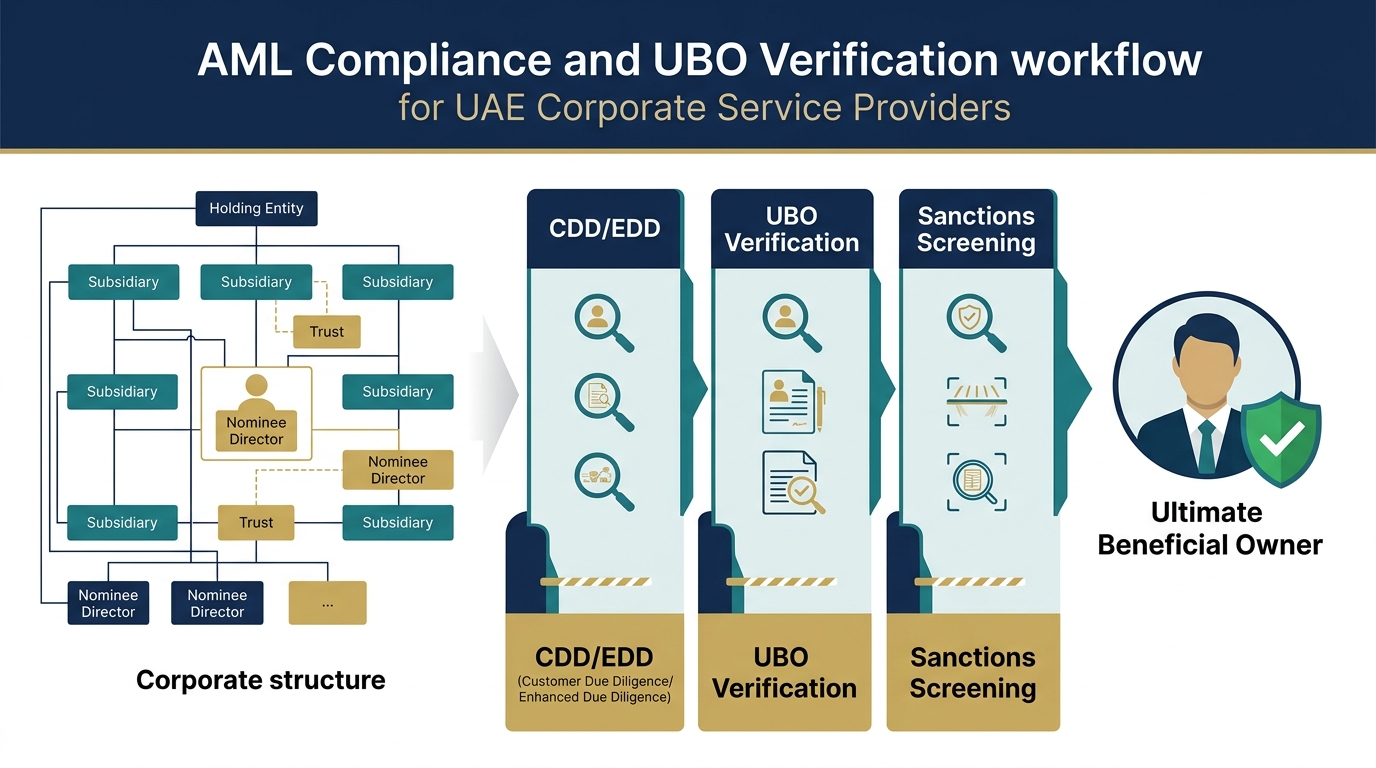
Corporate Service Providers (CSPs) serve as the primary gateway to the United Arab Emirates’ dynamic business ecosystem. By facilitating company formation, providing nominee director services, offering registered office addresses, and managing complex corporate structures, CSPs enable foreign and domestic investors to establish a robust commercial presence. However, this pivotal role also positions CSPs at a critical juncture of financial crime vulnerability. Because they handle the creation, structuring, and management of legal entities, they are highly attractive targets for bad actors seeking to obscure illicit funds behind complex corporate veils.
In the UAE, the regulatory framework classifies Corporate Service Providers as Designated Non-Financial Businesses and Professions (DNFBPs). Under the oversight of the Ministry of Economy (MoE), CSPs are subject to strict Anti-Money Laundering and Countering the Financing of Terrorism (AML/CFT) regulations. Non-compliance is no longer just a regulatory risk; it carries severe financial penalties, reputational damage, and the potential suspension of business licenses. Navigating this complex regulatory landscape requires a structured, proactive approach to compliance.
As an experienced AML Compliance Specialist working within the framework of Farahat & Co., Tareq Badarin provides tailored compliance solutions designed specifically for the unique operational realities of UAE-based CSPs. This comprehensive guide outlines the essential pillars of a robust AML compliance program for corporate service providers, detailing how to mitigate risks, satisfy regulatory audits, and protect your business from exploitation.
The Regulatory Landscape for UAE Corporate Service Providers
The UAE has significantly strengthened its financial crime defenses in recent years, aligning its domestic framework with the international standards set by the Financial Action Task Force (FATF). For CSPs, compliance is governed by a comprehensive suite of federal laws, cabinet decisions, and regulatory circulars, including:
- Federal Decree-Law No. (20) of 2018 on Anti-Money Laundering and Combating the Financing of Terrorism and Financing of Illegal Organisations.
- Cabinet Decision No. (10) of 2019, which outlines the implementing regulations of the federal decree-law.
- Cabinet Decision No. (109) of 2023 regarding the Regulation of Beneficial Owner Procedures, which mandates strict Ultimate Beneficial Ownership (UBO) transparency.
- Federal Decree-Law No. (10) of 2025, which further refines and updates the national AML standards to address emerging financial crime typologies.
Under these regulations, the Ministry of Economy acts as the primary supervisory authority for DNFBPs, including trust and company service providers. The Ministry conducts regular on-site and off-site inspections to verify that CSPs have implemented effective compliance programs. Failure to demonstrate adequate compliance can result in administrative fines ranging from AED 50,000 to AED 1,000,000 per violation, alongside public naming-and-shaming or license revocation.
Why CSPs are Classified as High-Risk DNFBPs
To build an effective compliance program, CSPs must first understand why their services are inherently vulnerable to financial crime. Money launderers frequently exploit corporate vehicles to distance themselves from their illicitly acquired wealth. The primary risk areas associated with corporate services include:
1. Shell Companies and Complex Ownership Structures
Criminals often attempt to establish multi-layered corporate structures spanning multiple jurisdictions to hide the identity of the true beneficial owners. CSPs that incorporate entities without conducting deep-dive ownership analysis risk facilitating these illicit networks.
2. Nominee and Proxy Services
Providing nominee shareholders or directors can easily be abused if the CSP does not maintain complete visibility over who is actually directing the company’s activities. Nominees can act as frontmen, masking the involvement of Sanctioned individuals or Politically Exposed Persons (PEPs).
3. Registered Office and Correspondence Addresses
Providing a physical address or mail-forwarding service to an entity that has no real operational substance in the UAE can help illicit businesses project an aura of legitimacy. Without proper vetting, a CSP might unwittingly host dozens of fraudulent enterprises under a single roof.
Core Pillars of an AML Compliance Program for UAE CSPs
An effective AML compliance program is not a one-size-fits-all template. It must be tailored to the specific size, client profile, and geographic reach of the corporate service provider. A compliant framework must rest on the following core pillars:
1. Enterprise-Wide Risk Assessment (EWRA) and AML Risk Assessment Matrix
Answer-First Overview: In the UAE, a Corporate Trust Service Provider AML Risk Assessment Matrix is a structured evaluation tool used by DNFBPs to categorize and score money laundering and terrorism financing risks across four core risk pillars: client profile, geographic risk, delivery channels, and product/services risk.
Before implementing controls, a CSP must conduct a comprehensive Enterprise-Wide Risk Assessment. The EWRA identifies and evaluates the specific risks the business faces across several categories:
- Client Risk: Assessing high-net-worth individuals, PEPs, clients from high-risk jurisdictions, or businesses with complex, opaque ownership structures.
- Geographic Risk: Evaluating clients or transactions linked to countries identified as high-risk by FATF or the UAE authorities.
- Services Risk: Identifying the inherent risks of specific services, such as trust creation, nominee appointments, or rapid company formation.
- Delivery Channel Risk: Assessing risks associated with non-face-to-face onboarding, online portals, or third-party intermediaries.
The EWRA must be documented, approved by senior management, and updated at least annually to reflect changes in the business model or regulatory environment.
2. Customer Due Diligence (CDD) and Enhanced Due Diligence (EDD)
CSPs must establish robust Customer Due Diligence procedures to verify the identity of their clients before establishing a business relationship. This involves collecting and verifying official identification documents, proof of address, and corporate registration certificates.
When a client or transaction presents a higher risk—such as a PEP, a client from a high-risk jurisdiction, or an unusually complex corporate structure—the CSP must apply Enhanced Due Diligence (EDD). EDD requires gathering additional information, such as the source of wealth (SoW) and source of funds (SoF), conducting deeper background checks, and obtaining senior management approval before proceeding.
3. Ultimate Beneficial Ownership (UBO) Identification
Under Cabinet Decision No. (109) of 2023, CSPs must identify and verify the Ultimate Beneficial Owner (UBO) of every legal entity they help establish or manage. A UBO is any natural person who ultimately owns or controls, directly or indirectly, 25% or more of the company’s capital or voting rights, or who exercises ultimate control over the company through other means.
CSPs must maintain an updated UBO register, a Partners or Shareholders register, and a Register of Directors. This information must be submitted to the relevant licensing authority (such as the Dubai Department of Economy and Tourism or free zone authorities) and kept readily accessible for regulatory inspections.
4. Appointment of a Qualified Compliance Officer
Every CSP in the UAE must appoint a dedicated, qualified Compliance Officer (often acting as the Money Laundering Reporting Officer or MLRO). The Compliance Officer is responsible for overseeing the daily operations of the AML program, ensuring staff training, updating policies, and serving as the primary liaison with the Ministry of Economy and the Financial Intelligence Unit (FIU).
5. Transaction Monitoring and Sanctions Screening
CSPs must implement continuous screening processes to ensure they do not facilitate transactions or provide services to individuals or entities on national or international sanctions lists. This includes screening against the UAE Local Terrorist List and the UN Security Council Consolidated List. Screening must occur at the time of onboarding and continuously thereafter to capture real-time updates to sanctions lists.
6. Suspicious Activity Reporting via goAML
All UAE CSPs must register on the goAML portal, the integrated platform operated by the UAE Financial Intelligence Unit (FIU). If a CSP suspects, or has reasonable grounds to suspect, that a client’s funds or intended transactions are linked to money laundering, terrorist financing, or any criminal activity, they must immediately file a Suspicious Activity Report (SAR) or Suspicious Transaction Report (STR) through the goAML system.
A Comparison of CDD vs. EDD Requirements for CSPs
To help compliance officers distinguish between standard and enhanced measures, the following table outlines the operational differences in due diligence application:
| Compliance Element | Customer Due Diligence (CDD) | Enhanced Due Diligence (EDD) |
|---|---|---|
| Applicability | Standard, low-to-medium risk clients with transparent ownership. | High-risk clients, PEPs, complex corporate vehicles, or high-risk jurisdictions. |
| Identity Verification | Standard passport, Emirates ID, and proof of residential address. | Additional independent verification, background checks, and third-party intelligence reports. |
| UBO Identification | Identify natural persons holding 25% or more shares or voting rights. | Deep-dive analysis of multi-layered ownership structures to identify ultimate control. |
| Source of Wealth (SoW) | Self-declaration or basic business profile review. | Mandatory verification of the origin of the client’s entire net worth using bank statements, tax returns, or audited accounts. |
| Source of Funds (SoF) | Basic understanding of the funds used for the transaction. | Documentary evidence showing the exact origin of the funds used for the specific transaction. |
| Approval Authority | Compliance Officer / MLRO. | Senior Management approval is mandatory before onboarding. |
| Monitoring Frequency | Periodic review (e.g., annually or biennially). | Continuous, real-time transaction monitoring and frequent profile reviews. |
Step-by-Step Guide to Onboarding Clients Compliantly
To ensure operational consistency and regulatory compliance, CSPs should implement a standardized, step-by-step onboarding workflow:
Step 1: Initial Risk Assessment
Gather preliminary information about the client, including their country of origin, business activity, and proposed corporate structure. Use this information to assign an initial risk rating (Low, Medium, or High) based on your EWRA methodology.
Step 2: Sanctions and PEP Screening
Run the names of all prospective clients, directors, and beneficial owners through automated screening software. Check for matches against the UAE Local Terrorist List, the UN Security Council Consolidated List, and international sanctions databases (OFAC, EU, UK). Screen for Politically Exposed Persons (PEPs) and adverse media.
Step 3: Document Collection and Verification
Collect official identification documents. For corporate clients, obtain the certificate of incorporation, memorandum and articles of association, register of directors, and register of shareholders. Verify these documents using reliable, independent sources, such as government registries or notarized copies.
Step 4: UBO Identification and Verification
Trace the ownership chain upward until you identify the natural persons who ultimately own or control 25% or more of the entity. Collect identification documents for these individuals and verify their identities.
Step 5: Apply Appropriate Due Diligence (CDD or EDD)
Based on the risk rating established in Step 1, apply either standard CDD or EDD. If EDD is required, collect and verify the Source of Wealth and Source of Funds, and obtain senior management sign-off.
Step 6: Register on goAML and Establish Monitoring
Ensure the client’s profile is integrated into your transaction monitoring system. If any red flags arise during onboarding that cannot be resolved, file a Suspicious Activity Report (SAR) via the goAML portal and decline the business relationship.
Common Red Flags for Corporate Service Providers
CSPs must train their staff to recognize red flags that may indicate money laundering or terrorist financing. Common red flags in the corporate services sector include:
- Unusual Corporate Structures: Clients who insist on complex, multi-layered structures involving offshore jurisdictions with no clear commercial or tax justification.
- Reluctance to Provide Information: Clients who are hesitant to disclose the identity of the ultimate beneficial owners or provide standard identification documents.
- Nominee Arrangements Without Clear Purpose: Requests to use nominee directors or shareholders without a legitimate business or privacy rationale.
- Inconsistent Business Activities: The company’s stated business activities do not align with the client’s background, experience, or source of wealth.
- Rapid Changes in Ownership or Management: Frequent, unexplained changes in shareholders, directors, or beneficial owners shortly after incorporation.
- Transactions with High-Risk Jurisdictions: Proposed business activities or transactions involving countries subject to international sanctions or identified as having weak AML/CFT regimes.
The Role of Professional Advisory in AML Compliance
Maintaining a fully compliant AML framework requires specialized knowledge, continuous monitoring, and regular updates to align with changing regulations. For many CSPs, managing these requirements internally can be overwhelming and resource-intensive.
Partnering with an experienced AML compliance specialist ensures that your business remains compliant while focusing on core operations. Tareq Badarin, working within the framework of Farahat & Co., offers comprehensive AML advisory services tailored to the specific needs of UAE Corporate Service Providers. Our services include:
- AML Policy and Procedure Development: Designing and implementing robust AML/CFT manuals and compliance frameworks.
- Enterprise-Wide Risk Assessments (EWRA): Conducting thorough risk assessments to identify and mitigate operational vulnerabilities.
- KYC and CDD Optimization: Streamlining onboarding processes to ensure compliance without compromising client experience.
- Independent AML Audits: Conducting independent reviews of your compliance program to prepare for Ministry of Economy inspections.
- Staff Training Programs: Providing practical training to equip your team with the skills to identify red flags and manage compliance risks.
By establishing a proactive compliance posture, UAE Corporate Service Providers can protect their businesses from financial crime, avoid costly regulatory penalties, and contribute to the integrity of the UAE’s financial system.
Frequently Asked Questions
What is a corporate trust service provider AML risk assessment matrix in the UAE?
A corporate trust service provider AML risk assessment matrix in the UAE is a structured risk-scoring framework used by DNFBPs to evaluate client, geographic, service, and delivery channel vulnerabilities in compliance with Ministry of Economy guidelines and federal AML laws.
Are Corporate Service Providers (CSPs) in the UAE considered DNFBPs?
Yes. Under UAE AML legislation, Corporate Service Providers (CSPs) are classified as Designated Non-Financial Businesses and Professions (DNFBPs) and are subject to strict regulatory oversight by the Ministry of Economy.
What is the penalty for a CSP failing to maintain a UBO register in the UAE?
Failing to maintain an accurate and updated Ultimate Beneficial Ownership (UBO) register can result in severe administrative fines from the Ministry of Economy, ranging from AED 50,000 to AED 1,000,000, along with potential suspension of the business license.
How often should a CSP update its Enterprise-Wide Risk Assessment (EWRA)?
A CSP should review and update its Enterprise-Wide Risk Assessment (EWRA) at least once a year, or sooner if there are significant changes to its business model, services, target markets, or the local regulatory framework.
Is registration on the goAML portal mandatory for UAE CSPs?
Yes, registration on the goAML portal is mandatory for all registered DNFBPs, including CSPs, in the UAE. It is the official platform used to report suspicious transactions and activities to the Financial Intelligence Unit (FIU).