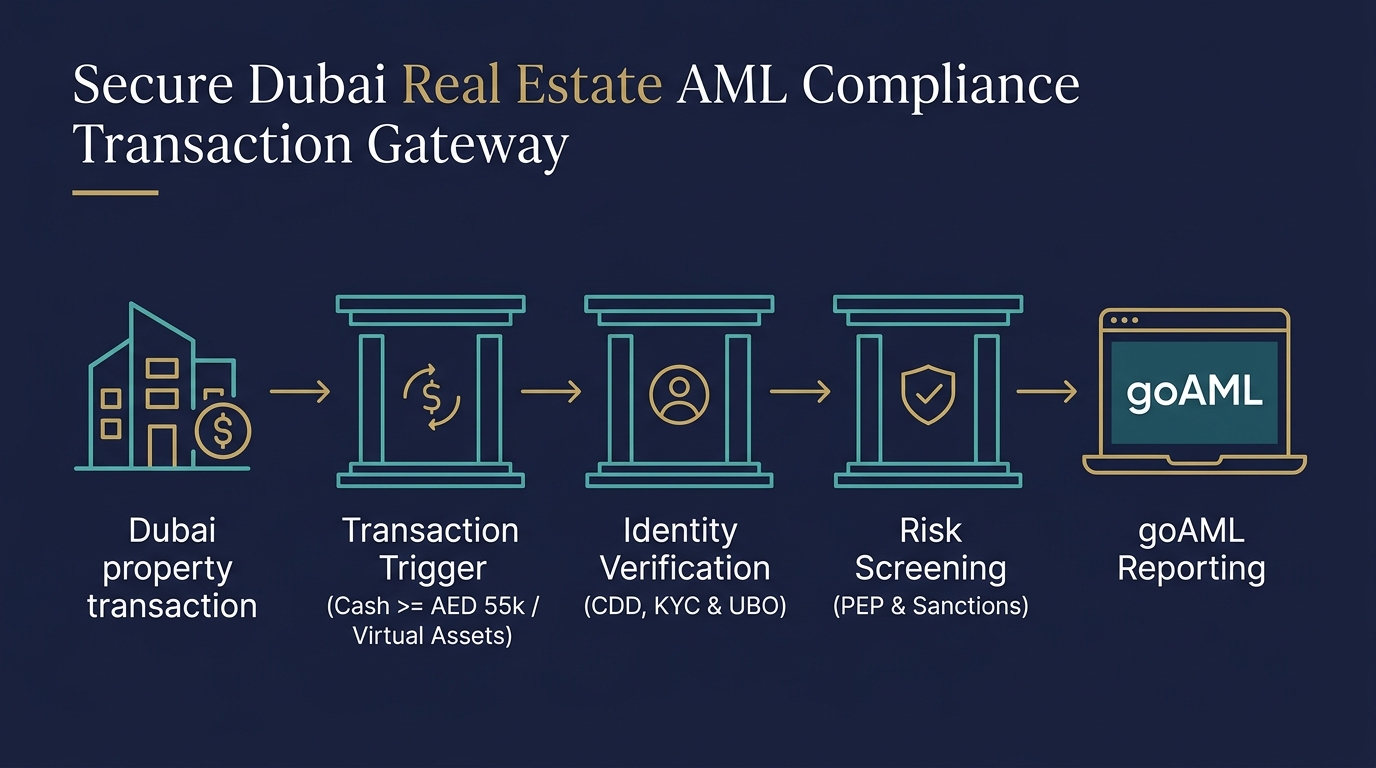
Dubai’s real estate market has established itself as one of the most dynamic and attractive investment destinations globally. However, this rapid influx of foreign capital and high-value transactions has placed the sector under intense regulatory scrutiny. To safeguard the financial system and maintain its standing as a transparent global business hub, the United Arab Emirates (UAE) has implemented a rigorous Anti-Money Laundering (AML) and Counter-Terrorism Financing (CFT) framework. For real estate brokers, agents, and developers, compliance is no longer a secondary operational concern—it is a critical legal and business mandate.
As Designated Non-Financial Businesses and Professions (DNFBPs), real estate companies in Dubai are subject to strict oversight by the Ministry of Economy (MoE) and the Financial Intelligence Unit (FIU). Implementing a robust system for AML compliance for real estate Dubai is essential to protect your business from severe administrative penalties, license revocations, and reputational damage. This comprehensive guide explores the regulatory requirements, core compliance pillars, and practical steps necessary to secure your real estate transactions in the UAE.
The Regulatory Landscape for Dubai Real Estate
The legal foundation of the UAE’s AML/CFT regime rests on Federal Decree-Law No. (20) of 2018 on Anti-Money Laundering and Combating the Financing of Terrorism and Financing of Illegal Organisations, along with its implementing regulations under Cabinet Decision No. (10) of 2019. Under these laws, real estate brokers and developers are classified as DNFBPs when they engage in transactions involving the buying and selling of real estate for their clients.
The Ministry of Economy (MoE) is the primary supervisory authority responsible for monitoring compliance within the real estate sector. The MoE conducts regular on-site and off-site inspections to ensure that businesses have established sufficient internal controls to detect, prevent, and report suspicious financial activities. Additionally, the UAE Financial Intelligence Unit (FIU) manages the goAML portal, the centralized platform where all suspicious transaction reports must be submitted.
Key Transaction Thresholds and Triggers
Real estate professionals must pay close attention to specific transaction types that automatically trigger heightened compliance obligations. In the UAE, real estate agents and developers must report any purchase or sale transaction of a freehold property that involves any of the following payment methods, regardless of the amount:
- Cash Payments: Any single cash payment or physical cash installments equal to or exceeding AED 55,000.
- Virtual Assets: Any transaction where the payment method involves virtual assets, cryptocurrencies, or digital tokens.
- Funds Derived from Virtual Assets: Transactions where the funds used were converted from virtual assets into fiat currency.
When these triggers are met, real estate businesses must submit a Real Estate Transaction Report (RETR) through the goAML system, ensuring that all participant identities and financial details are fully documented and verified.
Core Pillars of an Effective Real Estate AML Program
To achieve full compliance with UAE regulations, real estate firms must design and implement an internal AML compliance program. This program should not be a generic template; it must be tailored to the specific risk profile, transaction volume, and client base of the business. A robust framework consists of several interconnected pillars.
1. Appointment of a Dedicated Compliance Officer
Every real estate DNFBP in Dubai must appoint a qualified Compliance Officer who possesses the appropriate expertise and authority. The Compliance Officer is responsible for overseeing the daily operations of the AML program, reviewing internal alerts, submitting reports on the goAML portal, and acting as the primary liaison with the Ministry of Economy and other regulatory bodies.
2. Customer Due Diligence (CDD) and Know Your Customer (KYC)
Customer Due Diligence is the cornerstone of financial crime prevention. Real estate firms must verify the identity of all buyers, sellers, and their authorized representatives before establishing a business relationship or executing a transaction. This process involves:
- Collecting valid identification documents (e.g., Emirates ID for residents, passports for international buyers).
- Verifying corporate entities by obtaining trade licenses, certificates of incorporation, and memorandum of association.
- Identifying and verifying the natural persons who ultimately own or control the legal entity.
3. Ultimate Beneficial Ownership (UBO) Verification
In real estate transactions involving corporate entities, shell companies, or trusts, identifying the ultimate beneficial ownership real estate structure is mandatory. Compliance teams must trace the ownership chain to identify any natural person who holds a direct or indirect ownership interest of 25% or more, or who exercises ultimate control over the entity. This prevents bad actors from using complex corporate layers to obscure the illicit origin of funds.
4. Sanctions Screening and PEP Identification
Real estate businesses must screen all transaction parties against local and international sanctions lists, including the UAE Local Terrorist List and the UN Security Council Consolidated List. Additionally, firms must determine whether a client is a Politically Exposed Person (PEP), a family member of a PEP, or a close associate. PEPs present a higher risk of corruption and bribery, requiring the application of Enhanced Due Diligence (EDD) measures and senior management approval before proceeding with the transaction.
5. Enterprise-Wide Risk Assessment (EWRA)
An Enterprise-Wide Risk Assessment allows real estate firms to identify, assess, and understand the specific money laundering and terrorism financing risks to which they are exposed. This assessment must evaluate risks associated with customers, geographic locations, services, transactions, and delivery channels. The findings of the EWRA must be documented and used to update internal policies and procedures annually.
Step-by-Step Guide to Handling High-Risk Real Estate Transactions
When a transaction or client is flagged as high-risk, standard due diligence is insufficient. Real estate professionals must follow a structured, risk-based approach to mitigate potential exposure and comply with MoE guidelines.
Step 1: Initiate Enhanced Due Diligence (EDD)
If a client is from a high-risk jurisdiction, is a PEP, or presents unusual transaction patterns, initiate EDD immediately. This involves gathering additional information, such as the purpose of the transaction, the source of the client’s wealth, and the specific source of funds used for the purchase.
Step 2: Verify Source of Funds (SoF) and Source of Wealth (SoW)
Verifying the Source of Funds requires obtaining documentary evidence showing how the money for the specific transaction was acquired (e.g., bank statements, audited financial statements, inheritance documents, or property sale contracts). Source of Wealth refers to the origin of the client’s entire accumulated net worth, ensuring it aligns with their professional profile and historical income.
Step 3: Conduct Transaction Monitoring
Monitor the transaction throughout its lifecycle. Look for sudden changes in payment structures, third-party payments from unrelated entities, or requests to refund payments to accounts in different jurisdictions. Any deviation from the agreed transaction plan must be thoroughly investigated.
Step 4: File Reports via the goAML Portal
If the transaction meets the reporting thresholds (such as cash or virtual asset payments over AED 55,000) or if there are reasonable grounds to suspect money laundering, the Compliance Officer must file the appropriate report on the goAML portal. This includes filing a Real Estate Transaction Report (RETR) or a Suspicious Transaction Report (STR) within the legally mandated timeframes.
Common Red Flags in Dubai Real Estate Transactions
Recognizing red flags is vital for front-line real estate agents and compliance teams. The table below outlines common indicators of suspicious activity and the corresponding actions required by compliance personnel.
| Suspicious Indicator (Red Flag) | Risk Category | Required Compliance Action |
|---|---|---|
| Client insists on paying large sums in physical cash or virtual assets without a clear business rationale. | High Risk | Request detailed Source of Funds, conduct EDD, and file an RETR or STR on the goAML portal. |
| The transaction involves a corporate buyer with an overly complex ownership structure or shell companies in tax havens. | Medium to High Risk | Trace the ownership structure to identify the natural persons holding 25% or more beneficial ownership (UBO). |
| A client buys a property and quickly resells it at a significant loss or an unexplained premium. | High Risk | Investigate the economic rationale of the transactions; document findings and file an STR if suspicious. |
| Payments are received from third parties who have no apparent connection to the buyer or the transaction. | Medium Risk | Verify the identity of the third-party payer and establish their relationship with the buyer. |
| The client is hesitant or refuses to provide standard identification documents or corporate registry details. | High Risk | Halt the onboarding process, refuse the transaction, and evaluate for filing a Suspicious Activity Report (SAR). |
The Cost of Non-Compliance: Penalties and Enforcement
The UAE authorities maintain a zero-tolerance policy toward money laundering and financial crime. The Ministry of Economy regularly conducts audits and imposes severe administrative and criminal penalties on non-compliant real estate firms. Penalties for failing to implement adequate AML measures include:
- Administrative Fines: Fines ranging from AED 50,000 to AED 5,000,000 per violation, depending on the severity of the non-compliance.
- Operational Restrictions: Suspension of business activities, restrictions on executing specific types of transactions, or the appointment of an independent monitor.
- License Revocation: Permanent cancellation of the company’s trade license and commercial registration.
- Criminal Prosecution: Imprisonment and substantial personal fines for compliance officers, directors, and senior management who knowingly facilitate or ignore money laundering activities.
Beyond financial and legal penalties, the reputational damage associated with being publicly named as a non-compliant entity can permanently destroy a real estate brand’s credibility with international investors, developers, and banking partners.
How Tareq Badarin Supports Your Compliance Journey
Navigating the complexities of real estate AML regulations UAE requires specialized expertise and a deep understanding of local regulatory expectations. Operating in collaboration with Farahat & Co., Tareq Badarin provides comprehensive, tailored AML compliance solutions designed specifically for real estate developers, brokers, and agencies in Dubai.
Our specialized services include:
- AML Compliance Framework Design: Developing customized policies, procedures, and internal controls aligned with MoE and FIU standards.
- Enterprise-Wide Risk Assessments (EWRA): Identifying and mitigating the unique risks inherent in your specific real estate operations.
- KYC & UBO Optimization: Streamlining client onboarding, corporate verification, and ultimate beneficial owner tracing.
- Independent AML Audits: Conducting rigorous independent reviews to assess the effectiveness of your existing compliance program and prepare for regulatory inspections.
- goAML Registration & Reporting Support: Assisting your team with goAML portal setup, RETR filings, and STR management.
- Compliance Training: Delivering practical, hands-on training sessions for your sales agents, brokers, and compliance staff to ensure they can identify red flags and follow correct protocols.
Protect your business, secure your transactions, and ensure seamless regulatory compliance in Dubai’s competitive real estate market. Contact Tareq Badarin today to schedule a professional consultation and strengthen your AML compliance framework.
Operationalizing goAML: A Practical Guide to RETR and STR Filings
While understanding the theory of AML compliance for real estate Dubai is essential, the operational reality centers on the goAML portal. Managed by the UAE Financial Intelligence Unit (FIU), this platform is the primary channel for regulatory reporting. Real estate brokers, developers, and legal consultants must move beyond basic registration and master the mechanics of filing specific reports to maintain compliance and avoid administrative scrutiny.
Understanding the Real Estate Transaction Report (RETR)
The Real Estate Transaction Report (RETR) is a mandatory regulatory filing unique to the UAE property sector. It is not reserved solely for suspicious behavior; rather, it is triggered by specific transaction parameters. Real estate professionals must file an RETR on the goAML portal within the designated regulatory timeframe whenever a transaction involves any of the following payment methods:
- Physical Cash: Any single or multiple linked cash payments equal to or exceeding AED 55,000.
- Virtual Assets: Any transaction where the funds are transferred using cryptocurrencies or digital assets, regardless of the equivalent fiat value.
- Funds Derived from Virtual Assets: Transactions where the source of funds was converted from virtual assets into traditional currency prior to the purchase.
When preparing an RETR, the Compliance Officer must compile and upload specific documentation. This includes copies of the sales and purchase agreement (SPA), title deeds, bank deposit slips or virtual asset transfer receipts, and comprehensive Know Your Customer (KYC) profiles for both the buyer and the seller. Failure to submit these reports systematically is one of the most common findings during Ministry of Economy audits.
Navigating Suspicious Transaction Reports (STRs) vs. Suspicious Activity Reports (SARs)
Unlike the RETR, which is trigger-based, Suspicious Transaction Reports (STRs) and Suspicious Activity Reports (SARs) require qualitative evaluation. Understanding when to file which report is critical for operational efficiency:
| Report Type | Primary Trigger | Key Focus Area | Required Action | |
|---|---|---|---|---|
| Suspicious Transaction Report (STR) | An active, pending, or completed transaction exhibits clear anomalies or matches known red flags. | The movement of funds, payment structure, or financial instruments used. | Freeze the transaction if possible, secure all financial records, and submit the STR on goAML immediately. | |
| Suspicious Activity Report (SAR) | The client’s behavior, background, or refusal to provide information raises suspicion, even if no transaction has occurred. | The customer’s profile, corporate structure, or communications. | Halt the onboarding process, document the interactions, and file a SAR detailing the behavioral red flags. |
Step-by-Step goAML Filing Workflow
To ensure consistency and accuracy, compliance departments should establish a standardized internal workflow for every goAML submission. This workflow prevents errors that could lead to report rejection or regulatory inquiries:
- Internal Escalation: When a front-line agent or transaction coordinator identifies a red flag or a qualifying RETR trigger, they must immediately submit an internal unusual activity report to the appointed Compliance Officer.
- Investigation and Documentation: The Compliance Officer reviews the internal alert, cross-references the client’s file, and verifies the transaction details. All decisions—whether to file or to close the alert without filing—must be documented with written rationales.
- Drafting the Report: Log into the goAML portal and select the appropriate report type (RETR, STR, or SAR). Complete all mandatory fields, ensuring that names, passport numbers, and corporate registration details match the official documents exactly.
- Narrative Construction: For STRs and SARs, write a clear, chronological narrative. Describe who is involved, what actions raised suspicion, when the events occurred, and why the behavior is considered unusual. Avoid speculative language; focus strictly on verifiable facts.
- Attachment and Submission: Upload all supporting evidence, including bank statements, identification documents, and correspondence. Submit the report and securely archive the goAML submission receipt.
By establishing these clear operational controls, real estate firms in Dubai can seamlessly integrate goAML reporting into their daily business activities, protecting the organization from regulatory penalties while supporting the UAE’s broader financial integrity initiatives.
Frequently Asked Questions
What are the AML compliance requirements for real estate brokers in Dubai?
Real estate brokers in Dubai must register on the goAML portal, appoint a qualified Compliance Officer, establish a risk-based AML/CFT policy, conduct Customer Due Diligence (CDD) and Ultimate Beneficial Ownership (UBO) verification, screen clients against sanctions lists, and report suspicious transactions or cash/virtual asset payments exceeding AED 55,000.
When must a real estate company file a report on the goAML portal?
A report must be filed when a transaction involves physical cash or virtual assets equal to or exceeding AED 55,000, or when there are reasonable grounds to suspect that the funds are linked to illicit activities, regardless of the transaction amount.
What is the role of the Ministry of Economy in real estate AML compliance?
The Ministry of Economy (MoE) acts as the supervisory authority for DNFBPs, including real estate brokers and developers. The MoE conducts audits, monitors compliance, issues guidelines, and imposes administrative penalties on non-compliant firms.
How do you verify Ultimate Beneficial Ownership (UBO) in real estate?
UBO verification involves identifying the natural persons who ultimately own or control a corporate buyer or seller. This requires obtaining corporate registration documents, share registries, and structure charts to identify any individual holding a direct or indirect ownership stake of 25% or more.