
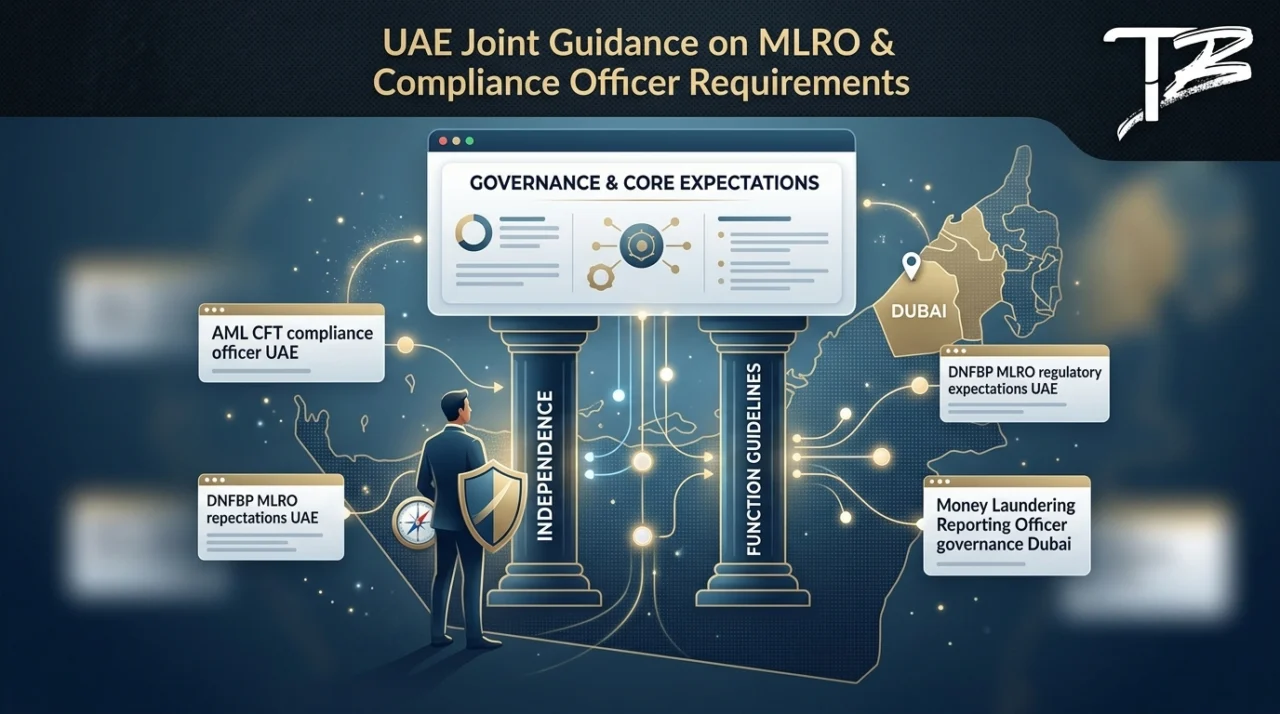
Quick Summary
An exhaustive compliance manual on the UAE Joint Guidance governing Money Laundering Reporting Officers (MLROs) and Compliance Officers (COs). Designed for senior management, board directors, and compliance leaders across UAE Financial Institutions (FIs) and Designated Non-Financial Businesses and Professions (DNFBPs), this analysis unpacks statutory mandates, governance architecture, goAML reporting workflows, outsourcing restrictions, supervisory enforcement risks, and practical implementation frameworks under CBUAE, MoE, MoJ, DFSA, and FSRA oversight.
The supervisory landscape across the United Arab Emirates has undergone a fundamental transformation, shifting from procedural check-the-box compliance toward rigorous, outcome-driven enforcement. Central to this strategic evolution is the unified regulatory framework promulgated by the primary anti-money laundering and counter-terrorism financing (AML/CFT) supervisory bodies across the state. The Central Bank of the UAE (CBUAE), the Ministry of Economy (MoE), the Ministry of Justice (MoJ), the Dubai Financial Services Authority (DFSA), and the Financial Services Regulatory Authority (FSRA) of ADGM have collectively formalized expectations regarding key compliance personnel. Understanding and operationalizing the UAE joint guidance MLRO compliance officer requirements has consequently become an urgent strategic imperative for board members, executive managers, and risk practitioners operating across both the financial and non-financial sectors.
This joint supervisory release reflects a zero-tolerance approach to structural compliance failures, nominal appointments, and institutional conflicts of interest. By standardizing the governance, authority, competency, and operational duties of the Anti-Money Laundering/Counter-Terrorism Financing/Counter-Proliferation Financing (AML/CFT/CPF) Compliance Officer and the Money Laundering Reporting Officer (MLRO), the supervisory authorities have established a clear, national standard. The guidance mandates that financial crime prevention functions across all commercial entities in mainland UAE and its financial free zones must act as independent, empowered, and fully resourced operational shields, capable of detecting and dismantling sophisticated illicit financial flows.
1. Operational Scope and Regulatory Context of the Joint Guidance
The publication of the joint guidance AML CFT compliance officer UAE regulatory benchmark addresses long-standing operational disparities across sectors. Historically, compliance management and suspicious transaction reporting structures varied significantly depending on whether an institution operated as a commercial bank, a exchange house, a real estate agency, a law firm, or a corporate service provider. This divergence created institutional vulnerabilities that illicit actors could exploit.
The guidance anchors its mandates in the statutory provisions of Federal Decree-Law No. (20) of 2018 on Anti-Money Laundering and Countering the Financing of Terrorism and Financing of Illegal Organisations, its Executive Regulations (Cabinet Decision No. (10) of 2019), and subsequent legislative amendments, including Federal Decree-Law No. (10) of 2025. It serves as an authoritative interpretation of how supervised entities must structure, empower, and resource their compliance infrastructure to comply with national laws and international standards set by the Financial Action Task Force (FATF).
A central tenet of the regulatory framework is the explicit distribution of liability. While the designated MLRO and Compliance Officer bear direct operational, statutory, and regulatory responsibility for day-to-day controls and external filings, ultimate legal and governance accountability remains squarely with the Board of Directors or Senior Management. Board members can no longer delegate away liability by hiring a compliance professional; rather, they are legally required to actively oversee, fund, and maintain an environment in which compliance officers can exercise their duties without commercial friction or fear of reprisal.
Key Regulatory Pillars Addressed in the Guidance
- :
- Formalization of Dual vs. Combined Roles: Establishing explicit parameters for when the Compliance Officer and MLRO duties may be assigned to a single individual, and when entity risk, operational scale, or transaction velocity requires structural separation.
- Unfettered Operational Access: Guaranteeing that compliance personnel possess absolute, unhindered access to all customer identification files, beneficial ownership structures, internal systems, and transaction data across all business units without corporate pre-filtering.
- Unmediated Governance Reporting Lines: Institutionalizing direct, independent reporting channels from the MLRO directly to the Board of Directors or its dedicated Audit/Risk Committee, bypassing commercial executive management.
- Outsourcing and Residency Restrictions: Formally defining strict limits on third-party compliance support, reiterating that the core statutory MLRO function must remain in-house, locally based, and fully accountable within the UAE jurisdiction.
2. Core Mandates: Compliance Officer vs. Money Laundering Reporting Officer
A critical contribution of the Money Laundering Reporting Officer governance Dubai and UAE-wide guidelines is the clean conceptual and operational division between the systemic, advisory role of the Compliance Officer (CO) and the statutory, investigative mandate of the Money Laundering Reporting Officer (MLRO). While medium-sized entities and DNFBPs often combine these roles within a single qualified individual, large-scale Financial Institutions and high-risk operations must maintain a clear understanding of the distinct functional duties tied to each title.
The Compliance Officer (CO) Function
The Compliance Officer is responsible for building, maintaining, and continually refining the institution’s overall AML/CFT/CPF compliance architecture. The CO operates primarily on a systemic and preventative level. Key operational mandates include:
- Policy Framework Development: Formulating, implementing, and regularly reviewing internal AML/CFT/CPF policies, procedures, and operational controls to match the changing findings of the Enterprise-Wide Risk Assessment (EWRA) and updated national threat matrices.
- Risk Assessment Oversight: Managing the methodology and execution of the entity’s EWRA, ensuring that customer, product, channel, and geographic risks are systematically quantified and mitigated.
- Customer Due Diligence (CDD) Frameworks: Overseeing the design and execution of Customer Due Diligence (CDD), Enhanced Due Diligence (EDD), and ongoing simplified due diligence workflows, ensuring that Ultimate Beneficial Ownership (UBO) verification meets strict regulatory standards.
- Sanctions Screening Protocols: Establishing and testing real-time screening mechanisms against the UAE Local Terrorist List and the UN Security Council Consolidated List for Targeted Financial Sanctions (TFS), ensuring instant freeze capabilities within 24 hours of list updates.
- Training and Capacity Building: Designing and delivering structured, role-specific AML/CFT training programs across all operational levels, from front-line relationship managers to executive directors.
- Independent Compliance Testing: Conducting regular internal compliance reviews and system assessments to verify that transaction monitoring rules and screening tools function effectively without generating unmanageable false-positive volumes or unsafe false-negative gaps.
The Money Laundering Reporting Officer (MLRO) Function
The MLRO occupies a specialized statutory position centered on the detection, internal investigation, and official reporting of suspected financial crime. The MLRO’s duties are investigative, retrospective, and reactive. Primary statutory obligations include:
- Internal Disclosure Evaluation: Receiving, cataloging, and evaluating internal Suspicious Transaction Reports (STRs) or Suspicious Activity Reports (SARs) submitted by staff through internal reporting channels.
- Independent Financial Crime Investigations: Conducting objective, deep-dive investigations into flagged transactions, client profiles, source of funds/wealth documentation, and counterparties using internal operational databases, open-source intelligence (OSINT), and specialized database tools.
- Statutory FIU Reporting: Determining whether reasonable grounds for suspicion exist and directly filing external STRs, SARs, or specialized reports—such as High-Risk Country Reports (HRC) or Real Estate Activity Reports (REAR)—to the UAE Financial Intelligence Unit (FIU) through the official goAML portal.
- FIU and Regulator Liaison: Serving as the sole authorized, confidential point of contact for communications with the UAE FIU, answering Information Requests (RFIs), executing operational freeze orders, and facilitating law enforcement inquiries.
- Comprehensive Record-Keeping: Maintaining complete, audit-ready confidential files of all internal disclosures, investigation notes, external filings, and detailed rationales for cases where the MLRO determined an external STR/SAR filing was not warranted.
| Functional Parameter | Compliance Officer (CO) | Money Laundering Reporting Officer (MLRO) |
|---|---|---|
| Primary Focus | Systemic policy creation, internal control maintenance, and overall AML/CFT governance. | Investigative evaluation of suspicious transactions/activities and statutory FIU reporting. |
| Operational Mandate | Preventative and structural oversight across daily business operations. | Reactive, investigative, and direct regulatory filing through the goAML portal. |
| Regulatory Interaction | Interfaces with sector supervisors (CBUAE, MoE, DFSA, FSRA) during routine audits and inspections. | Acts as confidential liaison directly to the UAE Financial Intelligence Unit (FIU). |
| Core Deliverables | EWRA execution, CDD/EDD policy updates, employee training programs, sanctions rule testing. | STR/SAR evaluations, goAML disclosures, RFI responses, freeze order executions. |
| Decision-Making Scope | Approves compliance policies, advises business units on client onboarding risks, approves high-risk CDD. | Holds sole statutory discretion to file external STRs/SARs without executive oversight. |
3. Governance Structure, Independence, and Authority
Under the UAE MLRO compliance officer function guidelines, compliance cannot be subordinated to commercial growth, sales targets, or executive convenience. Supervisory authorities consistently emphasize that an MLRO or Compliance Officer who lacks functional autonomy, operational authority, or direct corporate access represents a severe failure of corporate governance.
Ensuring Functional and Structural Independence
To align with regulatory mandates, regulated entities must establish structural safeguards that guarantee absolute compliance independence. Core requirements include:
- Complete Operational Segregation: The MLRO and Compliance Officer must remain completely free from commercial, revenue-generating, or operational responsibilities. Front-line sales managers, relationship executives, procurement officers, and general management personnel are legally prohibited from holding the MLRO position due to inherent conflicts of interest.
- Direct Board Access: The MLRO must maintain an unmediated line of reporting directly to the Board of Directors or the Board Risk Committee. The MLRO must meet regularly with the board without executive managers present to report on structural vulnerabilities, resource deficits, and significant reporting trends.
- Protection Against Retaliation: Corporate governance policies must explicitly protect the Compliance Officer and MLRO from internal dismissal, compensation penalties, or career marginalization resulting from their compliance decisions, objection to high-risk business, or statutory STR/SAR disclosures.
- Absolute Veto Power: Compliance Officers must hold formal veto authority over client onboarding, high-risk account approvals, and suspicious transaction processing whenever CDD, EDD, or sanctions requirements are incomplete or unsatisfactory.
Resource Allocation and Operational Capacity
Regulators actively inspect whether entities appoint nominal or symbolic compliance officers who lack the operational bandwidth or tools needed to execute their duties. Adequate resourcing requires:
4. Specific Expectations for DNFBPs vs. Financial Institutions
While the Joint Guidance establishes a unified compliance benchmark across the UAE, its operational application varies between Financial Institutions (FIs) and Designated Non-Financial Businesses and Professions (DNFBPs). Supervisory bodies tailor their oversight based on the operational realities and risk exposure inherent to each sector.
The regulatory expectations governing DNFBP MLRO regulatory expectations UAE focus on addressing high-value cash transactions, real estate transfers, precious metal trading, corporate structuring, and trust services. Conversely, the financial institution compliance officer responsibilities Dubai and mainland frameworks concentrate on high-velocity transactional monitoring, cross-border correspondent banking relationships, complex trade finance structures, and automated payment screening.
| Compliance Area | Financial Institutions (Banks, Exchanges, FinTechs) | DNFBPs (Real Estate, Lawyers, TCSPs, Dealers) |
|---|---|---|
| Supervisory Authorities | CBUAE, DFSA (DIFC), FSRA (ADGM). | Ministry of Economy, Ministry of Justice, DFSA, FSRA. |
| Structural Role Requirements | Mandatory segregation of CO and MLRO positions in large/high-risk entities; full-time in-house presence. | Single combined CO/MLRO role permitted for small-to-medium entities based on documented risk assessment. |
| Primary Focus & Typologies | Cross-border wire transfers, correspondent banking, trade-based money laundering (TBML), high-frequency transactions. | High-value cash transactions, real estate acquisitions, corporate formation, beneficial ownership concealment, asset purchases. |
| Monitoring Systems | Fully automated real-time transaction monitoring systems integrated into core banking/payment architecture. | Hybrid or automated transaction/activity tracking tools tailored to deal-based or project-based triggers. |
| Specialized Regulatory Filings | STR, SAR, High-Risk Country Reports (HRC), Fund Transfer Inquiries (FTI). | Real Estate Activity Reports (REAR), Dealers in Precious Metals and Stones Reports (DPMSR), STR/SAR. |
Financial Institutions: High-Velocity Operational Controls
Financial Institutions operate under constant supervisory focus from the CBUAE, DFSA, or FSRA. Compliance officers within FIs must manage high-velocity data flows and complex counterparty networks. Specific operational expectations include:
- Automated Transaction Screening: Deploying real-time, rule-based screening tools that intercept incoming and outgoing international payments instantly against sanctions lists before funds are released.
- Behavioral Baseline Analytics: Establishing dynamic customer transaction profiles to detect deviations in volume, frequency, counterparty geography, and structuring techniques designed to bypass reporting thresholds.
- Correspondent Banking Scrutiny: Managing rigorous due diligence on foreign respondent banks, evaluating their internal AML/CFT controls, and ensuring nested accounts or payable-through accounts are strictly controlled.
DNFBPs: High-Value Activity and Structuring Controls
DNFBPs—including real estate developers, brokers, legal practitioners, independent accountants, dealers in precious metals and stones (DPMS), and Trust and Company Service Providers (TCSPs)—face distinct operational risks. The Joint Guidance requires DNFBP leaders and compliance officers to enforce specific controls:
- Real Estate Activity Reporting (REAR): Real estate brokers and developers must ensure their MLRO files mandatory REARs via goAML for any physical cash transactions equal to or exceeding AED 55,000, or for payments involving virtual assets or non-bank payment mechanisms.
- Dealers in Precious Metals and Stones (DPMSR): Mandatory filing of DPMSRs for cash transactions or virtual asset exchanges involving gold, diamonds, and precious metals exceeding the statutory AED 55,000 threshold.
- TCSP Corporate Formation Oversight: Trust and Company Service Providers must maintain strict UBO verification protocols during business incorporation, legal structuring, or nominal service provision, ensuring complex corporate layers do not hide ultimate beneficial ownership.
5. Competency, Fitness, and Properness Criteria
The Joint Guidance sets clear standards regarding the eligibility, competence, and professional standing required for individuals appointed as Compliance Officers or MLROs. Regulators no longer allow firms to assign statutory compliance duties to administrative staff, junior human resource managers, or external administrative consultants who lack relevant experience.
Core Qualifications and Professional Credentials
Regulated entities must prove to supervisory authorities that their designated MLRO and Compliance Officer meet clear fitness and properness criteria before appointment:
- Demonstrated Compliance Expertise: Candidates must possess verified professional experience in financial crime prevention, regulatory compliance, risk management, or legal practice within regulated industries.
- Recognized Industry Certifications: Holding internationally recognized compliance designations—such as Certified Anti-Money Laundering Specialist (CAMS), International Compliance Association (ICA) Diplomas, or equivalent qualifications—is highly valued by supervisors as evidence of professional competence.
- In-Depth Statutory Knowledge: Candidates must demonstrate thorough understanding of UAE financial crime legislation, relevant Cabinet Decisions, CBUAE regulatory guidelines, FATF Recommendations, and goAML filing frameworks.
- Integrity and Clean Regulatory Record: Nominees must undergo comprehensive background checks, verifying they have no criminal convictions, regulatory enforcement penalties, or professional disciplinary actions on record.
Regulatory Approval and Approval Workflows
Depending on the operating sector and licensing authority, the appointment of an MLRO and Compliance Officer requires formal regulatory notification or pre-approval:
- CBUAE Supervised Entities: Mandatory formal pre-approval from the Central Bank before any candidate can take office as MLRO or Compliance Officer.
- DFSA (DIFC) and FSRA (ADGM) Entities: The MLRO position is classified as a mandatory “Recognized Function” or “Controlled Function,” requiring formal regulatory application, interviews, and explicit authorization prior to assuming the role.
- Ministry of Economy / Ministry of Justice DNFBPs: Entities must formally register their designated MLRO on the ministry portals and link their personal account directly to the UAE FIU goAML system upon corporate licensing.
6. Outsourcing Limits and Remote/Local Presence Rules
One of the most clear-cut operational mandates in the Joint Guidance concerns the restriction of compliance function outsourcing. Regulators have established explicit boundaries to ensure statutory accountability remains within the licensed UAE entity.
Strict Prohibition on Outsourcing Core MLRO Functions
The Joint Guidance explicitly states that the core statutory function of the MLRO cannot be outsourced to an external third-party consultancy, professional services firm, or law practice. The MLRO must be a direct, employed staff member of the licensed UAE entity or group.
External compliance consultants may be engaged exclusively to provide supplementary technical support, perform independent policy reviews, assist in conducting Enterprise-Wide Risk Assessments, or provide temporary operational help with false-positive clearing. However, the internal evaluation of suspicious activity, the ultimate decision to file, and the physical filing of an STR or SAR on goAML must be executed exclusively by the internal, authorized MLRO.
Mandatory Local Presence and UAE Residency
The regulatory guidance mandates that the designated MLRO must be a permanent resident of the United Arab Emirates and physically located within the state. Remote MLRO structures operating from foreign jurisdictions are strictly prohibited.
This requirement ensures that the statutory reporting officer remains directly accessible to UAE supervisory authorities, law enforcement agencies, and the FIU for urgent inquiries, freezing orders, or regulatory inspections. Furthermore, local physical presence ensures the officer maintains practical operational control over the entity’s daily business activities.
7. Suspicious Activity Investigation and goAML Workflow
The core statutory function of the MLRO revolves around managing internal red flags, conducting objective financial crime investigations, and executing external disclosures via the UAE Financial Intelligence Unit goAML system. Building an operational goAML reporting framework is a key benchmark for regulatory compliance reviews.
Step-by-Step STR/SAR Investigation and Escalation Architecture
-
Internal Red Flag Identification:
Front-line operational staff, relationship managers, or automated transaction monitoring systems identify unusual activity (e.g., sudden transaction volume spikes, uncooperative customer CDD behavior, circular wire transfers, or third-party cash payments) and submit an internal Suspicious Activity Disclosure to the MLRO through secure, confidential channels.
-
Initial Logging and Assessment:
The MLRO logs the internal disclosure into a confidential registry, immediately establishing statutory tipping-off protections. The MLRO assesses whether the disclosure provides initial grounds for investigation.
-
Deep-Dive Investigation & Case Building:
The MLRO exercises unfettered access rights to gather internal operational data, historical transactional records, UBO documents, and source of wealth records. The officer cross-references counterparties against open-source intelligence (OSINT), regulatory databases, and commercial screening tools.
-
Evaluation against National Typologies:
The MLRO evaluates the case against established national threat typologies, FATF red flags, and sector-specific indicators to determine if reasonable grounds exist to suspect money laundering, terrorist financing, or proliferation financing.
-
Formulation of the Discretionary Decision:
The MLRO independently decides whether to file an external disclosure. This decision rests solely with the MLRO. No executive manager, board member, or legal counsel holds the authority to edit, delay, or block an external filing.
-
External Filing via goAML:
If suspicion is validated, the MLRO logs into the UAE FIU goAML portal and completes the required STR, SAR, or specialized report (REAR/DPMSR/HRC). The MLRO attaches comprehensive supporting documentation, transactional logs, CDD files, and an investigative narrative.
-
Post-Filing Governance and Freeze Actions:
The MLRO securely archives the complete investigation file. If requested by the FIU or required by law, the MLRO executes account freezing orders or places internal restrictions on the customer profile while managing strict tipping-off controls to ensure the client remains unaware of the report.
Crucial Compliance Alert: Mandatory Tipping-Off Protections
Under Article 25 of Federal Decree-Law No. (20) of 2018, it is a strict criminal offense for any director, officer, MLRO, or staff member to inform a customer or third party that an internal suspicious report or goAML disclosure has been filed or is under active investigation. Violations carry severe criminal penalties, including mandatory imprisonment and substantial personal fines.
8. Implementation Roadmap: Aligning Governance with Joint Guidance
To transition from theoretical understanding to full regulatory compliance, board members, executive directors, and compliance managers must execute a structured, step-by-step implementation plan. Below is a practical roadmap designed to align corporate governance with the UAE Joint Guidance requirements.
Phase 1: Structural Governance and Gap Analysis (Weeks 1–4)
- Execute Corporate Compliance Audit: Review current organizational reporting lines, position descriptions, and employment contracts for the Compliance Officer and MLRO to ensure total independence from commercial roles.
- Formalize Board Charters: Update Board Risk and Audit Committee charters to explicitly grant the MLRO direct, unmediated access to top-level governance meetings.
- Perform Resource Adequacy Review: Evaluate current compliance software, automated screening capabilities, and staffing ratios against transaction volumes and customer risk profiles.
Phase 2: Policy Standardization and Workflow Refinement (Weeks 5–8)
- Update AML/CFT/CPF Policy Framework: Align internal manuals with updated regulatory expectations, explicitly defining the distinct duties of the Compliance Officer versus the MLRO.
- Formalize goAML Escalation Procedures: Document written internal protocols governing how front-line red flags are escalated, evaluated, documented, and reported via goAML.
- Establish Mandatory Non-Retaliation Protections: Draft clear corporate governance provisions protecting compliance officers from internal interference, sales-driven pressure, or retaliatory actions.
Phase 3: System Testing, Licensing, and Verification (Weeks 9–12)
- Validate goAML System Integration: Ensure the designated MLRO holds active, fully functional credentials on the UAE FIU goAML portal with valid primary and delegate access.
- Conduct Sanctions System Testing: Test automated real-time screening mechanisms against UN and UAE local list updates, verifying that freeze capabilities trigger within statutory timelines.
- Execute Targeted Governance Training: Deliver specialized training sessions to senior executives and board members regarding their statutory accountability under UAE financial crime laws.
9. Supervisory Enforcement Framework and Risk Considerations
The regulatory climate across the UAE is backed by an aggressive, technology-driven enforcement framework. Regulators actively inspect supervised institutions through off-site transaction monitoring analysis and unannounced on-site examinations.
Failure to implement the structural requirements outlined in the Joint Guidance exposes both the institution and its senior leaders to administrative, civil, and criminal enforcement penalties. Supervisory authorities—including the CBUAE, Ministry of Economy, DFSA, and FSRA—regularly publish details of regulatory sanctions to maintain public transparency and promote compliance discipline across the market.
| Enforcement Category | Typical Non-Compliance Trigger | Potential Regulatory Impact |
|---|---|---|
| Administrative Fines | Failure to appoint a qualified MLRO; inadequate resourcing; failure to maintain proper goAML operational links. | Substantial financial penalties ranging from AED 50,000 to tens of millions of Dirhams based on entity scale and violation severity. |
| Operational Restrictions | Operating with severe compliance conflicts of interest; outsourcing statutory MLRO duties to third parties. | Formal restrictions placed on commercial operations, suspension of client onboarding, or prohibition of high-risk business lines. |
| Individual Accountability | Senior Management or Board interference in goAML filings; deliberate failure to address identified compliance deficits. | Direct fines imposed on board members and executives; formal disqualification from holding regulated roles across the state. |
| Licensing Actions | Systemic, willful non-compliance; facilitating illicit money flows; complete failure to execute mandatory STRs/SARs. | Temporary suspension or permanent revocation of commercial and financial operating licenses. |
| Criminal Prosecution | Tipping off suspects; deliberate concealment of suspicious assets; active involvement in financial crime. | Referral to federal public prosecutors, leading to asset confiscation, personal imprisonment, and corporate liquidation. |
10. Strategic Advisory and Governance Imperatives
The UAE Joint Guidance on MLRO and Compliance Officer Requirements represents a fundamental evolution in how regulatory oversight operates across the state. Compliance can no longer be treated as an administrative cost center or a superficial legal requirement. Under current supervisory standards, the compliance function is an essential risk management engine that protects the continuity, reputation, and commercial standing of the entire organization.
Board members, executive directors, and general counsel must actively evaluate their corporate governance structures against the standards set by CBUAE, MoE, MoJ, DFSA, and FSRA. Securing experienced, fully independent, and adequately resourced compliance leadership—while providing them with the technological tools and operational authority to execute their statutory duties—is essential for long-term legal protection and operational resilience in the UAE’s evolving economic market.
Frequently Asked Questions
Can_ Summary
Introduction
Understanding Context
robust In-depthactive In-depthactive
