In the rapidly evolving regulatory landscape of the United Arab Emirates, maintaining robust financial integrity is no longer just a legal obligation—it is a strategic necessity. As Dubai continues to solidify its position as a premier global financial and commercial hub, regulatory authorities including the Central Bank of the UAE (CBUAE), the Ministry of Economy (MoE), and the Executive Office for Control and Non-Proliferation (EOCN) have intensified their oversight. For financial institutions and Designated Non-Financial Businesses and Professions (DNFBPs) alike, implementing professional transaction monitoring services Dubai is the most effective defense against money laundering, terrorist financing, and proliferation financing.
Effective transaction monitoring and real-time sanctions screening ensure that your business does not inadvertently facilitate illicit financial flows. By systematically analyzing transaction patterns and screening counterparties against global watchlists, businesses can identify suspicious activities before they escalate into severe regulatory breaches or reputational crises. This comprehensive guide explores the mechanics of transaction monitoring, the regulatory frameworks governing the UAE, and how tailored compliance solutions protect your enterprise.
Understanding Transaction Monitoring and Sanctions Screening
While often discussed together, transaction monitoring and sanctions screening serve distinct yet complementary roles within an organization’s Anti-Money Laundering (AML) and Counter-Terrorist Financing (CTF) framework. Understanding these differences is critical for designing an integrated compliance architecture that satisfies both internal risk appetites and external regulatory mandates.
What is Transaction Monitoring?
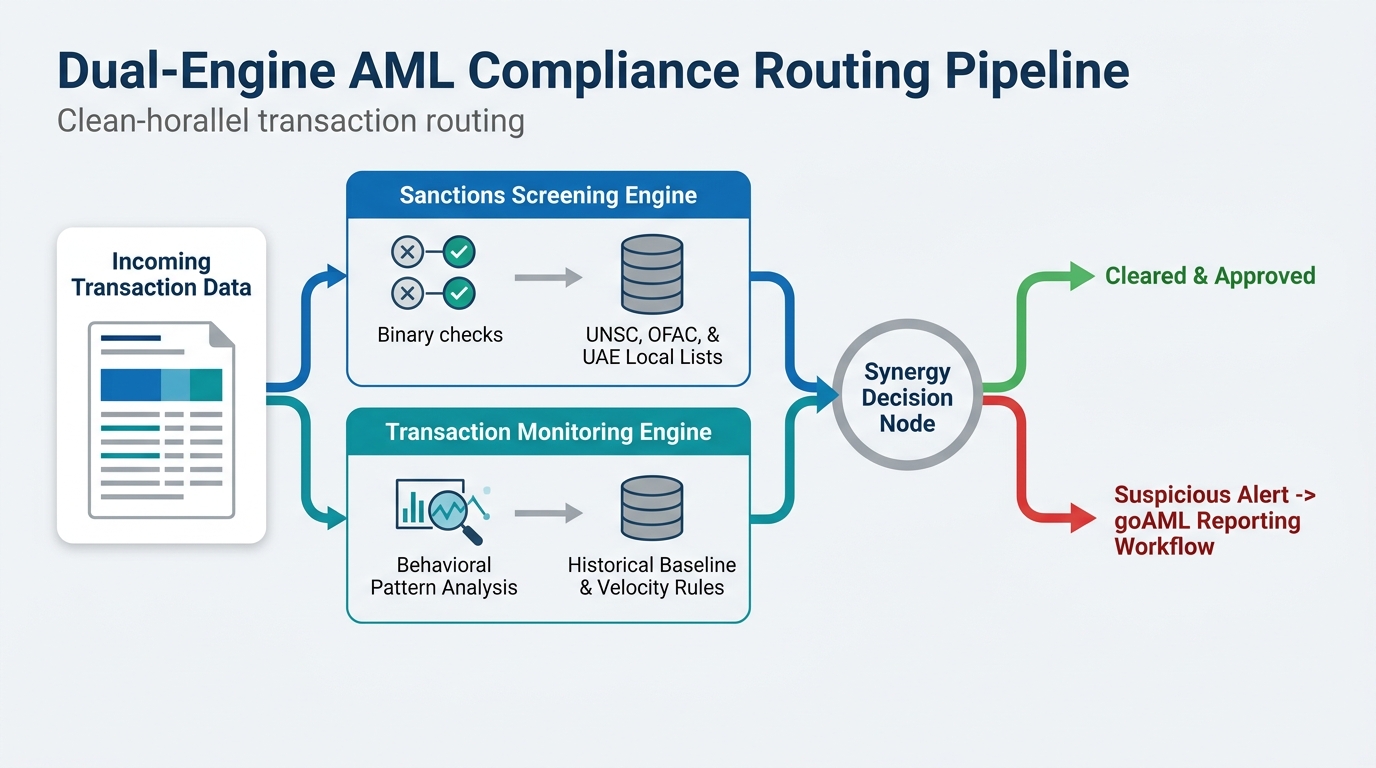
Transaction monitoring is the ongoing process of analyzing historical and current transactions to identify patterns, anomalies, or specific behaviors that deviate from a customer’s established profile, historical baseline, or typical industry standards. Rather than looking at a single point in time, it evaluates the flow of funds over days, weeks, or months to detect structuring, unusual velocity, or unexplained cross-border transfers.
For instance, if a corporate client typically processes local supplier payments averaging AED 50,000 per month, a sudden spike to AED 1,500,000 sent to an offshore jurisdiction with no clear commercial justification will trigger an alert. The monitoring process involves setting specific rules, thresholds, and scenarios that flag these deviations for manual review by a compliance analyst.
What is Sanctions Screening?
Sanctions screening is a real-time or periodic verification process where individuals, entities, vessels, and countries are cross-referenced against official sanctions lists. In the UAE, this includes the Local Terrorist List issued by the UAE Cabinet, as well as international lists such as the United Nations Security Council Consolidated List (UNSC), the US Office of Foreign Assets Control (OFAC) list, and the UK Office of Financial Sanctions Implementation (OFSI) list.
Screening must occur at the onboarding stage (Customer Due Diligence) and continuously whenever sanctions lists are updated or transaction counterparties change. Unlike transaction monitoring, which looks at behavioral patterns, sanctions screening is a binary check: is the counterparty or their beneficial owner on a restricted list? If yes, immediate regulatory protocols must be initiated.
The Synergy Between Monitoring and Screening
A truly resilient compliance program integrates both mechanisms. While sanctions screening prevents transactions with prohibited parties at the gateway, transaction monitoring detects complex, hidden schemes executed by seemingly legitimate actors. Together, they form a multi-layered shield that satisfies UAE regulatory expectations and safeguards the integrity of the local financial system. Without both systems operating in tandem, an organization remains highly vulnerable to sophisticated financial crime networks that utilize clean front companies to move illicit funds.
The UAE Regulatory Framework for Transaction Monitoring
Operating a business in Dubai requires strict adherence to federal laws and cabinet decisions designed to combat financial crime. The regulatory environment is highly sophisticated, with specific mandates for different sectors. The primary legislative foundation is Federal Decree-Law No. 20 of 2018 on Anti-Money Laundering and Combating the Financing of Terrorism and Financing of Illegal Organisations, along with its implementing regulations and subsequent amendments.
| Regulatory Body | Target Sectors | Key Compliance Mandates |
|---|---|---|
| Central Bank of the UAE (CBUAE) | Banks, Exchange Houses, Finance Companies, Payment Service Providers | Real-time transaction monitoring, automated screening, immediate Suspicious Transaction Report (STR) filing via goAML, and strict adherence to the CBUAE AML/CFT Guidelines. |
| Ministry of Economy (MoE) | DNFBPs (Real Estate Agents, Precious Metals/Stones Dealers, CSPs, Auditors) | Risk-based transaction monitoring, manual or automated screening, Suspicious Activity Report (SAR) filing, and mandatory registration on the goAML portal. |
| DFSA / FSRA | DIFC and ADGM licensed financial entities | International-standard risk assessments, robust automated transaction monitoring systems, independent annual audits, and dedicated compliance officer appointments. |
Under this federal framework, businesses must establish internal controls capable of identifying suspicious transactions. Failure to implement adequate transaction monitoring services in Dubai can result in severe administrative penalties, including millions of Dirhams in fines, suspension of business licenses, public censures, or criminal prosecution of compliance officers and senior management. The UAE authorities have demonstrated a zero-tolerance policy toward systemic compliance failures, making robust monitoring systems an operational necessity.
Key Components of an Effective Transaction Monitoring System
A generic, off-the-shelf compliance solution is rarely sufficient to meet the specific risk profiles of Dubai-based businesses. An effective transaction monitoring system must be tailored, dynamic, and risk-based. The core components of a robust system include:
1. Risk-Based Rules and Scenarios
Your monitoring system must be calibrated according to your Enterprise-Wide Risk Assessment (EWRA). For instance, a real-estate firm in Dubai faces different risks (such as large cash deposits or third-party payments for luxury properties) compared to a corporate service provider (which may face risks related to complex shell company structures). Rules should be established to flag:
- Transactions exceeding specific cash thresholds (e.g., the AED 55,000 threshold for real estate transactions in the UAE).
- Rapid movement of funds (high velocity) with no clear economic purpose.
- Transactions involving high-risk jurisdictions or non-cooperative territories.
- Unusual round-tripping of funds or sudden changes in a client’s transaction volume.
- Structuring of transactions (splitting large sums into smaller amounts to evade reporting thresholds).
2. Integration with Customer Risk Profiles
Transaction monitoring cannot operate in a vacuum. The system must compare transaction data against the customer’s established Know Your Customer (KYC) and Customer Due Diligence (CDD) profile. If a client registered as a salaried employee with an annual income of AED 150,000 suddenly attempts a multi-million Dirham corporate transfer, the system must trigger an immediate alert for Enhanced Due Diligence (EDD). This integration ensures that alerts are contextualized, reducing false positives while highlighting genuine anomalies.
3. Real-Time and Post-Event Analysis
While certain transactions require real-time intervention (such as sanctions screening before funds are cleared), others are analyzed post-event to detect long-term trends. A balanced approach ensures operational efficiency without compromising on risk detection. Post-event analysis allows compliance teams to look at historical data over a 90-day or 180-day window to identify slow-moving structuring schemes that real-time filters might miss.
4. Alert Management and Investigation Workflow
When an anomaly is flagged, it generates an alert. Your compliance team must have a structured, documented workflow to investigate these alerts. This involves gathering supporting documentation (such as invoices, contracts, or bank statements), documenting the rationale for clearing or escalating the alert, and maintaining a clear audit trail for regulatory inspectors. Every decision made by the compliance analyst must be defensible and recorded systematically.
Sanctions Screening Best Practices in the UAE
Sanctions compliance in the UAE is non-negotiable. The Executive Office for Control and Non-Proliferation (EOCN) mandates that all registered entities screen their databases and transactions against local and international sanctions lists. To ensure compliance, businesses should adopt the following best practices:
Immediate Screening of Updates
Sanctions lists are dynamic and can change overnight due to geopolitical developments. When the UAE Cabinet or the UNSC updates their lists, businesses must screen their existing customer databases immediately—typically within 24 hours of the publication of the update. Automated screening tools are highly recommended to handle these updates seamlessly, ensuring that no transaction is processed against a newly sanctioned entity during the lag time.
Fuzzy Matching and Name Variation Handling
Bad actors often attempt to bypass screening systems by using variations of their names, alternative spellings, or transliterations. Your screening software must utilize advanced “fuzzy matching” algorithms to detect close matches, phonetic similarities, and common aliases without generating an overwhelming volume of false positives. For example, the system should be able to flag variations of Arabic names that may be spelled differently in English scripts (e.g., “Mohammad”, “Mohammed”, “Muhammed”).
Handling False Positives and True Matches
Your compliance manual must clearly define the steps for handling matches:
- False Positives: If a name matches a sanctioned entity but further investigation (such as date of birth, nationality, or passport number) proves they are different, the alert must be documented and cleared with a clear written justification.
- True Matches: If a true match is identified, the business must immediately freeze any funds or assets belonging to the sanctioned party, refrain from providing any services, and submit a Fund Freeze Report (FFR) or Partial Name Match Report (PNMR) via the goAML portal within the mandated timeframe (typically 24 hours).
The Role of goAML in UAE Transaction Monitoring
The goAML portal, developed by the United Nations Office on Drugs and Crime (UNODC) and implemented by the UAE Financial Intelligence Unit (FIU), is the central platform for reporting suspicious financial activity. Transaction monitoring is the primary mechanism that feeds data into this portal.
When transaction monitoring reveals suspicious behavior that cannot be plausibly explained by the client after conducting inquiries, the compliance officer must file a report:
- Suspicious Transaction Report (STR): Filed when there are reasonable grounds to suspect that funds are the proceeds of a crime or are linked to money laundering or terrorist financing.
- Suspicious Activity Report (SAR): Filed when a transaction or attempted transaction raises suspicion, even if the exact value or flow of funds is not fully established.
Properly configuring your transaction monitoring services in Dubai ensures that your business can compile the detailed transaction histories, KYC documents, and narrative justifications required to submit high-quality, actionable reports through the goAML system. High-quality reports reduce the likelihood of regulatory follow-ups and demonstrate your organization’s commitment to compliance.
Step-by-Step Implementation of a Transaction Monitoring Program
Establishing a transaction monitoring program requires a structured approach. Below is a practical roadmap for Dubai-based businesses looking to build or upgrade their monitoring capabilities:
Step 1: Conduct an Enterprise-Wide Risk Assessment (EWRA)
Before selecting software or writing rules, you must understand your business’s specific risk exposure. Assess your customer base (e.g., PEPs, high-net-worth individuals), geographic reach (e.g., transactions involving high-risk countries), products/services offered, and delivery channels. The findings of the EWRA will dictate the complexity and parameters of your monitoring rules.
Step 2: Define Rules and Thresholds
Based on your EWRA, establish clear rules. For a Dubai real estate agency, this might include a rule flagging any transaction where the buyer pays using multiple third-party bank accounts. For a corporate service provider, it might involve flagging companies with complex ownership structures involving offshore jurisdictions. Ensure these rules are documented in your AML policy manual.
Step 3: Select and Deploy the Right Technology
Depending on your transaction volume, choose between manual monitoring (suitable for very low-volume DNFBPs) and automated transaction monitoring software. The software should integrate seamlessly with your core business systems (such as ERP or CRM platforms) and support real-time screening and historical analysis.
Step 4: Establish an Alert Investigation Protocol
Create a standard operating procedure (SOP) for alert handling. Define who receives the alert, how long they have to investigate it, what documentation is required to clear it, and the escalation path to the Compliance Officer or Money Laundering Reporting Officer (MLRO) for potential goAML filing.
Step 5: Continuous Testing and Optimization
Transaction monitoring is not a “set-and-forget” project. Criminal methodologies evolve, and your system must adapt. Conduct regular “above-the-line” and “below-the-line” testing to ensure your thresholds are capturing suspicious activity without overwhelming your team with false positives.
Common Pitfalls in Transaction Monitoring and How to Avoid Them
Many organizations in the UAE face challenges when implementing transaction monitoring. Recognizing these pitfalls early can save your business from regulatory penalties and operational inefficiencies:
1. Alert Fatigue
When monitoring systems are configured too sensitively, they generate thousands of low-risk alerts. This leads to “alert fatigue,” where compliance analysts may rush through investigations and miss genuine red flags. To avoid this, regularly tune your system’s rules and apply a risk-based approach that prioritizes high-risk alerts.
2. Siloed Data
If your transaction monitoring system does not communicate with your KYC database, analysts will lack the context needed to evaluate alerts. Ensure your systems are integrated so that an analyst can view a customer’s risk rating, source of wealth, and business profile directly alongside the flagged transaction.
3. Inadequate Documentation
During regulatory audits by the Ministry of Economy or the Central Bank, inspectors will look closely at how alerts were cleared. If an analyst clears an alert with a simple note like “discussed with client, looks fine,” the regulator will deem this insufficient. Every cleared alert must have a clear, documented rationale supported by objective evidence.
4. Lack of Specialized Training
Using staff who are not trained in AML typologies to manage alerts is a major risk. Compliance personnel must receive regular training on the latest money laundering trends in the UAE, such as trade-based money laundering, real estate integration schemes, and the misuse of virtual assets.
How Professional Advisory Optimizes Your Compliance Framework
Implementing and managing an in-house transaction monitoring and sanctions screening program can be resource-intensive and complex. Partnering with an experienced AML compliance specialist ensures that your systems are both compliant and operationally efficient.
System Calibration and Tuning
One of the biggest challenges businesses face is alert fatigue. A professional consultant can help tune your transaction monitoring rules, ensuring that your compliance team focuses their energy on high-risk alerts while maintaining full regulatory compliance. This optimization reduces operational costs and improves the overall detection rate of your compliance program.
Independent AML Audits
Regulators in the UAE frequently require businesses to undergo independent AML audits to verify the effectiveness of their compliance programs. An external review of your transaction monitoring and screening protocols provides an unbiased assessment of your system’s health, identifies potential gaps before regulators do, and provides a clear roadmap for remediation.
Staff Training and Capacity Building
A compliance system is only as good as the people operating it. Customized training programs ensure that your compliance officers, risk managers, and front-line staff understand how to interpret transaction alerts, conduct investigations, and utilize the goAML portal effectively. This builds a strong compliance culture across the entire organization.
Secure Your Business with Expert AML Solutions
As regulatory scrutiny intensifies across Dubai and the wider UAE, businesses must proactively strengthen their compliance frameworks. Implementing robust transaction monitoring and sanctions screening is not just about avoiding penalties; it is about protecting your business reputation, securing your banking relationships, and contributing to a clean financial ecosystem.
Tareq Badarin, working in partnership with the established expertise of Farahat & Co., provides comprehensive, practical, and regulatory-compliant AML solutions tailored to your specific industry. From system implementation and rule calibration to independent audits and goAML reporting support, we ensure your business remains fully aligned with UAE laws.
Contact us today to schedule a consultation and elevate your transaction monitoring and compliance standards.
Frequently Asked Questions
What is the difference between transaction monitoring and sanctions screening?
Transaction monitoring analyzes ongoing transaction patterns and behaviors to detect suspicious activity over time, while sanctions screening is a real-time check of individuals and entities against official watchlists to prevent transactions with prohibited parties.
How often should sanctions screening be conducted in the UAE?
Sanctions screening must be conducted during customer onboarding, whenever transaction counterparties change, and immediately (within 24 hours) after any updates are made to the UAE Local Terrorist List or the UN Security Council Consolidated List.
What should a business do if a transaction monitoring alert reveals a true sanctions match?
If a true match is identified, the business must immediately freeze the funds or assets of the sanctioned party, refrain from providing further services, and submit a Fund Freeze Report (FFR) via the goAML portal.
Can DNFBPs in Dubai use manual transaction monitoring?
While smaller DNFBPs with low transaction volumes may use manual processes, larger firms or those with high-volume transactions are highly encouraged to use automated systems to ensure accuracy and prevent regulatory oversight.