
Could a single oversight justify a AED 20 million fine and personal liability for your leadership? In June 2026, the CBUAE proved that it could, marking a definitive end to the era of checkbox compliance. You likely feel the mounting pressure as Federal Decree-Law No. 10 of 2025 and the fifth round of FATF Mutual Evaluations drive regulatory scrutiny to unprecedented levels. It’s no longer enough to simply possess a policy manual; your institution must now prove that its defenses are active, intelligent, and impenetrable through rigorous CBUAE audit preparation.
This professional guide provides a structured methodology to navigate the complexities of Central Bank expectations with executive-level precision. We’ll explore how to validate your enterprise-wide risk assessment frameworks, address the new standalone offense of Proliferation Financing, and establish the demonstrable effectiveness required to secure a clean audit report. By the end of this analysis, you’ll have the strategic insights needed to transform heavy regulatory requirements into a source of institutional strength and peace of mind.
Key Takeaways
- Grasp the strategic implications of Federal Decree-Law No. 10 of 2025 to ensure your compliance program meets the Central Bank’s heightened standards for 2026.
- Learn why a top-down governance framework is essential for projecting institutional strength and satisfying the CBUAE’s focus on individual accountability.
- Master the development of a comprehensive Enterprise-Wide Risk Assessment (EWRA) to serve as the critical foundation of your CBUAE audit preparation.
- Execute a structured timeline for document collation that prevents last-minute failures and ensures your organization remains operational during the inspection.
- Explore how specialized AML Inspection Support provides a protective layer of expertise to help you achieve a clean audit report and long-term stability.
Understanding the Strategic Gravity of CBUAE AML Inspections
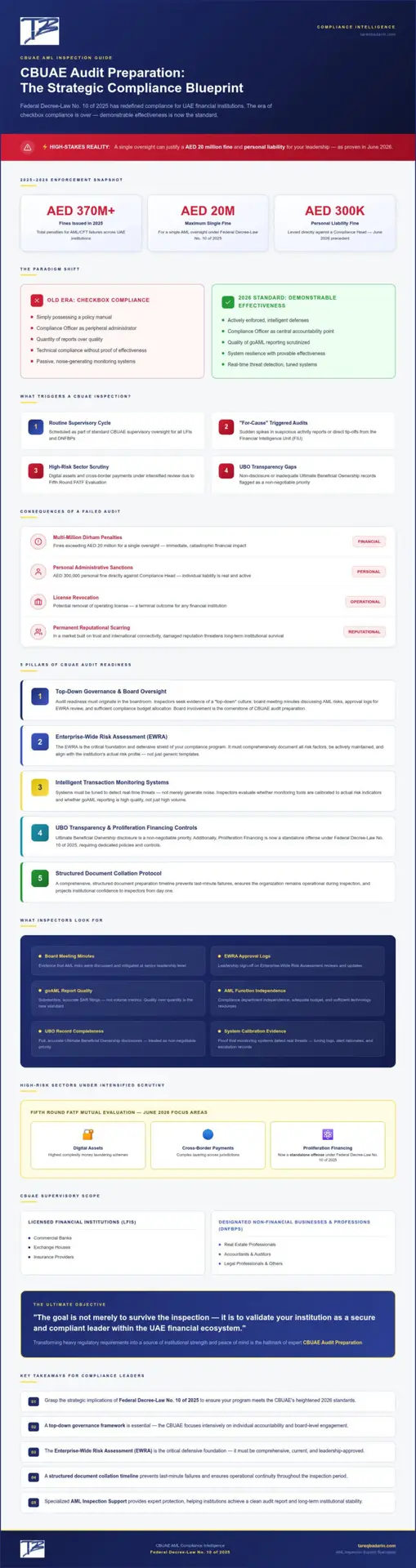
The Central Bank of the UAE (CBUAE) does not view inspections as mere procedural formalities; they represent a high-stakes evaluation of an institution’s moral and operational integrity. Under the stringent requirements of Federal Decree-Law No. 10 of 2025, the regulatory environment has transitioned into a period of intensified vigilance. This legislative shift demands that licensed financial institutions (LFIs) and designated non-financial businesses and professions (DNFBPs) move beyond the superficial comforts of “check-box” compliance. Effective CBUAE audit preparation now requires a demonstrable proof of system resilience, where policies are not just written but actively enforced to meet global anti-money laundering standards.
The Regulatory Mandate for Financial Institutions and DNFBPs
The CBUAE’s supervisory umbrella extends across a broad spectrum of the UAE economy, including commercial banks, exchange houses, and insurance providers. While routine inspections are scheduled as part of a standard supervisory cycle, “for-cause” audits are triggered by specific red flags. These may include sudden spikes in suspicious activity reports or direct tip-offs from the Financial Intelligence Unit (FIU). In either scenario, the Compliance Officer serves as the primary architect of the institution’s defense. This individual is no longer a peripheral administrator. They are the central point of accountability. Failure to fulfill these duties can lead to personal administrative sanctions, as evidenced by the AED 300,000 fine levied against a Compliance Head in June 2026.
The 2026 Enforcement Paradigm: What Has Changed?
The current enforcement landscape is defined by the CBUAE’s commitment to “demonstrable effectiveness.” Inspectors are increasingly focused on the quality of goAML reporting rather than just the quantity. They examine whether transaction monitoring systems are tuned to detect real-time threats or if they are merely generating noise. Additionally, transparency regarding Ultimate Beneficial Ownership (UBO) has become a non-negotiable priority. With the UAE’s Fifth Round FATF Mutual Evaluation occurring in June 2026, the CBUAE has intensified its scrutiny of high-risk sectors. This includes digital assets and cross-border payments, where the complexity of money laundering schemes is highest.
Failure to maintain a robust posture during CBUAE audit preparation carries catastrophic risks. In 2025 alone, the CBUAE issued over AED 370 million in fines for AML/CFT failures. Beyond the immediate financial impact of multi-million dirham penalties, a failed audit can lead to the revocation of licenses and permanent reputational scarring. In a market built on trust and international connectivity, institutional survival depends on the ability to withstand these rigorous examinations with unwavering confidence. The objective is not merely to survive the inspection, but to validate your institution as a secure and compliant leader within the UAE financial ecosystem.
Establishing a Robust Governance Framework for Regulatory Readiness
Audit readiness is not an administrative task relegated to the final weeks before an inspector arrives. It is a fundamental expression of institutional integrity that must originate within the boardroom. When regulators evaluate your organization, they aren’t merely looking for a signed policy manual. They are searching for evidence of a “top-down” culture of compliance where senior leadership actively steers the AML strategy. This shift in focus is a direct result of the FATF Mutual Evaluation of the UAE, which emphasizes that technical compliance is meaningless without demonstrable effectiveness. Consequently, the board’s involvement is the cornerstone of successful CBUAE audit preparation.
The Board’s Responsibility in AML Oversight
To satisfy the CBUAE, the board must prove they are proactive guardians of the institution. This proof is found in meticulous documentation, such as board meeting minutes where AML risks were discussed and mitigated. Inspectors look for approval logs showing leadership has reviewed the Enterprise-Wide Risk Assessment. Commitments must also be financial, ensuring the compliance department has a sufficient budget for AML inspection support and necessary technology.
Beyond approvals, the board is responsible for ensuring the independence of the AML function. This involves sanctioning regular, independent audits to verify that internal controls remain robust and impartial. When leadership treats compliance as a strategic priority rather than a cost center, it creates a shield that protects the entire organization from regulatory intervention. This level of oversight provides the authoritative assurance that CBUAE inspectors expect during a high-stakes review.
Cultivating Staff Vigilance and Training
Generic training modules often fail the CBUAE’s “effectiveness” test. Inspectors frequently interview staff to gauge their genuine understanding of suspicious activity. If a teller cannot identify a red flag or doesn’t know the internal reporting line, the framework is considered failed. Effective CBUAE audit preparation involves role-specific training that addresses the unique risks of different departments, from the front line to back-office operations.
To ensure readiness, institutions should implement internal mock interviews. These exercises test staff knowledge under pressure, ensuring they can articulate the firm’s defensive posture clearly. This methodical approach transforms staff from passive participants into vigilant defenders. By documenting these sessions and their outcomes, you provide the CBUAE with concrete evidence that your compliance culture is deeply embedded and operationalized throughout the institution.
The Enterprise-Wide Risk Assessment (EWRA) as Your Defensive Shield
The Enterprise-Wide Risk Assessment (EWRA) is the foundational pillar of any successful CBUAE audit preparation strategy. It functions as the primary document a Central Bank inspector will scrutinize to determine if the institution possesses a sophisticated understanding of its own vulnerabilities. A deficient EWRA signals a fundamental lack of institutional control, whereas a robust assessment serves as a definitive defensive shield. To be effective, this document must meticulously map risks across four critical dimensions: customer profiles, product offerings, service delivery channels, and geographic reach. It’s the blueprint that proves your institution isn’t just reacting to threats but is actively managing them.
Central to this assessment is the clinical distinction between inherent risk and residual risk. Inherent risk represents the raw exposure your business faces before any mitigation efforts are applied. Residual risk is the exposure that remains after your internal controls have been executed. If the gap between these two figures is narrow, it suggests your controls are either insufficient or improperly calibrated. This mapping creates a vital link to your KYC and CDD optimization, ensuring that high-risk segments receive the enhanced scrutiny required by Federal Decree-Law No. 10 of 2025.
Methodology of a Robust AML Risk Assessment
A sophisticated EWRA utilizes a balanced blend of quantitative data, such as transaction volumes and frequency, and qualitative insights, like geopolitical stability or sector-specific red flags. In the UAE’s unique regulatory environment, this involves accounting for the complexities of cross-border payments and high-value commodities. The CBUAE expects the EWRA to be a dynamic document. Moving beyond a static annual review is essential; your risk profile must evolve alongside emerging threats to maintain its validity as a strategic defense.
Gap Analysis: Finding Vulnerabilities Before the Inspector
Proactive institutions conduct a clinical review of their current controls against the latest CBUAE standards. This gap analysis identifies where the “defensive shield” may be thinning. Once a vulnerability is found, leadership must implement a time-bound action plan for remediation. Engaging an objective “third eye” through professional Regulatory Advisory & Consultation ensures that internal biases don’t obscure critical failings. This level of CBUAE audit preparation ensures that when the inspector arrives, every identified risk has a corresponding, validated control that has already been tested for effectiveness.
Executing a Comprehensive CBUAE Audit Preparation Protocol
Success during a Central Bank inspection is rarely the result of a last-minute scramble. It’s the outcome of a methodical, phased protocol designed to stress-test every component of your compliance framework. A structured timeline ensures that potential failures are identified and remediated long before an official request for information arrives. This phase-based approach to CBUAE audit preparation transforms a high-pressure event into a manageable, validated process of institutional verification.
The protocol begins with Phase 1: Document collation and version control. This “Data Dump” involves gathering every relevant policy, procedure, and board minute. It’s vital to ensure that only the most current, board-approved versions are presented; providing outdated manuals is a common red flag that suggests poor governance. Phase 2 shifts focus to technical integrity, specifically Transaction Monitoring & Sanctions Screening systems. You must prove that your thresholds are appropriately calibrated to the risks identified in your EWRA, as discussed in the previous section.
Phase 3 involves rigorous sample testing of high-risk KYC files and Ultimate Beneficial Ownership (UBO) documentation. Inspectors will scrutinize whether your Enhanced Due Diligence (EDD) for Politically Exposed Persons (PEPs) is merely a formality or a deep investigative process. Finally, Phase 4 is the “Mock Audit.” This simulation replicates the intensity of a CBUAE inspection, testing your team’s ability to retrieve data quickly and defend their compliance decisions under pressure.
The Essential AML Document Checklist
A comprehensive repository is your first line of defense. Your checklist should include:
- Governance documents and previous internal audit reports.
- Proof of goAML registration and a log of all Suspicious Transaction Reports (STRs) submitted.
- Specific evidence of EDD for high-risk clients and geographic exposures.
- Training logs that demonstrate role-specific education for all staff members.
Day-of Logistics: Managing the Inspection Process
The physical and operational management of the inspection is just as critical as the documentation itself. Establish a dedicated “War Room” where your compliance team can coordinate responses and review requested files before they reach the inspector. Designate a single point of contact, typically the MLRO, to manage the flow of information. If an inspector identifies an “immediate finding,” address it with professional composure and a commitment to swift remediation. This authoritative approach signals that your institution is a proactive guardian of regulatory standards, rather than a passive recipient of sanctions.
Securing Institutional Stability through Professional AML Support
Internal compliance departments often operate under the immense pressure of dual responsibilities: maintaining daily operational flow while simultaneously acting as the organization’s primary defensive line. This proximity can occasionally obscure systemic vulnerabilities that an objective, external eye would readily identify. Engaging specialized AML Inspection Support provides a strategic shield, allowing your institution to validate its defenses before they are tested by the regulator. This collaborative approach doesn’t just prepare you for an inspection; it establishes your firm as a benchmark for regulatory integrity in the UAE financial sector.
Professional advisory services offer more than technical guidance. They provide the authoritative assurance that your CBUAE audit preparation is aligned with the most recent shifts in the enforcement paradigm. By utilizing high-stakes advisors who understand the gravity of the local landscape, you transform compliance from a reactive burden into a source of institutional strength. Initiating a comprehensive regulatory health check is the first step toward securing this stability and ensuring that your risk management frameworks are resilient enough to withstand the scrutiny of the Central Bank.
The Role of Tareq Badarin in Regulatory Defense
Operating within the established infrastructure of Farahat & Co, Tareq Badarin offers elite consultancy that bridges the gap between theoretical law and practical application. His expertise is deeply rooted in the nuances of Federal Decree-Law No. 10 of 2025 and the specific requirements of the CBUAE rulebook. This specialized support serves as a buffer between the regulator and your business operations, ensuring that communication is precise and that all UAE AML Policies are fully operationalized. By leveraging this level of expertise, you ensure that your Enterprise-Wide Risk Assessment is not merely a document, but a sophisticated instrument of institutional defense.
Beyond the Audit: Maintaining a Culture of Vigilance
The conclusion of a CBUAE inspection shouldn’t signal a relaxation of standards. Instead, it marks the beginning of a continuous improvement cycle that reinforces your compliance culture. Maintaining a long-term strategic partnership ensures that post-audit remediation is handled with the same rigor as the initial preparation. This ongoing vigilance protects your reputation and prevents the recurrence of findings that could lead to administrative sanctions in future cycles. It’s about building a legacy of compliance that permeates every level of the organization. To begin this process, you can secure your institutional future with expert CBUAE audit preparation and ensure your defenses remain impenetrable.
Safeguarding Your Institution Through Strategic Compliance Leadership
The transition from technical compliance to demonstrable effectiveness marks a new era for financial institutions across the UAE. Success requires more than just documentation; it demands a vigorous governance framework and a risk assessment that evolves with the landscape. By treating your Enterprise-Wide Risk Assessment as a living defense and adhering to a structured preparation protocol, you ensure that your institution remains resilient against the gravity of regulatory scrutiny. This proactive stance transforms compliance from a source of anxiety into a strategic advantage.
Navigating the complexities of Federal Decree-Law No. 10 of 2025 and the CBUAE Rulebook requires a level of precision that internal teams alone may find challenging to maintain. This is where authoritative advisory, backed by the longstanding infrastructure of Farahat & Co, becomes a critical asset. Comprehensive CBUAE audit preparation isn’t just about avoiding administrative sanctions; it’s about validating your institutional integrity and securing long-term peace of mind. To ensure your defenses are impenetrable, Request a Professional AML Gap Analysis from Tareq Badarin. Taking these steps today builds the foundation for a secure and compliant future.
Frequently Asked Questions
What is the primary focus of a CBUAE AML inspection?
The primary focus of a CBUAE AML inspection is the demonstrable effectiveness of an institution’s compliance program. Regulators look beyond static policies to ensure that risk-based controls are actively identifying and mitigating threats in real time. This evaluation includes assessing how well the institution handles Proliferation Financing and transaction monitoring under the mandates of Federal Decree-Law No. 10 of 2025.
How much time do we have to prepare once a CBUAE audit notice is received?
Institutions typically receive a notice of routine inspection two to four weeks in advance; however, “for-cause” audits may occur with significantly less warning. Strategic CBUAE audit preparation requires a state of perpetual readiness rather than a reactive scramble. Maintaining updated documentation and version control is the only reliable way to ensure institutional stability when the regulator initiates a review.
What are the most common findings in CBUAE AML audits?
Common findings often include inadequate Enterprise-Wide Risk Assessments, poor Ultimate Beneficial Ownership transparency, and weak board-level oversight. Inspectors frequently identify failures in the calibration of transaction monitoring systems or insufficient evidence of Enhanced Due Diligence. These gaps often lead to severe administrative sanctions, including the multi-million AED fines observed throughout 2025 and 2026.
Can a DNFBP be fined as heavily as a bank for AML failures?
Designated Non-Financial Businesses and Professions face the same rigorous enforcement standards and potential for multi-million AED fines as traditional banks. The CBUAE maintains a zero-tolerance posture for AML failures across all regulated sectors. Recent enforcement actions in June 2026 demonstrate that individual accountability and institutional penalties apply universally to protect the UAE financial ecosystem.
What is the difference between an internal audit and a CBUAE inspection?
An internal audit is a proactive, self-initiated verification of controls, while a CBUAE inspection is a formal regulatory enforcement evaluation. Internal audits function as a diagnostic tool to identify and remediate gaps. The CBUAE inspection is a high-stakes assessment where findings carry legal and financial consequences, making professional CBUAE audit preparation support a vital institutional shield.
How does the goAML system impact our audit readiness?
The goAML system serves as the primary gateway for reporting suspicious activity to the Financial Intelligence Unit. Inspectors evaluate the quality, accuracy, and timeliness of your Suspicious Transaction Reports within this system. Poor reporting quality or delayed filings are viewed as evidence of a failing compliance culture, which directly negatively impacts your overall audit score.
What role does staff training play in a CBUAE audit?
Staff training is the litmus test for the effectiveness of your compliance framework. Inspectors often conduct interviews with front-line and back-office employees to verify their genuine understanding of AML red flags and internal reporting lines. If staff can’t articulate the institution’s defensive posture, the training program is deemed a failure, regardless of how many attendance logs you provide.
Is an Enterprise-Wide Risk Assessment (EWRA) mandatory for all UAE firms?
An Enterprise-Wide Risk Assessment is mandatory for every regulated entity under CBUAE supervision. It is the foundational document that informs all other compliance controls and resource allocations. Without a validated EWRA that accounts for customers, products, and geographic risks, an institution cannot demonstrate the risk-based approach required by UAE federal law.

Article by
Tareq Badarin
Tareq Badarin is a dedicated Anti-Money Laundering (AML) and Compliance Manager based in the UAE. As a Certified Anti-Money Laundering Specialist (CAMS) and Project Management Professional (PMP), Tareq leads compliance initiatives and regulatory frameworks for Farahat & Co. and HHS Lawyers. He writes about the evolving landscape of financial security, corporate integrity, and effective compliance management.