

In the current regulatory climate, treating your compliance protocol as a static checkbox is no longer just a deficiency; it’s a direct invitation for unprecedented administrative fines under Federal Decree-Law No. 10 of 2025. As the Central Bank of the UAE (CBUAE) intensifies its supervisory examinations, the margin for error in sanctions screening UAE has effectively vanished. You likely feel the weight of this responsibility, balancing the demand for exhaustive Ultimate Beneficial Owner (UBO) transparency against the operational drag of high false-positive rates that can paralyze legitimate business flow.
This article provides the strategic clarity required to master these complexities and protect your enterprise from evolving financial crime risks. You’ll gain a robust understanding of how to align your internal frameworks with the latest federal mandates, including the critical Counter Proliferation Financing (CPF) guidance issued in April 2026. We will explore the technical requirements for real-time screening, the nuances of independent system testing, and the precise protocols for fulfilling your reporting obligations to the Financial Intelligence Unit via the goAML system, ultimately mitigating individual liability for compliance leadership.
Key Takeaways
- Navigate the legislative shift toward Federal Decree-Law No. 10 of 2025 to ensure your compliance architecture meets current federal mandates.
- Identify the essential mandatory lists for sanctions screening UAE, including the UAE Local Terrorist List and the UN Consolidated List, while assessing the strategic value of international databases.
- Utilize an Enterprise-Wide Risk Assessment (EWRA) to calibrate your screening intensity, ensuring resources are focused on high-risk sectors like real estate and precious metals.
- Master the immediate legal obligations for asset freezing and goAML reporting to handle confirmed matches with precision and total confidentiality.
- Build a robust, evidence-based audit trail that demonstrates daily screening compliance to satisfy Central Bank and Ministry of Economy inspectors.
The Evolution of Sanctions Screening Under UAE Federal Law
Within the sophisticated regulatory architecture of the Emirates, sanctions screening UAE represents the proactive identification and mitigation of high-risk entities that threaten the integrity of the national financial system. It’s a strategic necessity. This process involves the systematic comparison of customer data and transaction participants against local and international restricted lists to prevent the flow of illicit funds. As the UAE solidifies its position as a global financial hub, the transition from basic compliance to a vigilant, technology-driven defense has become the expected standard for all licensed entities.
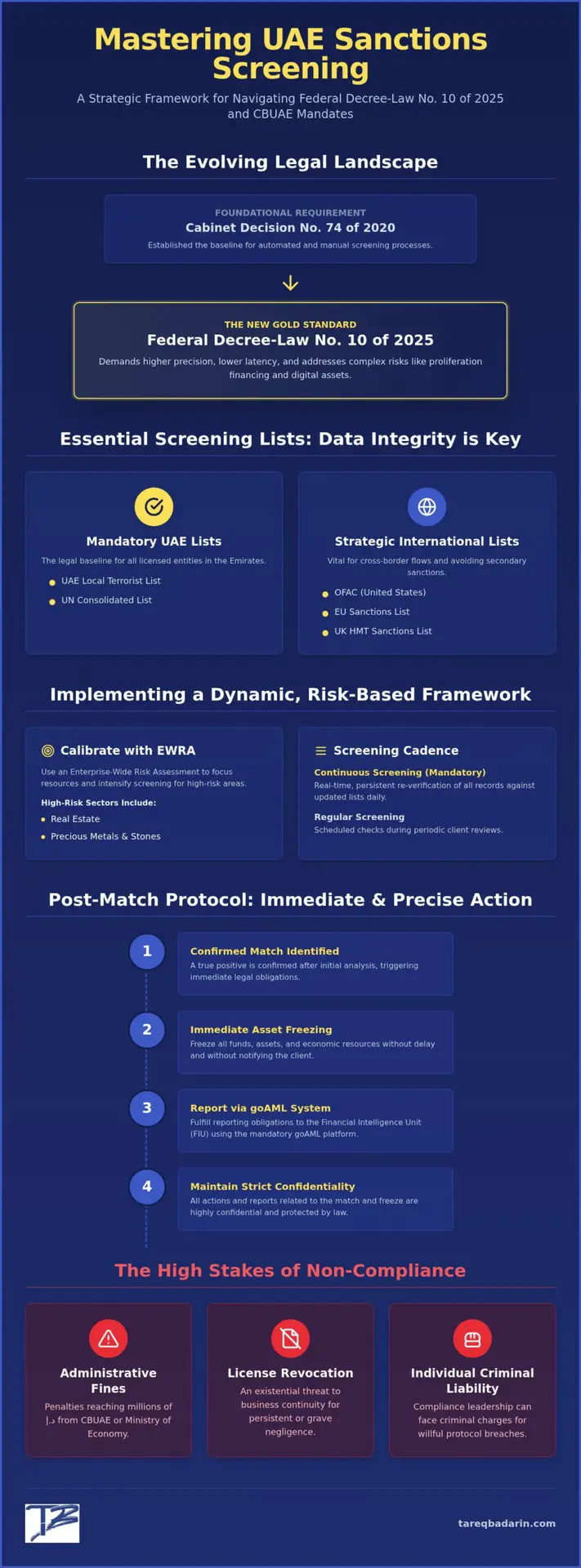
The UAE’s rigorous approach stems from its unwavering commitment to international standards, particularly following its historical efforts to move off the FATF grey list. This global alignment drives local mandates, ensuring that the domestic market remains a secure environment for legitimate investment. We’ve seen a decisive shift from the foundational requirements of Cabinet Decision No. 74 of 2020 toward the more comprehensive Federal Decree-Law No. 10 of 2025. This legislative journey reflects an evolution in how the state perceives risk, moving beyond traditional money laundering to address the complexities of proliferation financing and digital asset movement.
Regulators now distinguish between “regular” screening, which might occur during periodic reviews, and “continuous” screening, which is a real-time, persistent requirement. The Central Bank of the UAE (CBUAE) and the Ministry of Economy expect firms to maintain a state of perpetual readiness. It’s no longer sufficient to screen a client only at the point of onboarding; the modern compliance officer must ensure that every name in the database is re-verified against updated lists daily, or whenever a change in the regulatory landscape occurs.
Understanding the Legal Mandate: Cabinet Decision No. 74
Cabinet Decision No. 74 remains a cornerstone of the UAE’s AML/CFT framework, specifically through Article 21. This article mandates that financial institutions and Designated Non-Financial Businesses and Professions (DNFBPs) implement both automated and manual screening processes. For cross-border transactions, real-time screening isn’t an option; it’s a mandatory safeguard. Federal Decree-Law No. 10 of 2025 establishes the new gold standard for national compliance, demanding higher precision and lower latency in screening results.
The Consequences of Non-Compliance: Administrative and Criminal
The penalties for failing to maintain a robust sanctions screening UAE framework are severe and multi-layered. Administrative fines from the CBUAE or Ministry of Economy can reach millions of د.إ, depending on the gravity of the oversight and the entity’s history of negligence. Beyond financial loss, firms face the existential threat of license revocation. Authorities utilize the goAML platform to track screening gaps, and compliance officers can now face individual criminal liability if they’re found to have willfully ignored or bypassed mandatory screening protocols.
Essential Sanctions Lists and Data Integrity Protocols
The efficacy of sanctions screening UAE rests entirely on the integrity of the data being processed and the comprehensiveness of the watchlists being queried. It’s a strategic necessity. At the absolute minimum, every licensed entity in the Emirates must screen against two primary databases: the UAE Local Terrorist List and the United Nations Consolidated List. These aren’t suggestions; they’re the legal baseline for compliance. For enterprises with international aspirations or cross-border payment flows, screening against secondary lists like OFAC, the EU Sanctions List, and the UK’s HMT is vital to avoid secondary sanctions and maintain global banking relationships.
Data quality in the KYC and CDD phases serves as the bedrock for these efforts. If your customer data is incomplete or poorly formatted, even the most expensive screening software will fail. This is where “Fuzzy Matching” logic becomes indispensable. Given the linguistic nuances of the region, transliteration challenges between Arabic and English often lead to varying spellings of the same name. Effective systems must account for these phonetic variations and intentional aliases to ensure that high-risk individuals don’t bypass your defenses through simple orthographic changes.
The UAE Local Terrorist List vs. International Watchlists
The Executive Office for Control and Non-Proliferation (EOCN) manages the local listings, which can be updated at any moment. Regulators expect a nearly instantaneous response. Many sophisticated institutions now aim for a five-minute database update protocol following a new listing by the EOCN. For multi-national firms operating within the UAE, managing the intersection of local mandates and global watchlists requires a tiered approach to ensure no conflict of law occurs while maintaining total regulatory alignment.
Ultimate Beneficial Ownership (UBO) Screening Challenges
The most significant hurdle in modern sanctions screening UAE involves the identification of the individuals behind the corporate veil. Screening a legal entity alone is insufficient under the 2025 federal updates. You must identify the Ultimate Beneficial Owners. Identifying “shadow” owners and unraveling complex, multi-layered corporate structures is often where compliance friction is highest. Integrating UBO verification into your daily transaction monitoring workflow is the only way to ensure that a sanctioned individual isn’t hiding behind a seemingly benign holding company. If your team is struggling to calibrate these complex layers, seeking specialized KYC and CDD optimization can help streamline your internal frameworks.
Implementing a Risk-Based Sanctions Screening Framework
A one-size-fits-all approach to sanctions screening UAE is not only inefficient but creates dangerous vulnerabilities that regulators are increasingly quick to penalize. Effective compliance begins long before a name is entered into a database. It starts with the Enterprise-Wide Risk Assessment (EWRA), which serves as the strategic blueprint for your entire compliance program. By identifying the specific risks inherent to your products, services, and geographic reach, you can calibrate your screening intensity to focus resources where they’re most needed. This risk-based approach ensures that your defense remains robust without causing unnecessary operational friction for low-risk clients.
The strategic balance lies in minimizing false positives while maintaining a zero-failure rate for true matches. High false-positive rates lead to “alert fatigue,” where compliance teams may inadvertently overlook a genuine threat due to the sheer volume of noise. To prevent this, your framework must include a documented “Rationale of Rejection” for every potential match that is dismissed. This documentation is vital for audit-readiness; when the Central Bank or Ministry of Economy conducts an inspection, they don’t just look for matches you found, they look for the evidence-based reasoning behind the ones you cleared.
Calibrating Screening for DNFBPs
Designated Non-Financial Businesses and Professions (DNFBPs), such as real estate agents and dealers in precious metals, face unique challenges. Unlike financial institutions, these sectors often deal with high-value, one-off transactions that can be exploited for money laundering or proliferation financing. Your screening protocol must account for geographic risk factors, such as buyers from jurisdictions under increased monitoring. Determining “Low Risk” vs. “High Risk” profiles allows you to apply simplified due diligence where appropriate while maintaining high-intensity sanctions screening UAE protocols for complex, high-value corporate acquisitions.
Automation vs. Manual Review: Finding the Strategic Edge
As an enterprise grows, the transition from manual list checking to automated enterprise software becomes inevitable. Automation provides the speed and real-time updates required by Federal Decree-Law No. 10 of 2025. However, technology is the tool, but expert advisory is the governing intelligence. Human intervention remains a necessity in the “Potential Match” escalation process. A specialist must review the nuances that software might miss, such as complex corporate structures or phonetic variations that don’t trigger a standard fuzzy-matching algorithm but still pose a significant regulatory risk.
Post-Match Protocols: Freezing, Reporting, and goAML
Identifying a true match through sanctions screening UAE is a high-stakes event that demands immediate, disciplined action. Your response protocol must be calibrated to prevent “tipping off,” a criminal offense where the suspect is alerted to the investigation. Once a match is confirmed, the entity’s obligation shifts from monitoring to enforcement. Under Cabinet Decision No. 74, you’re required to freeze funds or assets instantly, without any prior notice to the client or the beneficial owner. This preemptive strike ensures that illicit assets cannot be moved or liquidated before the authorities can intervene.
The reporting obligation is equally stringent. You have a 24-hour window from the moment of detection to submit the appropriate documentation through the goAML portal. This timeframe is absolute. Failing to meet this deadline or submitting incomplete data can expose your organization to the severe administrative penalties outlined in Federal Decree-Law No. 10 of 2025. Managing this pressure requires a pre-defined escalation chain where the Compliance Officer has the authority to act without bureaucratic delay. Every second counts when navigating these regulatory deadlines.
The Mechanics of Asset Freezing in the UAE
UAE law defines “funds” and “assets” broadly, encompassing everything from cash and bank balances to real estate, corporate shares, and even digital assets. When a match occurs, you must cease all business relationships with the party immediately. This involves more than just blocking a single payment; it requires a total cessation of service and the implementation of enhanced Transaction Monitoring to ensure no secondary attempts to access the financial system are made. Your internal records must reflect the exact timestamp of the freeze to prove compliance during future audits.
Communicating with the Financial Intelligence Unit (FIU)
Submitting a Fund Freeze Report (FFR) or a Partial Name Match Report (PNMR) through goAML requires meticulous detail. You’ll need to provide the individual’s full identity details, the specific grounds for the match, and a comprehensive inventory of the frozen assets. If you later discover the match was a false positive, you cannot unilaterally unfreeze the assets. You must wait for explicit, written instruction from the FIU or the Executive Office for Control and Non-Proliferation (EOCN). To ensure your reporting protocols are audit-proof and fully compliant, you can engage our Regulatory Advisory & Consultation services to refine your internal reporting chain.
Strategic Advisory: Preparing for CBUAE and Regulatory Inspections
Regulatory inspections in the Emirates are increasingly focused on the effectiveness of technical controls rather than just the existence of a policy manual. Within this landscape, sanctions screening UAE serves as a vital indicator of an organization’s actual risk posture. When the Central Bank of the UAE (CBUAE) or the Ministry of Economy conducts an examination, they prioritize the integrity of the “Audit Trail.” This documentation must clearly evidence that every client, counterparty, and beneficial owner has been screened at onboarding and persistently monitored against the latest local and international watchlists. Providing this level of granular proof is what separates an audit-ready framework from one that is vulnerable to administrative sanctions.
Tareq Badarin’s advisory services are designed to act as a proactive safeguard, identifying potential screening gaps before they’re flagged by federal regulators. By bridging the gap between high-level UAE AML policies and the daily technical execution of screening protocols, we ensure that your compliance architecture is both theoretically sound and operationally resilient. This synergy is essential for maintaining the “Strategic Shield” required to protect your enterprise’s reputation and its license to operate. It’s a matter of ensuring that your internal defenses are as sophisticated as the risks they’re designed to mitigate.
Gap Analysis: The Pre-Audit Shield
Preparation for a live audit begins with a comprehensive gap analysis. This process involves conducting mock inspections that simulate the rigor of a CBUAE examination, testing both the technical resilience of your screening software and the depth of your staff’s practical knowledge. It’s often necessary to remediate historical data to ensure that your entire customer database aligns with the enhanced 2026 regulatory standards. Accessing specialized AML Inspection Support allows you to address these deficiencies in a controlled environment, ensuring that your first interaction with a regulator is one of strength and transparency.
The Role of Specialized AML Consultation
While many firms rely on off-the-shelf screening solutions, these tools often require expert configuration to meet the specific mandates of the UAE landscape, such as the real-time reporting requirements through goAML discussed in previous sections. A specialized consultant ensures that your software’s fuzzy-matching logic and update frequency are calibrated to local risks. Beyond technology, building a culture of vigilance starts with the “Tone at the Top.” Comprehensive staff training ensures that every member of the compliance team understands their individual liability and the strategic importance of their role. To ensure your framework is beyond reproach, you should secure your enterprise with professional AML advisory and sanctions screening support today.
Securing Your Enterprise Against the Evolving Regulatory Horizon
The transition from basic compliance to a sophisticated, risk-based sanctions screening UAE framework is no longer an elective strategy; it’s a fundamental requirement for institutional survival. As established, the implementation of Federal Decree-Law No. 10 of 2025 has redefined the standards for real-time monitoring and reporting. Success in this landscape requires more than just functional software. It demands a meticulous audit trail, a deep understanding of UBO complexities, and a proactive approach to goAML reporting protocols.
Protecting your organization from severe administrative penalties requires a partner who understands the gravity of these mandates. Tareq Badarin provides specialized expertise in the 2025 legal updates, offering comprehensive AML inspection support and audit defense. Through a strategic alliance with the Farahat & Co infrastructure, established in 1985, we provide the elite positioning and technical precision necessary to navigate these high-stakes requirements.
Consult with Tareq Badarin for Strategic Sanctions Compliance to fortify your internal controls. By establishing a culture of vigilance today, you’re ensuring your enterprise remains a resilient and trusted leader in the Emirates’ financial landscape.
Frequently Asked Questions
What is the primary sanctions list used in the UAE?
The UAE Local Terrorist List and the United Nations Consolidated List are the two primary mandatory databases for all licensed entities. The Executive Office for Control and Non-Proliferation (EOCN) publishes the local list, while the UN list covers global security resolutions. Every enterprise must ensure their sanctions screening UAE protocols include both sources to maintain total regulatory alignment with federal mandates.
How often must a UAE business update its sanctions screening database?
Businesses must maintain a continuous screening posture, updating their databases immediately whenever a new listing is published by the EOCN or the UN. While historical standards allowed for periodic reviews, modern expectations demand real-time updates. You’re legally obligated to report matches within 24 hours of detection, which necessitates a system capable of near-instantaneous data refresh.
Are small businesses in the UAE exempt from sanctions screening requirements?
No entity is exempt from these requirements based on its size or transaction volume. The AML and CFT regulations apply to all Financial Institutions and Designated Non-Financial Businesses and Professions (DNFBPs), including small real estate firms and boutique legal consultancies. Regulators prioritize the risk profile of the transaction over the size of the business; therefore, small enterprises face the same scrutiny during Ministry of Economy inspections.
What is the difference between a “Confirmed Match” and a “False Positive”?
A “Confirmed Match” occurs when an individual’s identity precisely aligns with a sanctioned entry, requiring immediate asset freezing and reporting. Conversely, a “False Positive” is an alert triggered by phonetic similarities or shared names that is later dismissed through rigorous verification. You must document the rationale for every dismissed alert to ensure your audit trail remains resilient during CBUAE examinations.
Do I need to screen existing customers or only new ones at onboarding?
You must screen your entire customer database daily, not just new clients during the onboarding phase. While initial KYC provides the baseline, the status of an existing customer can change instantly if they’re added to a new local or international list. Continuous sanctions screening UAE ensures that your business doesn’t inadvertently facilitate transactions for a party that was cleared yesterday but sanctioned today.
What is the penalty for failing to report a sanctions match to the FIU?
Penalties for non-reporting are severe and include administrative fines that can reach millions of د.إ. Under Federal Decree-Law No. 10 of 2025, entities also face the risk of license revocation and the public disclosure of the institution’s failings. Crucially, compliance officers can be held individually liable, facing potential criminal charges for willful negligence in their reporting duties to the Financial Intelligence Unit.
Is automated software mandatory for sanctions screening in the UAE?
Automated software isn’t strictly mandated by the letter of the law, but it’s practically essential for meeting real-time screening expectations. Manual list checking is prone to human error and cannot realistically handle the volume of daily updates required for a modern business. Most enterprises utilize automated solutions to ensure they don’t miss phonetic variations or aliases that a human reviewer might overlook.
What should I do if I find a partial name match on a sanctions list?
You should perform enhanced due diligence to verify the individual’s identity without alerting them to the investigation. If you cannot definitively rule out the match after reviewing passports and UBO structures, you must file a Partial Name Match Report (PNMR) via the goAML portal. This protective measure shifts the final determination to the authorities while shielding your business from the risk of non-compliance.

Article by
Tareq Badarin
Tareq Badarin is a dedicated Anti-Money Laundering (AML) and Compliance Manager based in the UAE. As a Certified Anti-Money Laundering Specialist (CAMS) and Project Management Professional (PMP), Tareq leads compliance initiatives and regulatory frameworks for Farahat & Co. and HHS Lawyers. He writes about the evolving landscape of financial security, corporate integrity, and effective compliance management.