Quick Summary
A comprehensive guide to detecting sanctions evasion through name alterations using advanced fuzzy logic algorithms in the UAE. Learn threshold tuning, trade-based money laundering (TBML) detection, multi-script transliteration handling, and regulatory alignment with CBUAE, MoE, and DFSA standards.
In an increasingly intricate global sanctions ecosystem, illicit actors, front companies, and designated entities continuously refine their evasion techniques to bypass automated screening filters. Among the most prevalent methods used in trade-based money laundering (TBML), proliferation financing (PF), and illicit capital movement is deliberate name alteration. By making subtle modifications to the spelling, structural composition, character set, or phonetic rendering of a sanctioned individual or corporate entity, bad actors aim to pass through traditional exact-match filters without generating an alert.
For financial institutions, exchange houses, real estate brokers, dealers in precious metals and stones (DPMS), and Corporate Service Providers (CSPs) operating across the United Arab Emirates, robust targeted sanctions screening is both a core operational necessity and a strict statutory mandate. Achieving full compliance with Targeted Financial Sanctions (TFS), Countering the Financing of Terrorism (CFT), and Countering Proliferation Financing (CPF) regulations requires moving past rigid exact-match mechanisms. Implementing effective sanctions evasion name alteration detection with fuzzy logic in the UAE gives compliance teams the algorithmic precision required to uncover evasive variations while maintaining operational efficiency.
The Mechanics of Name Alteration in Sanctions Evasion
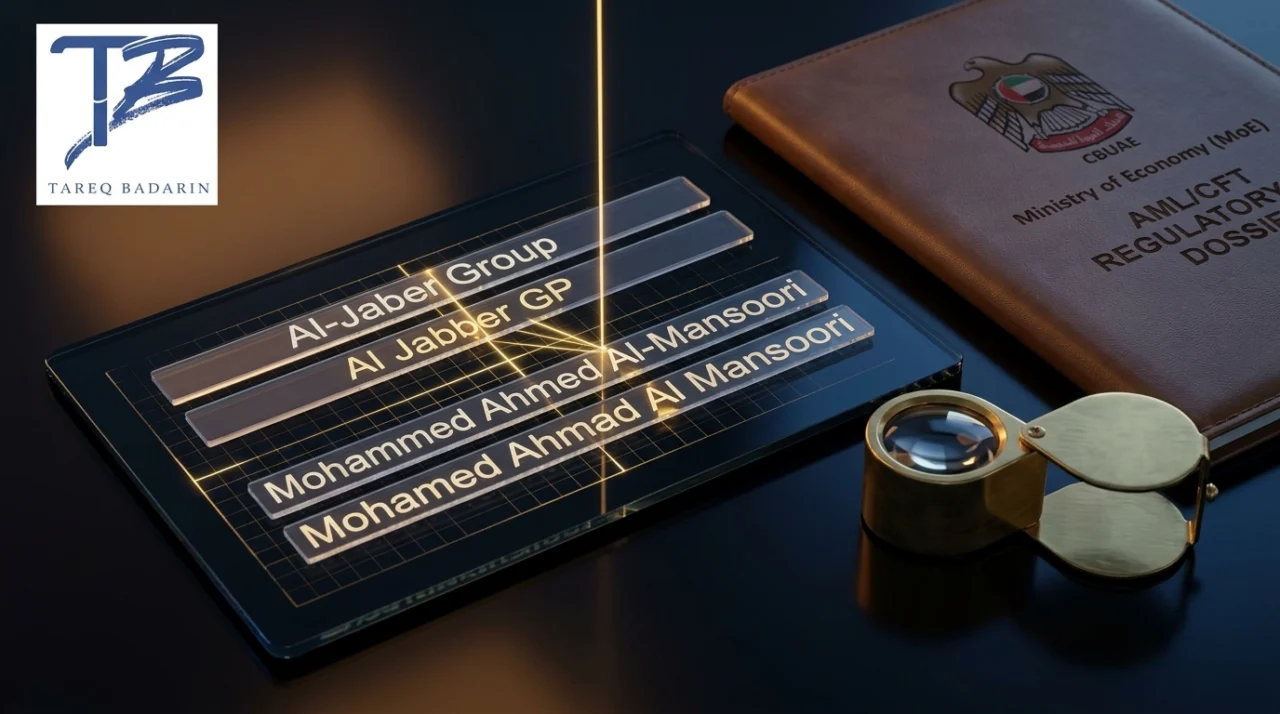
Name alteration exploits the structural limitations of binary database queries. Standard string-matching technology evaluates database entries based on exact character-by-character parity. If a sanctioned firm appears on the UN Security Council Consolidated List or the UAE Local Terrorist List as “Alpha Trading FZE”, an exact-match filter will fail to flag shipping documentation submitted under “Alfa Trading FZE”, “Alpha Trade Limited”, or “Al-Pha Trading”.
In trade-based sanctions evasion, these variations are rarely accidental typos. They represent calculated tactics designed to obscure beneficial ownership, ultimate consignees, maritime vessels, transshipment hubs, or corporate counterparties across cross-border payment rails and trade corridors. Common name alteration techniques include:
- Phonetic Substitutions: Replacing letters or character combinations with homophones or phonetically similar equivalents (e.g., swapping ‘F’ for ‘PH’, ‘K’ for ‘C’, or ‘Z’ for ‘S’).
- Character Transposition and Typos: Inverting adjacent letters or intentionally introducing minor spelling modifications (e.g., “Global Energy” vs. “Golbal Energy”).
- Script Conversion and Transliteration Discrepancies: Converting names from Arabic, Cyrillic, Chinese, or Urdu scripts into Latin characters using non-standard or alternative Romanization schemes.
- Token Reordering, Omission, and Insertion: Rearranging corporate terms, dropping structural identifiers, or inserting arbitrary noise words (e.g., removing “LLC”, “FZE”, or swapping “Middle East Trading” to “Trading Middle East”).
- Concatenation and Splitting: Joining separate words into a single string or splitting single words into multiple components (e.g., “AlSharq” vs. “Al Sharq”).
- Punctuation and Special Character Manipulations: Inserting or removing hyphens, apostrophes, slashes, or periods to alter the character count and sequence (e.g., “Al-Baraka” vs. “Al Baraka”).
How Fuzzy Logic Solves the Exact-Match Vulnerability
Fuzzy logic is a mathematical methodology that measures the degree of similarity between two data strings on a continuous scale between 0% (complete dissimilarity) and 100% (exact match), replacing strict binary logic. When integrated into transaction monitoring and sanctions screening architectures, fuzzy algorithms evaluate how closely an incoming data string resembles a listed record on an official sanctions or watch list.
Core Fuzzy Logic Algorithms Used in Screening Systems
Modern enterprise screening engines combine string-distance metrics, token-based matching, and phonetic algorithms to detect complex name variations. Understanding these algorithms enables compliance officers and system architects to configure screening engines effectively:
1. Levenshtein Distance (Edit Distance)
Levenshtein distance measures the minimum number of single-character edits—insertions, deletions, or substitutions—needed to transform one text string into another. For example, modifying “Tehran” to “Teheran” requires a single insertion, producing a high similarity score. This metric is effective at capturing typos, minor transpositions, and slight misspellings.
2. Jaro-Winkler Similarity
Jaro-Winkler measures edit distance while placing higher mathematical weight on strings that match from the beginning (the prefix). Because personal names and institutional brands often retain a consistent initial token or surname root, Jaro-Winkler effectively identifies variations where the trailing characters differ slightly due to corporate suffixes or minor descriptive additions.
3. Soundex and Double Metaphone
Phonetic algorithms transform text strings into numeric or alphabetic codes based on how words sound when spoken, rather than how they are spelled visually. While early algorithms like Soundex were designed primarily for English names, Double Metaphone is engineered for multi-lingual environments like the UAE. It calculates primary and secondary phonetic keys, accounting for irregular English spellings and foreign origin names common across Middle Eastern, European, and Asian trade lanes.
4. N-Gram Matching
N-Gram algorithms decompose text strings into overlapping contiguous sequences of ‘n’ characters (typically bi-grams or tri-grams). By measuring the statistical overlap of character sub-sequences, N-Gram engines reliably identify concatenated, split, or partially inverted entity names regardless of token arrangement.
5. Token-Set and Monge-Elkan Matching
Token-based algorithms segment long name strings into distinct words (tokens), sort them alphabetically, and run string-distance comparisons on individual components. This approach ensures that token reordering (e.g., “International Freight Logistics” vs. “Logistics International Freight”) yields a high match confidence score.
Comparative Matrix of Fuzzy Matching Algorithms
| Algorithm | Primary Strengths | Key Weaknesses | Best Operational Use Case |
|---|---|---|---|
| Levenshtein Distance | Detects minor typos, character transpositions, and single-letter omissions. | Computationally intensive for large databases; sensitive to token reordering. | Screening short names, individual surnames, and passport fields. |
| Jaro-Winkler | High accuracy for prefix matches; robust against trailing word variations. | Less effective if the initial characters or prefixes are altered or missing. | First name / last name combinations and primary brand names. |
| Double Metaphone | Captures phonetic variations across multi-lingual naming conventions. | Generates higher false positives for distinct names that sound alike. | Arabic, South Asian, and European cross-border trade transactions. |
| N-Gram (Tri-Gram) | Handles word splitting, concatenation, and missing structural tokens. | Slower processing speeds across massive real-time payment volumes. | Trade documentation, Bills of Lading, and unstructured free-text fields. |
| Token-Set Matching | Ignores word order changes and structural token inversions. | May match unrelated entities sharing common corporate descriptive words. | Complex corporate entity names and multi-party trade contracts. |
Configuring Fuzzy Matching Thresholds in UAE Compliance Frameworks
Deploying fuzzy logic requires a balance between risk coverage and operational capacity. Setting similarity thresholds too high (e.g., 95%) reintroduces the risk of missing intentional name alterations. Conversely, setting thresholds too low (e.g., 60%) generates a large volume of false positives that can overwhelm compliance teams, leading to alert fatigue and operational bottlenecks.
Establishing a Risk-Based Threshold Calibration Strategy
Regulated entities in the UAE—including commercial banks, exchange houses, real estate brokerages, DPMS, and corporate service providers—must establish a clear, documented rationale for their fuzzy matching parameters during regulatory inspections and independent AML/CFT audits.
| Match Threshold Range | Detection Capabilities | Operational Impact | Recommended Context |
|---|---|---|---|
| 90% – 100% | Detects minor typos and exact matches. Misses complex phonetic variations and reordered tokens. | Very low false positive rate; fast automated processing. | Low-risk domestic payments with verified recurring counterparties. |
| 80% – 89% | Captures common transliteration changes, character swaps, and standard phonetic variations. | Balanced alert volume requiring focused human review. | Standard baseline for TFS, CFT, and CPF customer onboarding and routine screening. |
| 70% – 79% | Detects significant name alterations, reordered words, and complex trade-based evasions. | High false positive rate; demands structured Level 1 filter rules. | High-risk jurisdictions, cross-border trade finance, and vessel/maritime screening. |
Technical Workflow for System Implementation
Building a resilient fuzzy logic screening environment requires a structured processing pipeline. Relying solely on raw string comparisons against uncleaned data leads to operational inefficiencies. The diagram below illustrates the standard data flow for fuzzy screening:
- Input Data Extraction: Capture structured customer data or unstructured text from trade messages (e.g., SWIFT MT700, ISO 20022 XML, Bills of Lading).
- Pre-Processing & Data Hygiene: Strip special characters, convert text to uniform case, remove non-informational legal suffixes, and isolate noise words.
- Script Normalization: Convert non-Latin scripts (Arabic, Cyrillic) into standard UTF-8 encodings to prevent homoglyph attacks.
- Multi-Algorithm Scoring Engine: Execute concurrent fuzzy matches using string distance, token-set, and phonetic algorithms.
- Contextual Score Weighting: Adjust initial name similarity scores based on secondary attributes (DOB, nationality, address, IMO number).
- Alert Routing & Dispositioning: Automatically suppress sub-threshold scores; route qualified alerts to Level 1 and Level 2 analysts for review and goAML escalation if required.
Detecting Trade-Based Sanctions Evasion in the UAE
Trade-based money laundering (TBML) and trade-based sanctions evasion present distinct screening challenges due to the unstructured data contained within commercial documents, such as Invoices, Bills of Lading, Certificates of Origin, and Letters of Credit. Evasive actors frequently alter the names of shipping lines, ultimate consignees, notify parties, or industrial goods manufacturers to bypass standard payment filters.
Operational Steps to Counter TBML Name Alterations
To establish an effective detection environment in line with UAE Executive Office for Control and Non-Proliferation (EOCN) guidelines, organizations should implement the following multi-layered process:
1. Pre-Processing and Structural Noise Removal
Before passing text through the fuzzy matching engine, standard legal suffixes (e.g., “LLC”, “FZC”, “Limited”, “PJSC”, “Free Zone Company”) and common stop words should be isolated. Removing structural noise prevents distorted similarity scores, ensuring the engine focuses on the core identity string.
2. Transliteration Standardization and Character Mapping
Given the UAE’s position as an international trade hub connecting Arabic, Cyrillic, South Asian, and Latin script regions, screening systems must normalize characters into standard UTF-8 encodings. Automated character mapping prevents evasion strategies that use look-alike Unicode characters (homoglyph attacks) to deceive optical character recognition (OCR) systems.
3. Multi-Factor Contextual Matching
Fuzzy matching should not operate in isolation. When a name match triggers a fuzzy threshold alert (e.g., at 82%), the transaction monitoring engine should automatically cross-evaluate secondary attributes—such as tax identifiers, date of birth, country of registration, SWIFT BIC, or vessel IMO numbers. Matching secondary attributes reinforces the validity of an alert, allowing low-confidence standalone matches to be dispositioned efficiently.
4. Threshold Tuning and Periodic Back-Testing
Regulators expect institutions to regularly test and recalibrate their fuzzy logic parameters. Back-testing involves running historical evasion patterns and synthetic test samples through the screening engine to verify that altered names trigger an alert at configured thresholds.
Managing Multi-Script Challenges: Arabic-English Transliteration
A frequent challenge in the UAE compliance landscape is the transliteration of Arabic names into Latin script. Arabic features consonants, long and short vowels, and prefixes that can be Romanized in multiple valid ways. For example, the name عبد العزيز can appear in Latin characters as “Abdul Aziz”, “Abdel Aziz”, “Abdulaziz”, “Abd-El-Aziz”, or “Abdelaziz”.
Standard fuzzy distance algorithms like Levenshtein often assign low similarity scores to these valid transliterations due to space insertions, hyphens, and vowel shifts. To address this issue without lowering global thresholds and causing high false positive rates, compliance systems should incorporate specialized pre-processing rules:
- Article and Prefix Isolation: Recognize and standardize common Arabic prefixes such as “Al-“, “El-“, “Abdul-“, “Bin-“, and “Ibn-” during pre-processing.
- Phonetic Dictionary Integration: Use specialized translation and transliteration dictionaries that map common Arabic naming variations directly to unified search keys before applying string-distance algorithms.
- Vowel Neutralization: Configure fuzzy algorithms to give lower negative weight to short vowel substitutions (e.g., ‘A’ vs ‘E’ vs ‘I’) in transliterated names.
Ensuring Alignment with UAE TFS, CFT, and CPF Requirements
Under UAE Federal Law No. 20 of 2018 and its regulatory updates, all regulated entities must screen their customer databases, beneficial owners (UBOs), and transactional counterparties without delay against the UAE Local Terrorist List and the UN Security Council Consolidated List. When a confirmed fuzzy match reveals a listed individual or entity, immediate freezing measures and reporting via the goAML portal are required by law.
Implementing calibrated fuzzy logic screening demonstrates to regulatory bodies—including the Central Bank of the UAE (CBUAE), Ministry of Economy (MoE), Dubai Financial Services Authority (DFSA), and Financial Services Regulatory Authority (FSRA)—that an institution maintains technical controls tailored to its enterprise-wide risk assessment.
Practical Implementation Plan: Calibrating Your Fuzzy Logic Engine
Optimizing a fuzzy matching screening engine requires a structured, multi-phase implementation roadmap. Compliance and IT teams can use the step-by-step project framework below:
Phase 1: Architecture and Algorithmic Audit
Review the existing screening system to determine its technical capabilities. Verify whether the engine supports multi-algorithmic matching (e.g., combining Levenshtein with Double Metaphone), handles multi-script normalization, and permits granular threshold settings by customer type or transaction channel.
Phase 2: Data Pre-Processing and Noise Standardization
Configure custom noise-word lists and legal suffix suppression tables tailored to UAE commerce. Ensure that structural elements (“FZE”, “LLC”, “Branch”) are stripped prior to scoring, and establish automated transliteration mapping for Arabic, Russian, and Chinese names.
Phase 3: Threshold Calibration and Segmentation
Establish segmented similarity thresholds based on risk levels. Assign higher sensitivity settings (75%–80%) to high-risk payment corridors, trade finance documents, and PEP screening, while maintaining standard baselines (80%–85%) for domestic retail customer onboarding.
Phase 4: Quantitative Back-Testing and Validation
Execute historical back-testing using a control set of known sanctions matches, historical false negatives, and artificially altered variants (typographic errors, phonetic swaps, token inversions). Measure detection rates against false positive volumes to validate configuration choices.
Phase 5: Governance and Audit-Ready Documentation
Draft a detailed methodology document outlining the mathematical rationale, algorithm selection, and risk-based justification for chosen thresholds. Ensure this documentation is reviewed and approved by the Chief Compliance Officer (CCO) and available for regulatory inspections.
Practical Compliance Checklist: Optimizing Your Screening Setup
- Audit Screening Engine Capabilities: Confirm whether your current compliance software supports multi-algorithm matching (e.g., combining Levenshtein with Double Metaphone).
- Document Threshold Rationale: Maintain a formally approved methodology document explaining why specific fuzzy thresholds (e.g., 80% or 85%) were selected for different risk tiers.
- Address Transliteration Gaps: Ensure your screening solution handles Arabic-to-English name variations accurately without generating excessive false positives.
- Integrate Trade Document OCR: For trade finance and real estate, ensure Optical Character Recognition (OCR) tools feed clean, structured text into the fuzzy screening engine.
- Conduct Periodic Back-Testing: Perform quantitative testing using realistic altered-name datasets to validate system detection rates.
- Establish Level 1 / Level 2 Review Protocols: Define clear operational workflows and SLA timeframes for investigating and dispositioning fuzzy match alerts.
Strengthen Your Sanctions Compliance Framework with Expert Advisory
Calibrating fuzzy matching algorithms and establishing transaction monitoring systems requires a balance between regulatory compliance and operational efficiency. Overly strict settings can delay business operations, while loose thresholds expose your firm to regulatory action, financial penalties, and reputational damage.
Operating in synergy with Farahat & Co., CAMS-certified expert Tareq Badarin provides specialized advisory services tailored to UAE financial institutions, DNFBPs, and corporate service providers. From optimizing screening thresholds and developing transaction monitoring frameworks to conducting independent AML reviews, ensure your compliance architecture is built to withstand regulatory scrutiny.
Contact Tareq Badarin today to schedule a technical assessment of your sanctions screening and transaction monitoring systems.
Frequently Asked Questions
What is fuzzy logic in sanctions screening?
Fuzzy logic in sanctions screening is a mathematical matching technique that measures the similarity between text strings on a percentage scale rather than requiring an exact match. It allows screening systems to detect names that have slight spelling differences, character transpositions, or transliteration changes.
Why do bad actors use name alteration for sanctions evasion?
Sanctioned entities use name alterations—such as subtle typos, character swaps, or dropping legal suffixes—to bypass basic exact-match automated screening filters in financial institutions and trade transactions while retaining recognizable identity attributes for trade counterparties.
What threshold should UAE firms set for fuzzy matching in sanctions screening?
While optimal thresholds depend on an institution's specific risk profile, standard baseline screening typically uses an 80% to 85% similarity threshold. Higher-risk trade contexts or complex transshipment monitoring may require lower thresholds (70% to 79%) combined with secondary attribute rules to balance detection accuracy and false positive volume.
How does fuzzy logic assist in preventing Trade-Based Money Laundering (TBML)?
In TBML, entity names on trade documents like Bills of Lading or Invoices are often intentionally altered or transliterated. Fuzzy logic algorithms analyze phonetic similarities and character overlaps across unstructured shipping data, flagging disguised sanctioned entities or restricted vessels.
