
Dubai’s real estate sector is a primary engine of the United Arab Emirates’ economic growth, attracting substantial foreign direct investment and high-net-worth individuals from across the globe. However, this rapid expansion and high transaction volume also make the property market a prime target for illicit financial activities. To safeguard the integrity of the financial system, the UAE government has established a stringent regulatory framework. Real estate brokers, agents, and developers are classified as Designated Non-Financial Businesses and Professions (DNFBPs) and are subject to rigorous oversight by the Ministry of Economy (MoE) and the Financial Intelligence Unit (FIU).
Navigating real estate AML compliance Dubai requirements is no longer optional; it is a critical operational necessity. Failing to implement robust Anti-Money Laundering (AML) and Countering the Financing of Terrorism (CFT) controls can result in severe administrative penalties, multimillion-dirham fines, license suspension, and criminal prosecution. This comprehensive guide outlines the essential compliance obligations for Dubai real estate firms and explains how professional advisory services can secure your business against regulatory and financial risks.
The Regulatory Framework for Dubai Real Estate
The UAE’s fight against financial crime is governed by a comprehensive set of federal laws and cabinet decisions. For real estate professionals operating in Dubai, the primary legislative pillars include:
- Federal Decree-Law No. 20 of 2018 on Anti-Money Laundering and Combating the Financing of Terrorism and Financing of Illegal Organisations.
- Cabinet Decision No. 10 of 2019 on the Implementing Regulation of Federal Decree-Law No. 20 of 2018.
- Cabinet Decision No. 24 of 2021, which amended several provisions regarding the administrative penalties imposed on DNFBPs.
Under these laws, the Ministry of Economy acts as the supervisory authority for the real estate sector. Any individual or corporate entity engaged in buying, selling, or brokering real estate transactions in Dubai must establish an internal compliance program that aligns with these federal mandates. The regulations apply to both freehold and leasehold transactions, covering residential, commercial, and industrial properties.
The Role of the Ministry of Economy (MoE)
The Ministry of Economy is responsible for supervising DNFBPs, which includes real estate brokers, agents, and developers. The MoE conducts regular on-site and off-site inspections, issues circulars, and enforces compliance. Its primary objective is to ensure that real estate firms have established adequate internal controls to detect and prevent money laundering and terrorist financing activities.
The Role of the Financial Intelligence Unit (FIU)
The Financial Intelligence Unit (FIU) is the central national agency responsible for receiving, analyzing, and disseminating intelligence related to money laundering, terrorist financing, and other financial crimes. Real estate firms must report suspicious transactions and activities directly to the FIU through the goAML portal. The FIU works closely with law enforcement agencies and international counterparts to investigate and prosecute financial crimes.
Core AML Obligations for Dubai Real Estate Firms
To achieve full compliance, real estate brokerages and developers must execute several core operational duties. These duties are designed to prevent money launderers from integrating illicit funds into the legitimate economy through property acquisitions.
1. Customer Due Diligence (CDD) and Enhanced Due Diligence (EDD)
Customer Due Diligence is the cornerstone of any effective AML program. Real estate firms must verify the identity of all parties involved in a transaction, including buyers, sellers, and their authorized representatives. This process involves:
- Collecting and verifying official identification documents, such as valid passports, Emirates IDs, and corporate registration certificates.
- Understanding the nature of the customer’s business and the intended purpose of the real estate transaction.
- Conducting Enhanced Due Diligence (EDD) when dealing with high-risk clients, such as Politically Exposed Persons (PEPs), clients from high-risk jurisdictions, or transactions that lack clear economic logic. EDD requires establishing the source of wealth (SoW) and source of funds (SoF) of the client.
2. Identifying the Ultimate Beneficial Owner (UBO)
When dealing with corporate buyers or legal arrangements (such as trusts or foundations), real estate firms must look through the corporate veil to identify the Ultimate Beneficial Owner (UBO). A UBO is any natural person who ultimately owns or controls 25% or more of the legal entity’s share capital or voting rights. Verifying the UBO ensures that anonymous shell companies are not used to obscure the true ownership of Dubai real estate.
3. Sanctions Screening and Terrorist Financing Checks
Real estate firms must screen all clients, beneficial owners, and counter-parties against the UAE Local Terrorist List and the United Nations Security Council (UNSC) Consolidated List. This screening must occur prior to onboarding the client and before executing any transaction. If a match is identified, the firm must immediately freeze any associated funds or assets and report the match to the Executive Office for Control and Non-Proliferation (EOCN) and the FIU.
4. Transaction Monitoring and Threshold Reporting
The Ministry of Economy enforces specific reporting thresholds for real estate transactions. Real estate agents and brokers must monitor transactions and submit reports via the goAML portal under the following circumstances:
- Cash Transactions: Any single physical cash transaction, or series of linked cash transactions, equal to or exceeding AED 55,000.
- Virtual Asset Transactions: Any transaction involving virtual assets (such as cryptocurrencies) for the purchase or sale of real estate, regardless of the value.
- Funds from High-Risk Countries: Transactions where the funds originate from, or are destined for, countries identified as high-risk by the Financial Action Task Force (FATF) or the UAE authorities.
Step-by-Step Implementation of an AML Compliance Framework
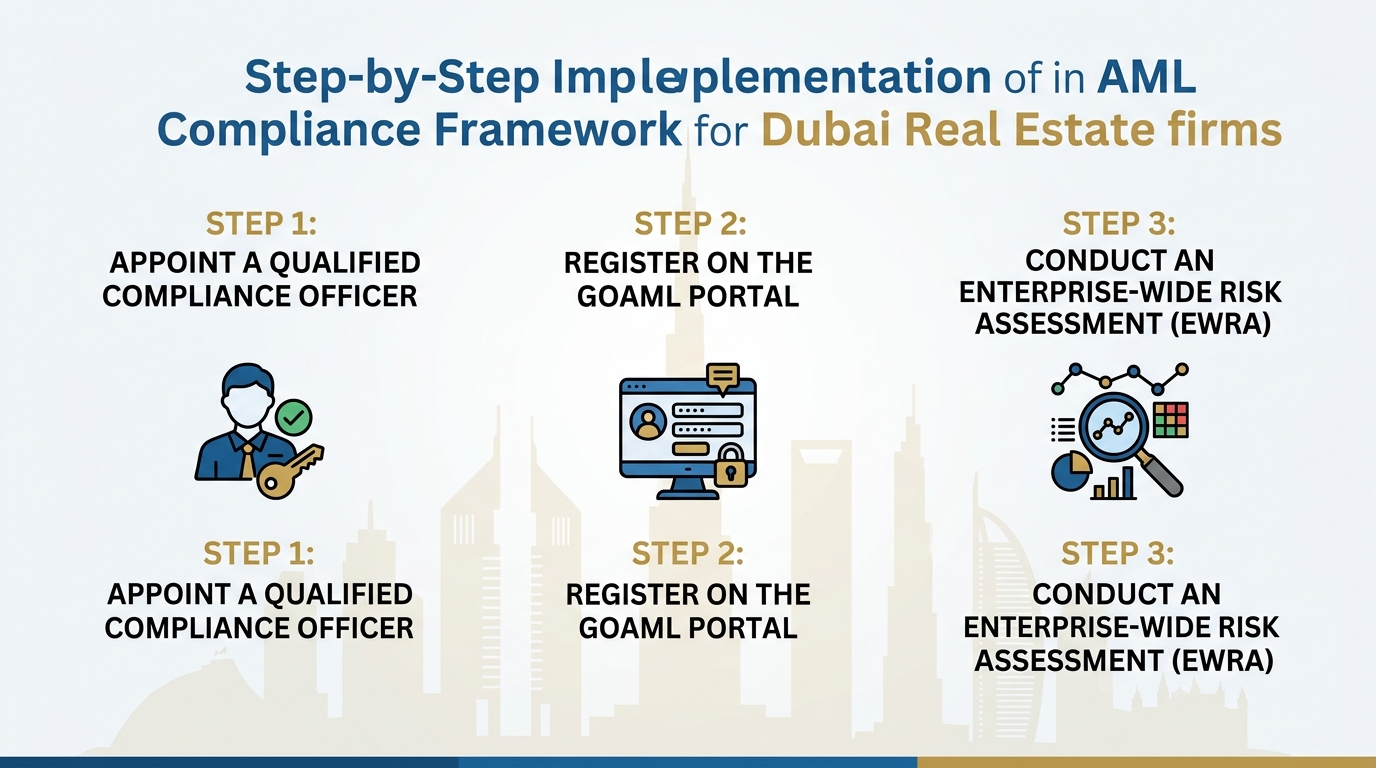
Establishing a compliant operational structure requires a systematic approach. Real estate firms in Dubai should follow these essential steps to build and maintain an effective AML compliance program:
Step 1: Appoint a Qualified Compliance Officer
Every real estate firm must appoint a dedicated AML Compliance Officer. This individual is responsible for overseeing the day-to-day compliance operations, updating internal policies, training staff, and acting as the primary liaison with the Ministry of Economy and the FIU. The Compliance Officer must possess the necessary expertise and authority to execute their duties independently.
Step 2: Register on the goAML Portal
The goAML portal is an integrated platform developed by the United Nations Office on Drugs and Crime (UNODC) and utilized by the UAE Financial Intelligence Unit. Real estate firms must complete their goAML registration Dubai to submit Suspicious Transaction Reports (STRs), Suspicious Activity Reports (SARs), and other mandatory threshold reports. Active monitoring of the goAML portal is required to receive regulatory updates and circulars.
Step 3: Conduct an Enterprise-Wide Risk Assessment (EWRA)
An AML risk assessment real estate firm-wide analysis is a mandatory requirement. The EWRA involves identifying, assessing, and understanding the specific money laundering and terrorist financing risks to which the business is exposed. Firms must evaluate risks associated with their customer base, geographic reach, services offered, and delivery channels. The findings of the EWRA must be documented and used to design risk-based mitigation strategies.
Step 4: Develop Internal Policies, Controls, and Procedures (PCPs)
Firms must draft a comprehensive AML/CFT manual that details the internal controls, procedures, and policies of the organization. This document must outline the CDD/EDD workflows, UBO identification processes, sanctions screening protocols, record-keeping policies (records must be kept for at least five years), and reporting mechanisms.
Step 5: Provide Ongoing Staff Training
Employees, particularly front-line sales agents and administrative staff, are the first line of defense against financial crime. Regular training programs must be conducted to ensure that all staff members understand the firm’s AML policies, can recognize red flags, and know how to escalate suspicious activities to the Compliance Officer.
Red Flags in Dubai Real Estate Transactions
Real estate professionals must remain vigilant for indicators of potential money laundering. The table below outlines common red flags that require immediate investigation and potential reporting:
| Red Flag Category | Specific Indicator | Required Action |
|---|---|---|
| Client Behavior | Client is reluctant to provide identity documents, UBO details, or source of wealth information. | Refuse transaction; conduct Enhanced Due Diligence; consider filing an SAR. |
| Payment Methods | Attempts to pay using large amounts of physical cash, multiple cashier’s checks, or virtual assets without clear justification. | Verify source of funds; submit a cash/virtual asset transaction report on goAML if thresholds are met. |
| Transaction Structure | Buying properties in the name of third parties, shell companies, or close relatives without a logical connection. | Identify the true Ultimate Beneficial Owner (UBO) and establish the relationship. |
| Pricing Discrepancies | Purchasing a property significantly above or below its market value, or rapid successive buying and selling (property flipping). | Investigate the economic rationale; document the findings; report if suspicious. |
Navigating Ministry of Economy Inspections
The Ministry of Economy regularly conducts on-site and off-site inspections of real estate firms in Dubai to verify compliance with federal AML laws. During an inspection, officers will review:
- The firm’s written AML/CFT policies and procedures manual.
- The Enterprise-Wide Risk Assessment (EWRA) documentation.
- Customer files to verify that CDD, EDD, and UBO verifications were performed correctly.
- Sanctions screening logs and evidence of goAML registration and reporting.
- Staff training records and certificates.
Firms that cannot produce these documents or demonstrate active compliance face immediate administrative sanctions. Working with an experienced compliance specialist ensures that your documentation is audit-ready and aligned with the latest regulatory expectations.
Deep-Dive: Practical CDD and EDD Workflows for Real Estate Brokers
To implement a truly robust compliance program, real estate firms must move beyond theoretical understanding and establish concrete, step-by-step workflows for Customer Due Diligence (CDD) and Enhanced Due Diligence (EDD). Given the high-velocity nature of the Dubai property market, these workflows must be both rigorous and efficient to avoid unnecessary transaction delays while maintaining absolute compliance.
The Standard CDD Workflow
For standard, low-to-medium-risk transactions (such as a local resident purchasing a residential property with funds drawn from a local UAE bank account), the CDD process should follow these structured steps:
- Initial Intake and Identification: Collect the buyer’s and seller’s full legal name, nationality, date of birth, residential address, and contact details. For individuals, obtain a high-resolution color copy of their valid passport and Emirates ID (if applicable).
- Verification of Identity: Cross-reference the provided identification documents against reliable, independent sources. For UAE residents, utilizing digital verification tools or checking the physical Emirates ID card is highly recommended.
- Corporate Entity Verification: If the buyer or seller is a corporate entity, obtain the trade license, certificate of incorporation, memorandum of association (MOA), and a register of directors and shareholders. Verify the active status of the company with the relevant licensing authority (e.g., Dubai Economy and Tourism, JAFZA, DMCC).
- UBO Identification: Trace the ownership structure of the corporate entity to identify any natural person who directly or indirectly holds 25% or more of the shares or voting rights. Document this structure clearly in the client file.
- Sanctions Screening: Run the names of all individuals, corporate entities, directors, and UBOs through your sanctions screening software to check against the UAE Local Terrorist List and the UN Security Council Consolidated List. Document the “no-match” result with a timestamped screenshot or system log.
The Enhanced Due Diligence (EDD) Workflow
When a transaction is flagged as high-risk—such as when dealing with a Politically Exposed Person (PEP), a client from a high-risk jurisdiction, or an unusually complex transaction structure—the compliance team must escalate the file to EDD. This involves the following additional measures:
- Establish Source of Wealth (SoW): Investigate how the client accumulated their total net worth. This requires gathering supporting documentation such as audited corporate financial statements, inheritance deeds, property sale agreements, or investment portfolio statements.
- Establish Source of Funds (SoF): Determine the origin of the specific funds being used for the transaction. This is typically verified through bank statements showing the accumulation and transfer of the purchase amount, or proof of a bank loan.
- Obtain Senior Management Approval: Before onboarding a high-risk client or executing a high-risk transaction, the Compliance Officer must present the findings to senior management and obtain formal, written sign-off to proceed.
- Continuous Monitoring: High-risk relationships must be subjected to more frequent reviews and ongoing transaction monitoring to ensure that the client’s activities remain consistent with their declared profile and source of wealth.
Understanding and Mitigating Risks in Virtual Asset Transactions
As Dubai positions itself as a global hub for digital assets, the intersection of real estate and cryptocurrency has become increasingly prominent. While purchasing property with virtual assets offers speed and flexibility, it also introduces unique money laundering risks that real estate developers and brokers must actively manage.
The Regulatory Stance on Crypto-to-Property Transactions
The UAE authorities do not prohibit the use of virtual assets for real estate transactions, but they subject them to strict reporting and verification requirements. Under the Ministry of Economy guidelines, any transaction where a property is purchased or sold using virtual assets must be reported to the Financial Intelligence Unit (FIU) via the goAML portal, regardless of the transaction value. This is a zero-threshold reporting requirement designed to ensure complete visibility over digital asset flows into the physical property market.
Key Compliance Steps for Virtual Asset Transactions
If your real estate firm decides to facilitate transactions involving virtual assets, you must implement the following specialized controls:
- Partner with Licensed Virtual Asset Service Providers (VASPs): Ensure that any exchange or custodian used to process the transaction is fully licensed by the Virtual Assets Regulatory Authority (VARA) in Dubai or the relevant federal authority.
- Conduct Blockchain Analytics: Utilize specialized blockchain analytics tools to trace the history of the digital wallet being used. This helps verify that the virtual assets do not originate from illicit sources, darknet markets, or sanctioned addresses.
- Verify Fiat Conversion: If the virtual assets are being converted to fiat currency (such as AED or USD) to complete the purchase, document the entire conversion process, including the bank accounts involved and the identity of the licensed intermediary performing the exchange.
- File a Real Estate Transaction Report (RETR): Submit the mandatory RETR on the goAML portal within the prescribed timeframe, detailing the wallet addresses, transaction hashes, fiat equivalents, and the identities of all parties involved.
The Consequences of Non-Compliance: Penalties and Reputational Risks
The UAE government maintains a zero-tolerance policy toward financial crime and non-compliance with AML/CFT regulations. The Ministry of Economy, in coordination with other regulatory bodies, actively enforces compliance through rigorous audits and the imposition of substantial penalties.
Administrative and Financial Penalties
Under Cabinet Decision No. 24 of 2021, DNFBPs—including real estate brokers and developers—face severe administrative penalties for failing to meet their AML obligations. Some of the standard penalties include:
- Failure to adopt internal AML policies and procedures: Fines ranging from AED 50,000 to AED 100,000.
- Failure to appoint a qualified Compliance Officer: Fines of AED 50,000.
- Failure to conduct an Enterprise-Wide Risk Assessment (EWRA): Fines of AED 50,000.
- Failure to perform Customer Due Diligence (CDD) or identify UBOs: Fines ranging from AED 100,000 to AED 200,000 per violation.
- Failure to report suspicious transactions or threshold transactions on goAML: Fines ranging from AED 50,000 to AED 100,000, alongside potential criminal prosecution.
In addition to financial penalties, the Ministry of Economy has the authority to suspend or revoke the trade license of non-compliant firms, publicly name and shame violating entities, and refer individuals to the public prosecution for criminal charges, which can carry prison sentences.
Reputational and Operational Impact
Beyond the immediate financial impact of fines, non-compliance can cause irreparable damage to a real estate firm’s reputation. In a highly competitive market like Dubai, trust is a critical asset. Public disclosure of AML violations can lead to:
- Loss of relationships with reputable developers, institutional investors, and high-net-worth clients.
- Termination of banking relationships, as local and international banks refuse to clear transactions for flagged or high-risk real estate firms.
- Difficulty in attracting and retaining top-tier sales talent and professional compliance staff.
Partnering with an AML Specialist in Dubai
Maintaining compliance in a fast-evolving regulatory landscape can be challenging for real estate brokerages and developers. Partnering with a specialized advisor helps mitigate risk while allowing you to focus on core business operations.
Tareq Badarin, a Dubai-based AML Compliance Specialist and Senior Compliance Analyst working within the framework of Farahat & Co., provides comprehensive, tailored compliance solutions. With deep expertise in the UAE regulatory environment, Tareq assists real estate firms in establishing robust AML frameworks, optimizing KYC/CDD workflows, conducting enterprise-wide risk assessments, and preparing for Ministry of Economy audits.
By leveraging professional advisory services, your firm can navigate complex regulatory demands with confidence, protect its reputation, and secure its position in Dubai’s competitive real estate market.
Secure Your Real Estate Compliance Today
Do not wait for a regulatory audit to discover gaps in your compliance framework. Contact Tareq Badarin today to discuss your real estate AML compliance needs, schedule an independent audit, or optimize your internal controls in partnership with Farahat & Co.
Frequently Asked Questions
Are real estate agents in Dubai considered DNFBPs?
Yes, under UAE AML legislation, real estate brokers, agents, and developers are classified as Designated Non-Financial Businesses and Professions (DNFBPs) and must comply with all federal AML/CFT regulations.
What is the cash transaction reporting threshold for Dubai real estate?
Real estate firms must report any physical cash transaction, or series of linked cash transactions, that are equal to or exceed AED 55,000 to the Financial Intelligence Unit via the goAML portal.
What happens if a real estate firm fails to comply with AML regulations in Dubai?
Non-compliant firms face severe administrative penalties, including fines ranging from AED 50,000 to AED 5,000,000, suspension or revocation of their business license, and potential criminal prosecution for serious violations.
How often should a real estate firm conduct an AML risk assessment?
Firms must conduct an Enterprise-Wide Risk Assessment (EWRA) regularly, typically on an annual basis, or whenever there are significant changes to their business model, customer base, or local regulations.