
In the rapidly evolving financial landscape of the United Arab Emirates, regulatory compliance is no longer just a legal obligation—it is a core pillar of operational excellence. For businesses operating in Dubai, particularly Designated Non-Financial Businesses and Professions (DNFBPs) such as real estate firms, corporate service providers (CSPs), legal consultants, and precious metals dealers, establishing robust identity verification protocols is critical. Achieving this balance requires specialized KYC and CDD optimization Dubai services that harmonize regulatory adherence with a seamless customer experience.
Under the supervision of the Ministry of Economy (MoE), the Central Bank of the UAE (CBUAE), and other licensing authorities, businesses must implement rigorous Know Your Customer (KYC) and Customer Due Diligence (CDD) procedures. However, manual, fragmented onboarding processes often lead to high customer abandonment rates, operational bottlenecks, and increased vulnerability to compliance failures. Optimizing these workflows ensures your business remains fully compliant with the latest UAE AML/CFT laws while maintaining competitive onboarding speeds.
Understanding KYC and CDD in the UAE Regulatory Framework
Before diving into optimization strategies, it is essential to understand the regulatory foundations that govern identity verification and risk assessment in the UAE. The legal framework, primarily driven by Federal Decree-Law No. 20 of 2018 on Anti-Money Laundering and Combating the Financing of Terrorism and Financing of Illegal Organisations, along with its subsequent amendments and executive regulations, mandates a risk-based approach to customer onboarding.
In Dubai, regulatory bodies such as the Dubai Financial Services Authority (DFSA) for the Dubai International Financial Centre (DIFC), and the Financial Services Regulatory Authority (FSRA) for Abu Dhabi Global Market (ADGM), alongside the Ministry of Economy for onshore DNFBPs, enforce strict guidelines. These guidelines require businesses to establish the true identity of their clients, understand the nature of their business, and continuously monitor transactions to detect and report suspicious activities via the goAML portal.
The Three Levels of Customer Due Diligence
The UAE AML framework categorizes customer due diligence into three distinct levels, depending on the risk profile of the client, business relationship, or transaction:
- Simplified Due Diligence (SDD): Applied when the risk of money laundering or terrorist financing is identified as low. This involves basic identity verification and is typically reserved for publicly listed companies, government entities, or regulated financial institutions. Even under SDD, firms must ensure that the low-risk classification remains valid throughout the relationship.
- Standard Customer Due Diligence (CDD): The baseline requirement for most business relationships. It involves identifying the customer, verifying their identity using independent source documents, and identifying the Ultimate Beneficial Owner (UBO). This requires obtaining valid passports, Emirates IDs, trade licenses, and corporate resolution documents.
- Enhanced Due Diligence (EDD): Mandated for high-risk customers, such as Politically Exposed Persons (PEPs), clients from high-risk jurisdictions, or complex corporate structures with no apparent economic purpose. EDD requires obtaining additional information regarding the source of wealth, source of funds, and senior management approval before establishing the business relationship.
Optimizing these processes involves establishing clear, automated triggers that transition a customer seamlessly from Standard CDD to EDD without stalling the onboarding pipeline.
The Operational Challenges of Legacy KYC/CDD Systems
Many firms in Dubai still rely on legacy, manual onboarding processes. These outdated methods introduce significant operational risks and inefficiencies, including:
| Operational Challenge | Impact on Business | Compliance Risk |
|---|---|---|
| Manual Document Collection | Slow onboarding times, high customer friction, and administrative fatigue. | Increased risk of accepting forged or altered identification documents. |
| Inconsistent Risk Scoring | Subjective assessments by different staff members leading to inconsistent compliance standards. | Failure to identify high-risk clients or apply Enhanced Due Diligence (EDD) appropriately. |
| Siloed Data Systems | Inability to share risk intelligence across departments or branches. | Missed red flags during ongoing transaction monitoring. |
| Poor UBO Identification | Difficulty tracing complex corporate ownership structures, especially involving offshore entities. | Non-compliance with UAE UBO disclosure regulations, leading to severe penalties. |
The Cost of Inefficiency
Beyond regulatory penalties, inefficient KYC/CDD processes carry heavy hidden costs. When a real estate transaction or corporate setup is delayed due to slow compliance checks, high-net-worth individuals (HNWIs) and foreign investors may take their capital elsewhere. In a fast-paced market like Dubai, speed to market is a critical differentiator. Manual compliance processes also inflate operational overhead, requiring larger teams to process paperwork that could easily be handled by automated systems.
Key Pillars of KYC and CDD Optimization
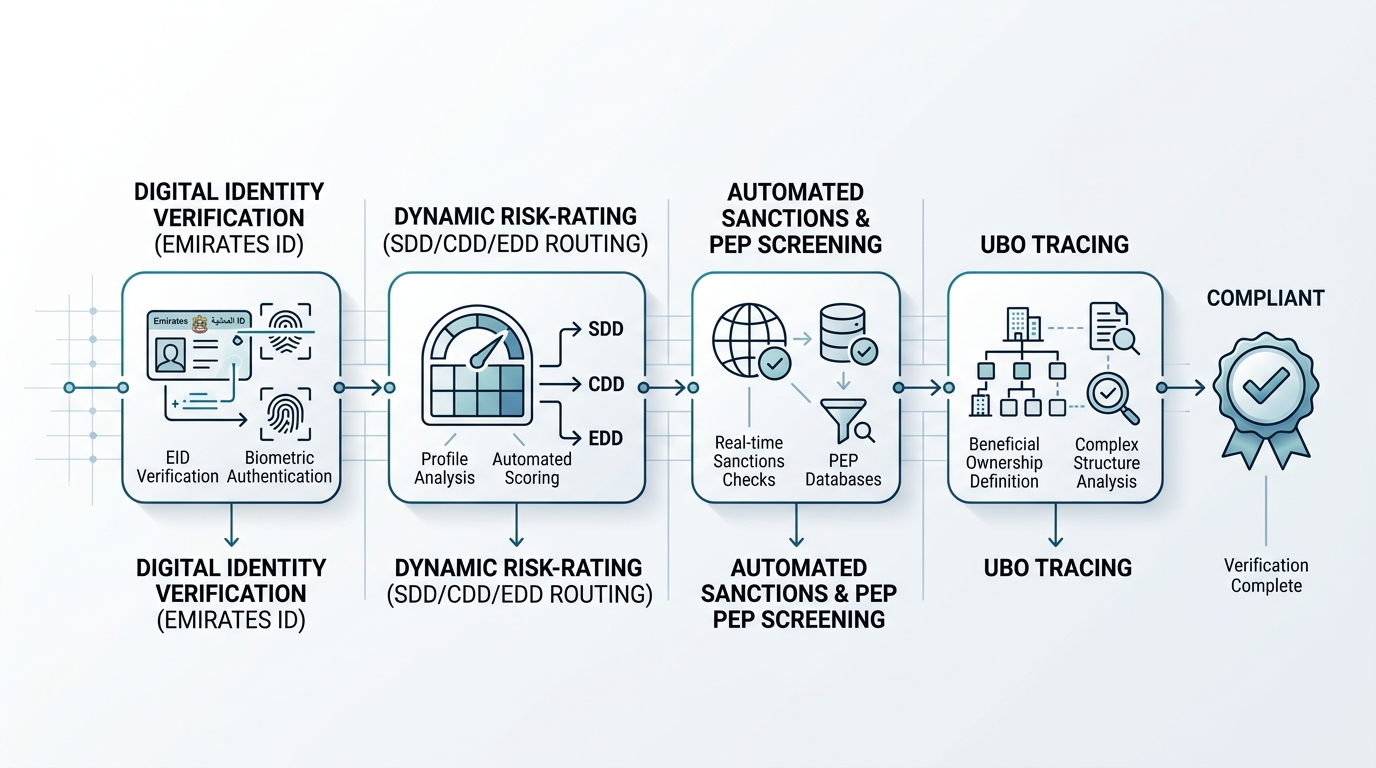
To transform compliance from a bottleneck into a competitive advantage, businesses must optimize their KYC and CDD workflows. This optimization relies on four core pillars: technology integration, risk-based calibration, structured UBO tracing, and continuous staff training.
1. Digital Identity Verification and Integration
Leveraging modern digital identity solutions is the cornerstone of optimization. In the UAE, integrating systems with the UAE Pass and verified government registries allows for instant identity verification of UAE residents. For international clients, integrating optical character recognition (OCR) and biometric liveness detection tools ensures that passports and national IDs are verified in real-time, reducing manual data entry errors and preventing identity fraud.
2. Dynamic Risk-Rating Engines
Instead of relying on static spreadsheets, optimized compliance programs utilize dynamic risk-rating engines. By defining clear, objective risk parameters—such as geographic location, industry sector, delivery channel, and transaction types—the system automatically assigns an initial risk score to each client. This automation ensures that high-risk profiles are instantly routed for Enhanced Due Diligence (EDD) and senior management sign-off, while low-risk clients proceed through an expedited onboarding path.
3. Streamlined Ultimate Beneficial Ownership (UBO) Tracing
Identifying the natural persons who ultimately own or control a legal entity is one of the most complex aspects of CDD. Optimization involves utilizing corporate registry aggregators and visual ownership mapping tools. These tools help compliance officers trace complex multi-layered corporate structures back to the individual beneficial owners holding 25% or more of the shares or voting rights, in strict accordance with UAE Cabinet Decision No. (109) of 2023 on the Regulation of Beneficial Owner Procedures.
4. Automated Sanctions and PEP Screening
Real-time screening against local and international sanctions lists (including the UAE Local Terrorist List and the UN Security Council Consolidated List) is non-negotiable. Optimized systems integrate automated screening tools that run background checks during onboarding and continue to monitor the client database daily for any changes in PEP status or sanctions designations, minimizing false positives through advanced fuzzy matching algorithms.
Step-by-Step Guide to Optimizing Your KYC/CDD Workflow
Implementing an optimized KYC and CDD framework requires a structured approach. Below is a practical roadmap designed for Dubai-based businesses looking to upgrade their compliance operations:
Step 1: Conduct a Gap Analysis
Begin by reviewing your current onboarding workflow. Identify where delays occur, where manual intervention is heavily required, and where compliance gaps exist. Document the average time to onboard a client and identify the primary drop-off points. Analyze past audit findings and regulatory feedback to pinpoint specific areas of weakness.
Step 2: Update the AML/CFT Policies and Procedures
Your operational workflows must align with your written policies. Update your AML/CFT manual to reflect the optimized processes, clearly defining the thresholds for SDD, CDD, and EDD, as well as the specific technology tools utilized for verification. Ensure these policies are approved by senior management and communicated clearly to all stakeholders.
Step 3: Implement a Tiered Onboarding Journey
Design a user-friendly onboarding portal that requests information progressively. For example, collect basic corporate details first, automatically run a registry search, and then request specific UBO documentation only as required by the corporate structure. This prevents overwhelming the client with document requests at the start of the relationship.
Step 4: Integrate Transaction Monitoring
KYC and CDD are not one-time events. The information gathered during onboarding must feed directly into your transaction monitoring systems. This ensures that the actual transaction behavior of the client is continuously compared against their declared source of wealth and expected transaction profile. Any deviation should trigger an automated alert for review.
Step 5: Regular Audits and System Calibration
Regularly audit your optimized systems to ensure they are functioning correctly. Calibrate screening thresholds to reduce false positives while ensuring no actual matches are missed. Independent AML audits are essential to validate the effectiveness of your optimized controls and demonstrate compliance to regulatory authorities.
The Role of Technology in Modern Compliance
Technology is the primary driver of KYC and CDD optimization. By transitioning from manual, paper-based processes to digital compliance platforms, businesses can achieve significant improvements in both efficiency and accuracy. Key technological solutions include:
- Artificial Intelligence (AI) and Machine Learning (ML): AI-driven tools can analyze vast amounts of unstructured data to identify patterns and anomalies that may indicate financial crime. ML algorithms can also help reduce false positives in sanctions screening by learning from historical decisions.
- Application Programming Interfaces (APIs): APIs enable seamless integration between your customer relationship management (CRM) systems, core business platforms, and third-party compliance databases, ensuring real-time data flow and reducing manual data entry.
- Cloud-Based Compliance Platforms: Cloud solutions offer scalability, flexibility, and secure data storage, allowing compliance teams to access critical information and perform checks from anywhere, which is particularly beneficial for businesses with multiple branches or remote teams.
Risk Considerations and Mitigation Strategies
While optimizing your KYC and CDD processes offers numerous benefits, it also introduces certain risks that must be carefully managed. Below are key risk considerations and strategies to mitigate them:
Data Privacy and Security Risks
Collecting and storing sensitive personal and corporate data increases the risk of data breaches and cyberattacks. To mitigate this risk, businesses must ensure compliance with the UAE Federal Decree-Law No. 45 of 2021 on Personal Data Protection (PDPL). Implement robust encryption protocols, access controls, and regular security audits to protect client data.
Over-Reliance on Technology
While automation improves efficiency, over-reliance on technology without human oversight can lead to missed red flags or false senses of security. To mitigate this, establish a hybrid approach where automated systems handle routine checks and flag high-risk cases, while experienced compliance officers conduct detailed reviews and make final decisions on complex cases.
Regulatory Change Risk
The regulatory landscape in the UAE and globally is constantly evolving. An optimized system that is compliant today may become non-compliant tomorrow if it is not updated. To mitigate this, establish a process for continuous regulatory monitoring and ensure your compliance systems and policies are flexible enough to adapt quickly to new laws and guidelines.
Why Partner with an AML Compliance Specialist in Dubai?
Navigating the complexities of UAE AML regulations while maintaining operational efficiency requires deep domain expertise. As an AML Compliance Specialist working within the framework of Farahat & Co., Tareq Badarin provides tailored advisory services to help businesses design, implement, and optimize their KYC and CDD frameworks.
From selecting the right compliance technology vendors and drafting robust policies to conducting enterprise-wide risk assessments and training compliance teams, professional advisory ensures your business remains fully compliant, resilient against financial crime, and optimized for growth.
Tailored Solutions for Diverse Sectors
Different industries face unique compliance challenges. A one-size-fits-all approach to KYC and CDD is rarely effective. For instance, real estate firms in Dubai must navigate complex property transactions involving high-value cash payments or virtual assets, requiring specialized risk assessment protocols. Corporate Service Providers (CSPs), on the other hand, must manage risks associated with company formation and nominee services. Partnering with a specialist ensures your compliance framework is tailored to the specific risks and regulatory requirements of your industry.
Secure and Streamline Your Business Operations Today
Do not let inefficient compliance processes slow down your business growth or expose you to regulatory penalties. Optimize your KYC and CDD workflows to achieve seamless customer onboarding and flawless regulatory compliance in the UAE.
Contact Tareq Badarin today to schedule a comprehensive consultation and discover how tailored KYC and CDD optimization services can safeguard your business reputation and drive operational efficiency.
Frequently Asked Questions
What is the difference between KYC and CDD in the UAE?
KYC (Know Your Customer) is the initial process of identifying and verifying a customer's identity using independent source documents. CDD (Customer Due Diligence) is a broader process that includes KYC but also involves understanding the nature of the customer's business, identifying the Ultimate Beneficial Owner (UBO), and assessing the overall money laundering or terrorist financing risk associated with the business relationship.
Who is considered an Ultimate Beneficial Owner (UBO) under UAE law?
Under UAE Cabinet Decision No. (109) of 2023, a UBO is any natural person who ultimately owns or controls, directly or indirectly, 25% or more of the physical shares or voting rights of a legal entity, or who exercises ultimate control over the management of the company through other means.
When is Enhanced Due Diligence (EDD) required in Dubai?
EDD is required when a business relationship or transaction is identified as presenting a high risk of money laundering or terrorist financing. This includes onboarding Politically Exposed Persons (PEPs), clients from high-risk jurisdictions identified by the FATF, complex corporate structures with no clear economic purpose, or transactions involving high-value assets like luxury real estate.
How does KYC and CDD optimization improve customer onboarding?
Optimization replaces manual, repetitive document collection with digital identity verification, automated risk scoring, and integrated screening databases. This significantly reduces onboarding times, minimizes human error, lowers customer drop-off rates, and ensures consistent compliance with UAE regulatory standards.