
In the rapidly evolving financial landscape of the United Arab Emirates, maintaining a robust anti-money laundering (AML) framework is no longer just a regulatory formality—it is a core pillar of operational integrity and business sustainability. As Dubai solidifies its position as a premier global financial and commercial hub, regulatory oversight from authorities such as the Ministry of Economy, the Central Bank of the UAE (CBUAE), and the Dubai Financial Services Authority (DFSA) has intensified. For Designated Non-Financial Businesses and Professions (DNFBPs)—including real estate firms, corporate service providers (CSPs), precious metals dealers, and legal professionals—securing independent AML audit services Dubai is a critical step to verify compliance, avoid severe financial penalties, and protect corporate reputation.
An independent AML audit serves as an objective, third-party evaluation of an organization’s compliance program. It tests the design, implementation, and operational effectiveness of internal controls, risk assessment methodologies, transaction monitoring systems, and staff training protocols. By identifying vulnerabilities before regulators do, businesses can proactively remediate gaps and align their operations with Federal Decree-Law No. 20 of 2018 on Anti-Money Laundering and Combating the Financing of Terrorism (AML/CFT) and its subsequent amendments, including Federal Decree-Law No. 10 of 2025.
The Regulatory Mandate for AML Audits in the UAE
The UAE regulatory framework explicitly mandates that financial institutions and DNFBPs subject their AML/CFT programs to regular, independent testing. This requirement ensures that policies are not merely static documents on a shelf but active, effective mechanisms capable of detecting and preventing illicit financial flows. The regulatory landscape has shifted from passive compliance to active enforcement, with supervisory bodies conducting on-site and off-site inspections to verify that independent testing is actually occurring.
Who Requires an Independent AML Audit?
The obligation to conduct independent AML audits spans multiple sectors across Dubai and the wider UAE. The primary entities required to undergo these reviews include:
- Real Estate Agents and Brokers: Particularly those involved in high-value property transactions, cash transactions, or transactions involving virtual assets. Real estate is historically a high-risk sector for capital placement, making independent verification of buyer profiles essential.
- Corporate Service Providers (CSPs): Entities offering company formation, directorship, or registered office services, which are highly scrutinized for Ultimate Beneficial Ownership (UBO) transparency and shell company prevention.
- Dealers in Precious Metals and Stones (DPMS): Businesses handling high-value cash transactions or trading in physical commodities, which are highly susceptible to alternative remittance systems and physical wealth transfer.
- Independent Legal Professionals and Accountants: Firms managing client funds, purchasing real estate, or organizing contributions for company creation, where professional privilege must not be misused to obscure illicit origins.
- Financial Institutions: Including banks, exchange houses, payment service providers, and investment firms regulated by the CBUAE or DFSA, which form the primary line of defense in the financial system.
Legal Consequences of Non-Compliance
The Ministry of Economy and other supervisory bodies in the UAE have demonstrated a zero-tolerance policy toward AML compliance failures. Non-compliance can lead to severe administrative and criminal penalties, including:
| Violation Type | Potential Administrative Penalty / Action |
|---|---|
| Failure to appoint a qualified Compliance Officer | AED 50,000 to AED 100,000 fine |
| Failure to conduct an Enterprise-Wide Risk Assessment (EWRA) | AED 50,000 to AED 100,000 fine |
| Failure to perform adequate Customer Due Diligence (CDD/EDD) | AED 100,000 to AED 200,000 fine |
| Failure to establish independent audit functions to test AML systems | AED 50,000 to AED 100,000 fine |
| Repeated or systemic compliance failures | Suspension of business license, closure of operations, or public blacklisting |
Beyond these structured fines, businesses face the risk of reputational damage that can lead to the loss of correspondent banking relationships, the termination of local corporate bank accounts, and the inability to attract foreign investment. In Dubai’s highly competitive market, a public regulatory sanction can be fatal to business operations.
Key Components of a Comprehensive AML Audit
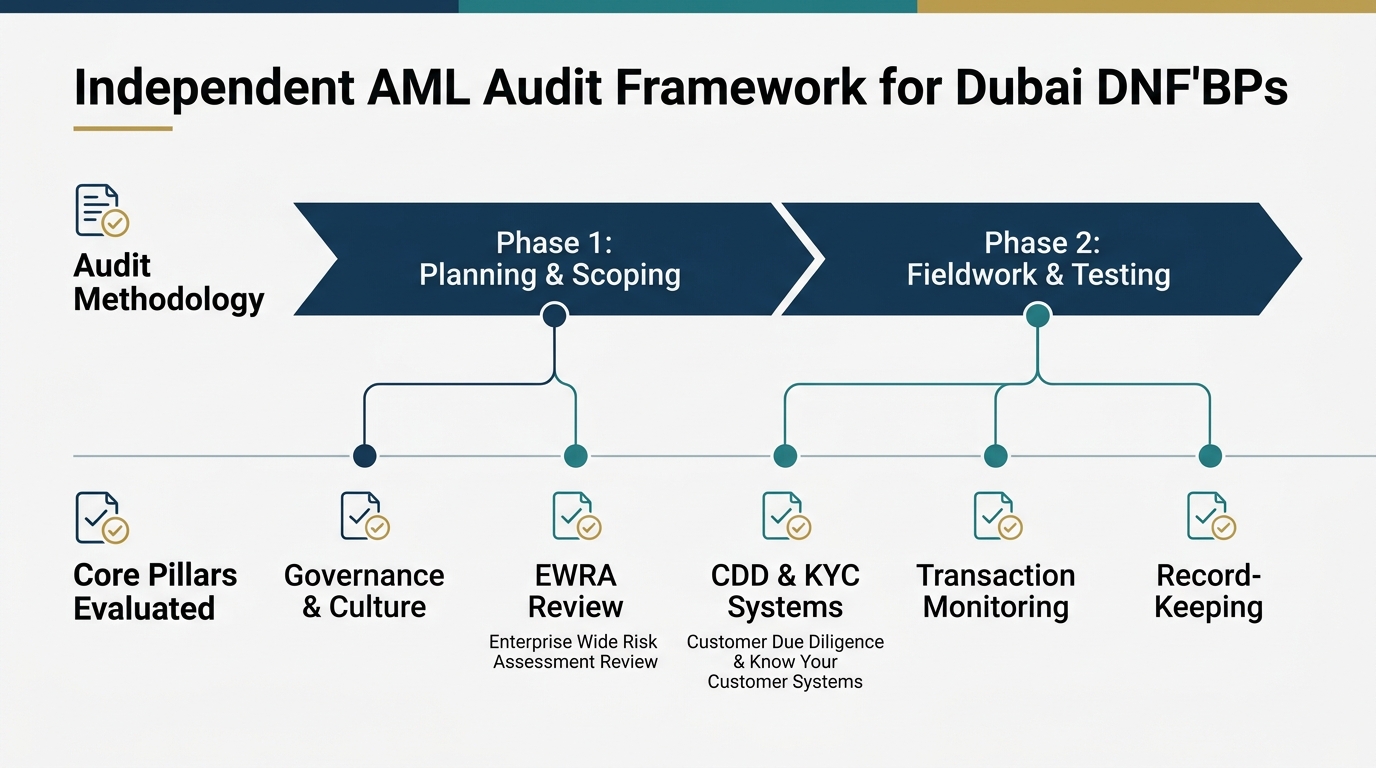
A robust AML audit must be systematic, risk-based, and tailored to the specific operational profile of the business. It goes beyond a simple checklist to analyze how well the compliance framework functions under real-world conditions. A standard, high-quality independent AML review covers several core pillars.
1. Governance and the Compliance Culture
The audit begins with an assessment of the “tone from the top.” Auditors evaluate whether senior management actively supports the compliance function and provides adequate resources. This includes reviewing the qualifications, independence, and authority of the appointed AML Compliance Officer, as well as the frequency and quality of compliance reporting to the Board of Directors. The auditor will look for evidence that compliance is integrated into the business strategy rather than treated as an isolated administrative hurdle.
2. Enterprise-Wide Risk Assessment (EWRA) Review
An organization’s AML policies must be grounded in a thorough understanding of its specific risks. The audit evaluates the Enterprise-Wide Risk Assessment to ensure it accurately identifies, measures, and mitigates risks associated with:
- Customers: High-net-worth individuals, Politically Exposed Persons (PEPs), and clients from high-risk jurisdictions.
- Geographies: Transactions involving countries subject to sanctions or identified as having strategic AML deficiencies by international bodies like the FATF.
- Products and Services: Complex corporate structures, cash-intensive services, or anonymous transaction methods.
- Delivery Channels: Non-face-to-face onboarding, online platforms, or reliance on third-party intermediaries.
The auditor will verify if the EWRA is updated at least annually or whenever significant changes occur in the business model, regulatory environment, or operational footprint.
3. Customer Due Diligence (CDD) and Know Your Customer (KYC) Systems
Auditors perform sample testing on client files to verify that Customer Due Diligence (CDD) and Enhanced Due Diligence (EDD) procedures are executed correctly. This testing checks whether:
- Ultimate Beneficial Owners (UBOs) are properly identified and verified using reliable independent sources down to the natural person level (typically a threshold of 25% or more ownership).
- The source of funds (SoF) and source of wealth (SoW) are documented and verified with supporting evidence for high-risk relationships.
- Sanctions screening is conducted against local and international watchlists (such as the UAE Local Terrorist List and UN Consolidated List) prior to onboarding and on an ongoing basis.
- Client risk ratings are dynamically updated based on changing transaction patterns or profiles.
4. Transaction Monitoring and Suspicious Activity Reporting (SAR)
The audit examines the mechanisms used to detect unusual or suspicious transaction patterns. This involves reviewing the rules and thresholds established in transaction monitoring systems, assessing how alerts are investigated, and verifying that Suspicious Activity Reports (SARs) or Suspicious Transaction Reports (STRs) are promptly submitted to the Financial Intelligence Unit (FIU) via the integrated goAML portal. The auditor will also review the quality of the narrative in submitted reports and the timeline of submission from the moment of detection.
5. Record-Keeping and Data Privacy
Under UAE law, compliance records must be maintained securely for a minimum of five years from the date of transaction completion or the termination of the business relationship. The audit verifies that all KYC documents, transaction records, risk assessments, and training logs are archived systematically and are easily retrievable for regulatory inspections. This also includes ensuring that data protection laws, such as the DIFC Data Protection Law or UAE Federal Decree-Law No. 45 of 2021 on Personal Data Protection, are respected during the collection and storage of sensitive client information.
The Step-by-Step AML Audit Methodology
Executing an effective AML audit requires a structured methodology to ensure all regulatory expectations are met without disrupting daily business operations. The process typically follows four distinct phases:
Phase 1: Planning and Scoping
The audit team collaborates with the business to define the scope of the review based on the size, complexity, and risk profile of the organization. During this phase, the auditors gather preliminary documentation, including existing AML/CFT policies, previous audit reports, regulatory correspondence, and organizational charts. This phase establishes the baseline and ensures the audit targets the areas of highest risk.
Phase 2: Fieldwork and Testing
This is the core operational phase of the audit. The audit team conducts interviews with key personnel, tests transaction monitoring systems, reviews sample client files (KYC/CDD), and evaluates the implementation of Targeted Financial Sanctions (TFS) screening. The goal is to verify that actual practices align with written policies. Auditors will perform “walkthroughs” of key processes to observe how compliance staff handle real-time alerts and exceptions.
Phase 3: Reporting and Gap Analysis
Upon completing the fieldwork, the auditors compile their findings into a detailed draft report. This report highlights areas of compliance strength, identifies specific regulatory gaps or operational weaknesses, and provides actionable, prioritized recommendations for remediation. The findings are typically categorized by risk level (High, Medium, Low) to help management allocate resources effectively.
Phase 4: Remediation and Follow-Up
The business develops a remediation plan to address the identified gaps. A follow-up review may be scheduled to verify that the corrective actions have been successfully implemented and that the AML framework is fully optimized. This phase is critical for demonstrating to regulators that the business takes audit findings seriously and is committed to continuous improvement.
Practical Risk Considerations and Common Audit Pitfalls
When preparing for an independent AML audit, businesses in Dubai often encounter common pitfalls that can lead to unfavorable audit findings. Understanding these risks allows compliance officers to address them proactively:
- Over-Reliance on Automated Systems: Many firms assume that purchasing expensive compliance software solves all AML issues. However, if the software is not calibrated to the specific risk profile of the business, it can generate excessive false positives or, worse, fail to detect actual red flags. Auditors will test the calibration and logic of these systems.
- Inadequate Training Documentation: While staff may receive informal guidance, regulators and auditors require formal, documented proof of AML training. This includes training materials, attendance logs, and assessment scores to prove that employees understand their obligations under UAE law.
- Outdated Policies: Using generic templates or failing to update policies to reflect recent regulatory updates (such as changes in UBO reporting requirements or new sanctions lists) is a major red flag. Policies must be dynamic and reflective of current UAE legislation.
- Incomplete UBO Verification: Simply obtaining a trade license is not enough. Auditors look for deep verification of corporate structures, especially when dealing with complex offshore entities or trust arrangements.
Why Partner with a Dubai-Based AML Specialist?
While generic audit firms can review financial statements, specialized AML compliance advisory requires deep domain expertise and localized knowledge of the UAE regulatory landscape. Partnering with an expert who understands the nuances of local supervisory bodies—such as the Ministry of Economy, the CBUAE, and the Dubai multi-commodities centers—offers distinct advantages:
- Local Regulatory Alignment: Direct experience navigating the specific expectations of UAE regulators, including goAML system integration and Targeted Financial Sanctions (TFS) compliance.
- Industry-Specific Insights: Tailored audit programs designed specifically for high-risk sectors like Dubai real estate, corporate services, and financial institutions.
- Practical Remediation: Recommendations that are not just theoretical but highly practical, helping you optimize workflows, refine KYC processes, and select the right compliance technology.
- Strategic Partnership: Access to ongoing advisory support, ensuring your business remains resilient against regulatory changes and emerging financial crime trends.
Secure Your Business with Expert AML Audit Services
Maintaining regulatory compliance should not be a burden that slows down your business growth. Instead, a robust, independently audited AML framework serves as a competitive advantage, demonstrating to investors, banking partners, and regulators that your organization operates with the highest standards of transparency and integrity.
As an AML Compliance Specialist operating in Dubai, Tareq Badarin, in collaboration with Farahat & Co., provides comprehensive, independent AML audit services, Enterprise-Wide Risk Assessments, and KYC/CDD optimization tailored to your business needs. Protect your business reputation and ensure seamless compliance in the UAE market by scheduling a professional consultation today.
Frequently Asked Questions
How often should a business in Dubai conduct an independent AML audit?
In the UAE, it is highly recommended—and often mandated by specific regulators—to conduct an independent AML audit annually. Regular reviews ensure that your compliance framework adapts to operational changes and updated regulatory requirements.
What is the difference between an internal AML review and an independent AML audit?
An internal AML review is conducted by the in-house compliance officer or internal team to monitor daily operations. An independent AML audit must be performed by an objective, qualified third-party specialist or external auditor who has no involvement in the development or daily operation of the AML program.
Are real estate agencies in Dubai required to undergo AML audits?
Yes, real estate agents and brokers in the UAE are classified as Designated Non-Financial Businesses and Professions (DNFBPs). They are strictly regulated by the Ministry of Economy and are required to establish independent audit functions to test their AML compliance frameworks.
What documents are typically reviewed during an AML audit?
Auditors typically review the Enterprise-Wide Risk Assessment (EWRA), AML/CFT policies and procedures manuals, customer KYC/CDD files, transaction monitoring logs, suspicious activity reports (SARs) submitted via goAML, staff training records, and sanctions screening logs.