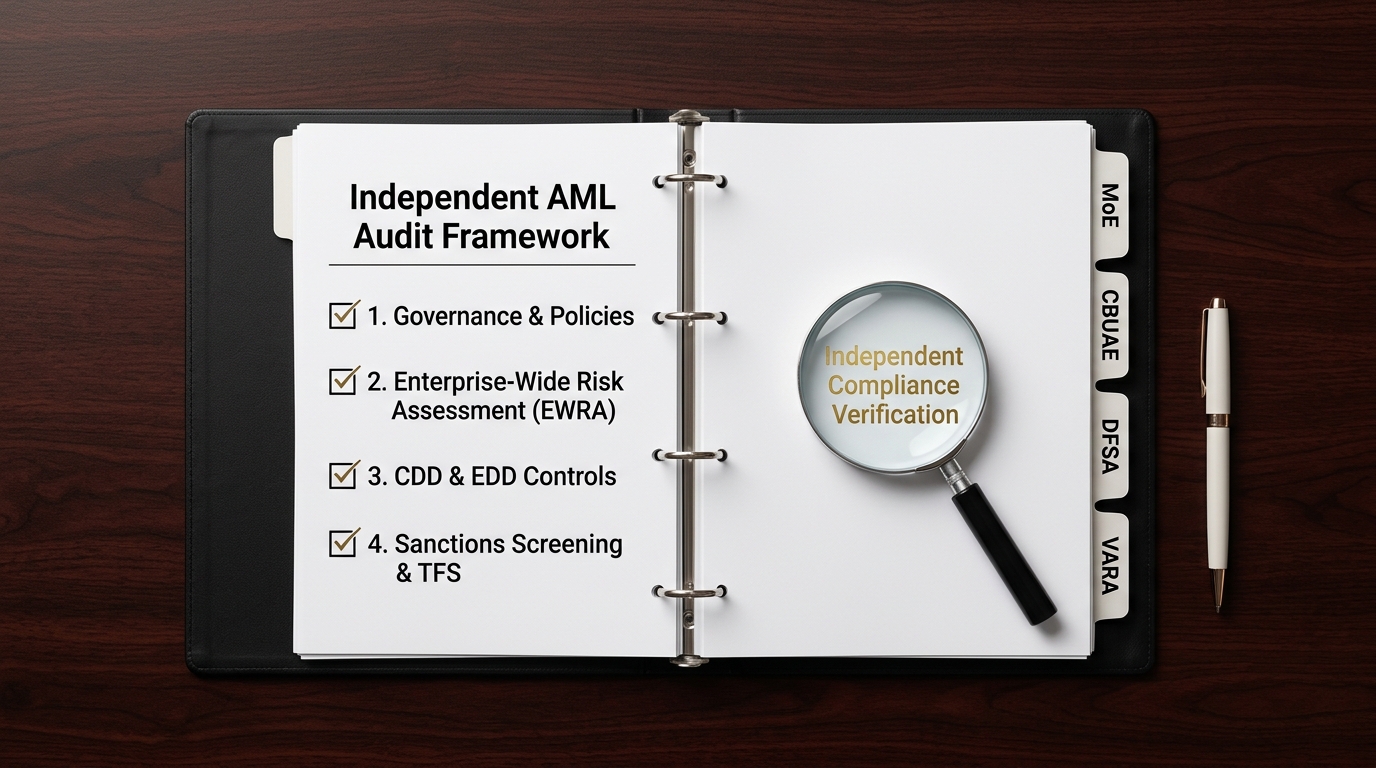

In the rapidly evolving regulatory landscape of the United Arab Emirates, maintaining a robust anti-money laundering (AML) and counter-terrorism financing (CFT) framework is no longer just a operational best practice—it is a strict legal mandate. For businesses operating in Dubai, particularly Designated Non-Financial Businesses and Professions (DNFBPs) and financial institutions, an independent AML audit Dubai serves as the ultimate mechanism to validate compliance integrity, identify systemic vulnerabilities, and satisfy federal regulatory authorities.
The UAE government, through the Ministry of Economy (MoE), the Central Bank of the UAE (CBUAE), and other licensing authorities, has intensified its supervisory oversight. Under the executive regulations of the UAE AML law, obligated entities must subject their compliance programs to regular, independent testing. This comprehensive guide explores the legal foundations, core components, step-by-step methodologies, and strategic benefits of undergoing an independent AML compliance review in Dubai.
Understanding the Mandate for an Independent AML Audit in Dubai
An independent AML audit is an objective, third-party evaluation of an organization’s AML/CFT policies, procedures, systems, and internal controls. Unlike internal compliance monitoring, which is conducted by the in-house compliance officer or internal audit team, an independent audit must be executed by a qualified, external specialist or an independent internal department that does not oversee the day-to-day compliance operations.
The Legal Basis: Cabinet Decision No. (10) of 2019 and Decree-Laws
The requirement for independent compliance testing is explicitly anchored in UAE legislation. Specifically, Article 20 of Cabinet Decision No. (10) of 2019 Concerning the Implementing Regulation of Decree-Law No. (20) of 2018 on Facing Money Laundering and Combating the Financing of Terrorism and Illegal Organisations mandates that financial institutions and DNFBPs must put in place an independent audit function to test the effectiveness and adequacy of their internal policies, controls, and procedures.
With the introduction of Federal Decree-Law No. 10 of 2025, the UAE has further aligned its national standards with the Financial Action Task Force (FATF) recommendations. Regulatory bodies now demand higher accountability, making regular independent audits a critical shield against severe administrative penalties, license revocations, and criminal prosecution.
Regulatory Authorities Overseeing Compliance
Depending on the nature of the business and its jurisdiction within Dubai, different regulatory bodies oversee the implementation of AML audits:
- The Ministry of Economy (MoE): Supervises DNFBPs across the mainland and non-financial free zones, including real estate brokers, corporate service providers, gold and precious stone dealers, and independent auditors.
- The Central Bank of the UAE (CBUAE): Regulates banks, exchange houses, finance companies, and other payment service providers.
- The Dubai Financial Services Authority (DFSA): Oversees financial institutions and DNFBPs operating within the Dubai International Financial Centre (DIFC).
- The Virtual Assets Regulatory Authority (VARA): Regulates virtual asset service providers (VASPs) operating in Dubai (excluding DIFC).
Who is Required to Undergo an Independent AML Audit?
The obligation to conduct independent AML testing applies to two primary categories of businesses in the UAE: Financial Institutions and Designated Non-Financial Businesses and Professions (DNFBPs). In Dubai’s commercial ecosystem, DNFBPs face significant scrutiny due to the high volume of high-value transactions, particularly in real estate and corporate structuring.
1. Designated Non-Financial Businesses and Professions (DNFBPs)
DNFBPs are highly vulnerable to money laundering risks and are subject to strict supervision by the Ministry of Economy. The following sectors must regularly commission an independent AML audit:
- Real Estate Agents and Brokers: When they engage in transactions for their clients concerning the buying and selling of real estate.
- Dealers in Precious Metals and Stones (DPMS): Anyone carrying out single cash transactions or several linked transactions equal to or exceeding AED 55,000.
- Independent Legal Practitioners and Accountants: When preparing, executing, or conducting transactions for clients related to buying/selling real estate, managing client money/assets, or managing bank accounts.
- Trust and Company Service Providers (TCSPs) / Corporate Service Providers (CSPs): Entities providing services such as acting as a formation agent, acting as a director or secretary of a company, or providing a registered office.
2. Financial Institutions (FIs)
This category includes commercial banks, investment banks, brokerage firms, insurance companies, and money remittance providers. Given the systemic risk they pose to the financial sector, their independent audits are highly structured and must align with the specific guidelines issued by the CBUAE or DFSA.
Core Objectives of an Independent AML Compliance Review
An independent AML audit in Dubai is not merely a box-ticking exercise to satisfy regulators. It is a strategic diagnostic tool designed to achieve several critical objectives:
- Assess Regulatory Alignment: Verify that the company’s AML/CFT manual, policies, and procedures are fully compliant with the latest UAE federal laws, cabinet decisions, and regulatory circulars.
- Evaluate System Effectiveness: Test whether the practical implementation of compliance controls matches the written policies. This includes evaluating transaction monitoring systems, sanctions screening tools, and the goAML reporting workflow.
- Identify Control Gaps: Uncover operational deficiencies, outdated risk assessments, or inadequate staff training before regulatory inspectors discover them.
- Validate Risk Methodology: Ensure that the Enterprise-Wide Risk Assessment (EWRA) accurately reflects the business’s actual risk profile, client base, geographic reach, and delivery channels.
- Provide Actionable Remediation: Deliver a clear, prioritized roadmap to rectify identified weaknesses, enhancing the overall compliance posture of the organization.
Key Components of a Comprehensive AML Audit Framework
A robust independent AML audit must cover all aspects of an organization’s compliance infrastructure. A standard audit program in Dubai evaluates the following six core pillars:
1. Governance, Policies, and Procedures
The auditor reviews the corporate governance structure to ensure clear lines of accountability. This includes assessing the appointment, qualifications, and independence of the AML Compliance Officer. The written AML/CFT policy manual is analyzed to ensure it is updated in accordance with recent legislative changes, such as the integration of Targeted Financial Sanctions (TFS) and Proliferation Financing (PF) controls.
2. Enterprise-Wide Risk Assessment (EWRA)
The EWRA is the foundation of a risk-based compliance program. The independent auditor evaluates the methodology used to identify, assess, and mitigate risks across various risk categories, including:
- Customer risk (e.g., Politically Exposed Persons, high-net-worth individuals).
- Geographic risk (e.g., transactions involving high-risk jurisdictions).
- Product, service, and transaction risk (e.g., cash-intensive services, complex corporate structures).
- Delivery channel risk (e.g., non-face-to-face onboarding, third-party intermediaries).
3. Customer Due Diligence (CDD) and Enhanced Due Diligence (EDD)
The auditor performs detailed sample testing of client files to verify the practical application of CDD, Simplified Due Diligence (SDD), and EDD procedures. Key verification points include:
- Accurate identification and verification of natural persons and corporate entities.
- Identification of the Ultimate Beneficial Owner (UBO) down to the individual level (typically a 25% or more ownership threshold, or as defined by specific sector regulations).
- Verification of the source of funds (SoF) and source of wealth (SoW) for high-risk clients.
- Ongoing monitoring of business relationships to ensure transactions align with the client’s known profile.
4. Sanctions Screening and Targeted Financial Sanctions (TFS)
In the UAE, compliance with the local UAE Terrorist List and the UN Security Council Consolidated List is mandatory and must be executed immediately (within 24 hours of any update). The independent audit tests the screening systems to ensure:
- Daily, automated screening of clients, beneficial owners, and counter-parties.
- Proper handling of potential matches, false positives, and confirmed matches.
- Immediate reporting of confirmed matches to the Executive Office for Control and Non-Proliferation (EOCN) via the goAML portal.
5. goAML Portal Integration and Suspicious Activity Reporting
The goAML portal, developed by the UNODC and managed by the UAE Financial Intelligence Unit (FIU), is the central platform for reporting. The auditor reviews the process for identifying, investigating, and escalating unusual transactions. They verify whether Suspicious Transaction Reports (STRs), Suspicious Activity Reports (SARs), and other mandatory reports (such as High-Risk Country Reports) are filed correctly and within the prescribed timelines.
6. Employee Training and Awareness
A compliance program is only as strong as the people executing it. The auditor reviews the annual AML training plan, training materials, attendance logs, and assessment results to ensure that all relevant staff members—including senior management and board members—are adequately trained to recognize red flags and follow internal escalation procedures.
Step-by-Step: How an Independent AML Audit is Conducted
An effective independent AML audit follows a structured, transparent methodology to ensure all regulatory aspects are thoroughly tested. The process typically unfolds in four distinct phases:
Phase 1: Planning and Scoping
The auditor collaborates with the business to define the scope of the audit, taking into account the industry sector, transaction volume, and previous regulatory feedback. The auditor requests initial documentation, including the AML manual, the latest EWRA, organizational charts, and access to compliance software logs.
Phase 2: Fieldwork and Sample Testing
During this phase, the auditor conducts interviews with the Compliance Officer, senior management, and operational staff. The core of the fieldwork involves sample testing. The auditor selects a representative sample of client files (onboarded, active, and terminated) and transaction records to test the operational effectiveness of CDD, EDD, screening, and monitoring controls.
Phase 3: Gap Analysis and Reporting
The auditor analyzes the findings from the fieldwork to identify gaps between regulatory requirements, internal policies, and actual practices. A draft audit report is prepared, detailing the findings, risk ratings (High, Medium, Low), and recommended remediation actions. The business is given an opportunity to provide management responses and action plans.
Phase 4: Finalization and Remediation Tracking
The final independent AML audit report is issued to the senior management and the Board of Directors. This report must be kept on file and made available to regulatory authorities during official inspections. The business then begins implementing the recommended corrective actions, tracking progress against agreed timelines.
Internal Compliance Review vs. Independent AML Audit
Many businesses confuse internal compliance monitoring with an independent AML audit. While both are essential components of a healthy compliance ecosystem, they serve different purposes and cannot replace one another. The table below highlights the key distinctions:
| Feature | Internal Compliance Review | Independent AML Audit |
|---|---|---|
| Conducted By | In-house Compliance Officer or internal compliance team. | Qualified external consultant, third-party auditor, or independent internal audit department. |
| Frequency | Continuous, ongoing daily monitoring and monthly/quarterly reporting. | Typically conducted annually, or as mandated by the specific regulator. |
| Primary Focus | Day-to-day execution of KYC, screening, transaction monitoring, and reporting. | Objective evaluation of the design, adequacy, and operational effectiveness of the entire AML framework. |
| Reporting Line | Reports directly to senior management or the Board of Directors. | Reports independently to the Board, Audit Committee, and external regulatory supervisors. |
| Regulatory Status | Required as part of daily operations (Article 21 of Cabinet Decision No. 10/2019). | Mandated as a separate, independent validation function (Article 20 of Cabinet Decision No. 10/2019). |
Common Gaps Identified During Dubai AML Audits
Through extensive experience in the Dubai market, several recurring compliance gaps have been observed across various sectors. Identifying these common pitfalls can help businesses proactively strengthen their frameworks before an audit begins:
- Outdated Risk Assessments: Many companies fail to update their EWRA to reflect new business lines, changes in UAE regulations (such as Decree-Law No. 10 of 2025), or emerging global financial crime typologies.
- Inadequate UBO Verification: Relying solely on basic trade licenses without obtaining official share registries, constitutional documents, or structure charts to trace the ultimate natural persons holding ownership or control.
- Weak Source of Funds (SoF) Documentation: Accepting generic self-declarations from clients regarding their source of funds without obtaining independent, supporting documentary evidence (e.g., bank statements, audited accounts, property sale agreements), especially in high-risk real estate transactions.
- Inconsistent Sanctions Screening: Failing to screen clients against updated local and international sanctions lists in real-time, or neglecting to document the rationale for clearing potential matches (false positives).
- Lack of Tailored Training: Utilizing generic, off-the-shelf AML training modules that do not address the specific risks, red flags, and operational workflows of the business’s unique sector in the UAE.
Penalties for Non-Compliance in the UAE
The UAE authorities maintain a zero-tolerance policy toward AML/CFT non-compliance. The Ministry of Economy and other regulators regularly publish lists of administrative fines imposed on non-compliant firms. The consequences of failing to maintain an adequate compliance framework—including the failure to conduct regular independent testing—can be devastating:
- Administrative Fines: Fines for DNFBPs can range from AED 50,000 to AED 5,000,000 per violation, depending on the severity and nature of the non-compliance.
- Operational Restrictions: Regulators have the authority to restrict business activities, suspend licenses, or order the temporary closure of offices.
- Reputational Damage: Public disclosure of enforcement actions and fines can severely damage a company’s reputation, leading to the loss of banking relationships, clients, and investor trust.
- Personal Liability: Compliance Officers, directors, and senior managers can be held personally liable, facing substantial personal fines and, in severe cases of willful negligence or complicity, imprisonment.
How Tareq Badarin and Farahat & Co. Deliver Authoritative AML Audits
Navigating the complexities of UAE AML regulations requires specialized expertise, local market knowledge, and a deep understanding of regulatory expectations. Operating within the professional framework of Farahat & Co., Tareq Badarin provides comprehensive, high-quality independent AML audit and compliance review services tailored to the unique needs of businesses in Dubai.
Our approach combines rigorous regulatory analysis with practical, business-friendly solutions. We do not just identify gaps; we work collaboratively with your team to design and implement robust remediation strategies that protect your business, satisfy regulatory inspectors, and support sustainable growth in the UAE’s dynamic commercial environment.
Whether you are a real estate firm, a corporate service provider, or a financial institution, securing an independent, expert review of your AML framework is the most effective way to ensure compliance continuity and operational peace of mind. Contact us today to schedule your independent AML audit and safeguard your business against financial crime risks.
Frequently Asked Questions
How often should a business in Dubai undergo an independent AML audit?
In the UAE, it is highly recommended and widely expected by regulatory bodies like the Ministry of Economy that DNFBPs and financial institutions undergo an independent AML audit at least once a year. This ensures the compliance framework remains aligned with rapid legislative updates and evolving risk profiles.
Can our internal compliance officer perform the independent AML audit?
No. Under UAE regulations, the audit function must be independent. The internal compliance officer is responsible for the day-to-day execution of the AML program and cannot objectively audit their own work. The audit must be conducted by an external third-party specialist or an independent internal audit department that has no involvement in compliance operations.
What documents are typically reviewed during an independent AML audit in Dubai?
The auditor will review your written AML/CFT policies and procedures manual, the Enterprise-Wide Risk Assessment (EWRA), customer onboarding files (KYC/CDD/EDD), sanctions screening logs, goAML registration and reporting history, staff training records, and previous regulatory inspection reports.
What happens if the independent audit identifies compliance gaps?
Identifying gaps is a primary purpose of the audit. The final report will include a detailed gap analysis with prioritized recommendations. The business must then develop and execute a remediation plan to address these weaknesses before they are flagged during an official regulatory inspection by authorities like the Ministry of Economy.