The United Arab Emirates (UAE), particularly Dubai, has rapidly cemented its position as a premier global financial and commercial hub. This rapid growth, characterized by massive capital inflows, a booming real estate sector, and a highly dynamic corporate environment, has naturally attracted the attention of global regulatory bodies. In response, the UAE authorities have implemented some of the world’s most stringent anti-money laundering (AML) and counter-terrorism financing (CTF) frameworks. For businesses operating in this landscape, navigating these complex regulations is no longer just a legal obligation; it is a critical pillar of operational survival and reputational integrity.
This is where a specialized financial crime prevention consultant Dubai becomes indispensable. By partnering with an expert who understands both local regulatory expectations and international best practices, organizations can transition from a reactive compliance posture to a proactive, risk-based defense system. Whether you operate a real estate firm, a corporate service provider (CSP), or a financial institution, establishing a robust financial crime prevention framework is essential to mitigate risks, avoid severe penalties, and foster long-term trust with global partners.
The Evolving Regulatory Landscape of Financial Crime in the UAE
The regulatory environment in the UAE has undergone a profound transformation over the past few years. Following the country’s successful exit from the Financial Action Task Force (FATF) grey list, regulatory bodies have intensified their supervisory activities. The UAE’s commitment to combating financial crime is enforced through a multi-layered regulatory framework involving several key authorities:
- The Central Bank of the UAE (CBUAE): Supervises licensed financial institutions, exchange houses, and insurance companies.
- The Ministry of Economy (MoE): Oversees Designated Non-Financial Businesses and Professions (DNFBPs), including real estate brokers, precious metals dealers, auditors, and corporate service providers.
- The Executive Office for Control and Non-Proliferation (EOCN): Coordinates the implementation of Targeted Financial Sanctions (TFS) and proliferation financing controls.
- The Financial Intelligence Unit (FIU): Receives and analyzes Suspicious Transaction Reports (STRs) and Suspicious Activity Reports (SARs) submitted via the goAML portal.
Compliance is governed primarily by Federal Decree-Law No. 20 of 2018 on Anti-Money Laundering and Combating the Financing of Terrorism and Financing of Illegal Organisations, supplemented by Federal Decree-Law No. 10 of 2025. These laws mandate that businesses establish comprehensive internal controls, conduct regular risk assessments, and report suspicious activities promptly. Failure to comply can result in catastrophic consequences, including multi-million AED administrative fines, suspension of business licenses, and criminal prosecution of compliance officers and senior management.
The Strategic Shift Post-FATF Grey List Exit
The UAE’s exit from the FATF grey list was not a signal to relax controls, but rather a validation of the country’s enhanced supervisory rigor. Regulatory inspections have transitioned from simple checklist-based reviews to deep-dive, risk-based assessments. This means that supervisory authorities like the Ministry of Economy and the CBUAE are actively looking at how effectively a business identifies and mitigates its specific risks, rather than just checking if they have a compliance manual on the shelf.
The Role of the goAML Portal in National Security
The goAML portal is a critical component of the UAE’s financial intelligence infrastructure. It serves as a direct, secure communication channel between reporting entities and the Financial Intelligence Unit (FIU). A key focus for any financial crime prevention consultant in Dubai is ensuring that businesses do not just register on the portal, but actively and correctly utilize it to report suspicious transactions (STRs) and suspicious activities (SARs). Inadequate or delayed reporting is one of the most common findings during regulatory audits and can lead to severe administrative sanctions.
Core Services Provided by a Financial Crime Prevention Consultant
A professional financial crime prevention consultant in Dubai offers a suite of specialized services designed to align your business operations with regulatory mandates while maintaining operational efficiency. These services are tailored to address the specific vulnerabilities of your industry sector.
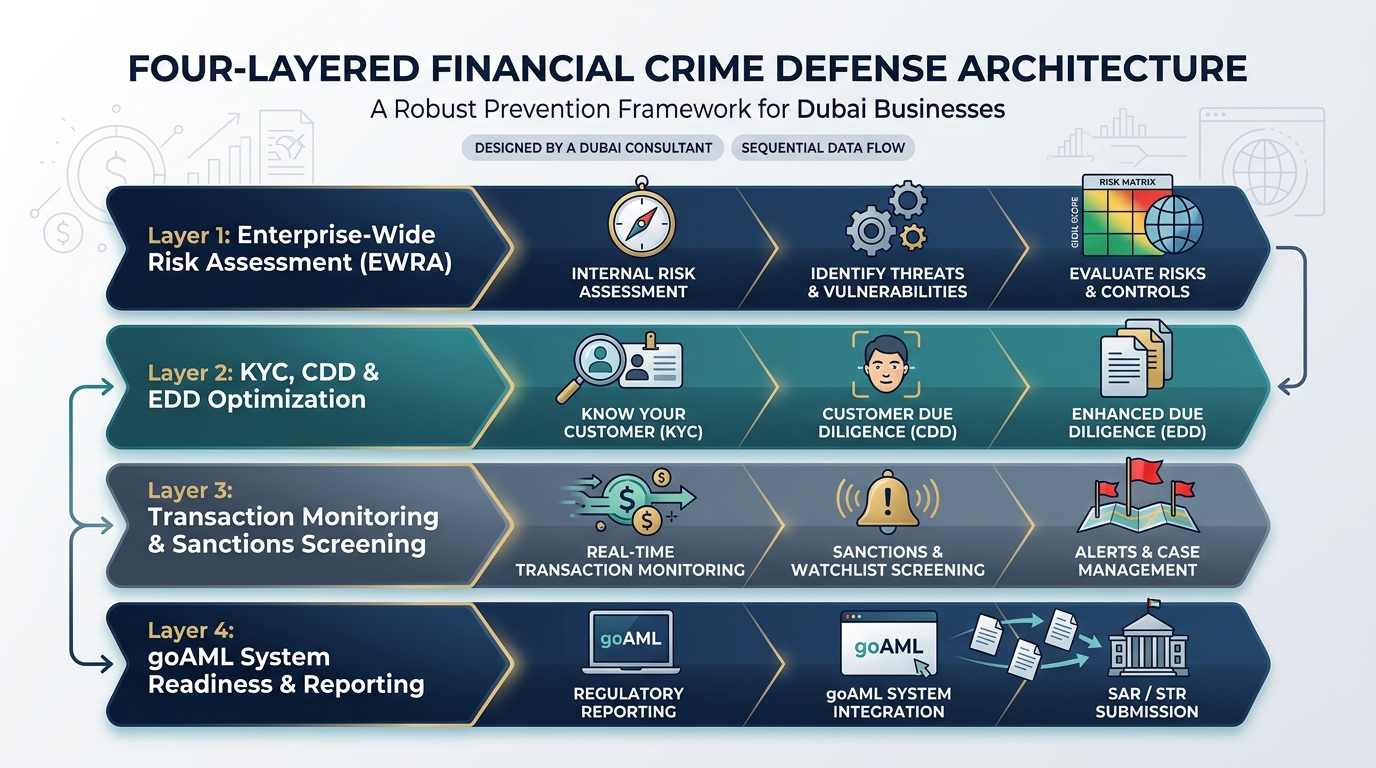
1. Enterprise-Wide Risk Assessments (EWRA)
An Enterprise-Wide Risk Assessment is the foundation of any effective compliance program. It involves a systematic evaluation of the inherent financial crime risks your business faces across various dimensions, including customer demographics, geographic reach, product and service offerings, and delivery channels. A consultant analyzes these risks and evaluates the effectiveness of your existing mitigating controls to determine your residual risk level. This process ensures that your compliance resources are allocated efficiently to the areas of highest risk.
During an EWRA, a consultant will typically evaluate:
- Inherent Risks: The natural level of risk your business is exposed to before any controls are applied. This includes assessing high-risk jurisdictions your clients may be connected to, the complexity of your services, and the volume of high-value transactions.
- Control Effectiveness: An objective review of how well your current policies, procedures, systems, and staff training mitigate those inherent risks.
- Residual Risk: The remaining risk level after controls are applied. If the residual risk is too high, the consultant will recommend and help implement additional mitigating controls.
2. KYC, CDD, and EDD Optimization
Know Your Customer (KYC) and Customer Due Diligence (CDD) are critical entry-point controls. A consultant helps design and implement robust onboarding procedures that accurately verify client identities, identify Ultimate Beneficial Owners (UBOs), and screen for Politically Exposed Persons (PEPs) and sanctioned individuals. For high-risk clients, the consultant establishes Enhanced Due Diligence (EDD) protocols, which require deeper investigation into the source of wealth (SoW) and source of funds (SoF).
Optimizing these processes involves striking a delicate balance between regulatory compliance and customer experience. A consultant helps integrate modern digital identity verification tools and automated screening solutions that streamline onboarding while maintaining compliance integrity. This prevents the operational bottlenecks that often occur when compliance processes are entirely manual and fragmented.
3. Transaction Monitoring and Sanctions Screening
Financial criminals constantly devise sophisticated methods to move illicit funds through legitimate channels. Consultants assist in setting up automated transaction monitoring systems and establishing clear rules and thresholds tailored to your business model. Furthermore, they ensure your sanctions screening processes are updated in real-time to comply with UAE Local Terrorist Lists and the United Nations Security Council (UNSC) Consolidated List, preventing transactions with sanctioned entities.
Effective transaction monitoring requires continuous calibration. A consultant helps establish scenarios and thresholds that are relevant to your business size and transaction profiles, reducing the volume of false positives that can overwhelm your compliance team. They also design clear escalation pathways for when a transaction triggers an alert, ensuring that potential red flags are investigated and documented thoroughly.
4. goAML System Readiness and Reporting
The goAML portal, developed by the United Nations Office on Drugs and Crime (UNODC) and utilized by the UAE FIU, is the primary platform for reporting suspicious activities. A financial crime consultant ensures your compliance team is fully trained on the goAML system, understands the specific triggers for filing Suspicious Transaction Reports (STRs) or Suspicious Activity Reports (SARs), and maintains the necessary documentation to support these filings.
Consultants also assist in establishing internal reporting mechanisms. This ensures that front-line employees know how to identify suspicious indicators and escalate them to the Money Laundering Reporting Officer (MLRO) internally, who can then make an informed decision on whether to submit a formal report via goAML.
Why High-Risk Sectors in Dubai Require Specialized Advisory
While all businesses must adhere to AML laws, certain sectors are classified as DNFBPs and face heightened scrutiny due to their susceptibility to money laundering and financial crime. A specialized consultant provides targeted guidance for these high-risk industries:
Real Estate Firms
Dubai’s real estate market is one of the most vibrant in the world, making it a prime target for individuals attempting to integrate illicit funds into the formal economy through property purchases. Real estate brokers and developers must comply with strict regulations, particularly regarding cash transactions exceeding AED 55,000, virtual asset payments, or transactions involving funds derived from virtual assets. A consultant helps real estate firms implement robust CDD procedures for buyers and sellers, ensuring all transactions are thoroughly vetted and documented.
In the real estate sector, specific risks include:
- High-Value Cash Transactions: The use of physical cash for property purchases remains a high-risk area. Consultants help establish strict thresholds and reporting mechanisms for cash payments.
- Third-Party Payments: Transactions where the buyer of record is different from the entity or individual funding the purchase require deep investigation to identify the true beneficial owner.
- Virtual Assets: The growing use of cryptocurrencies for real estate transactions in Dubai introduces unique compliance challenges. Consultants help establish frameworks to verify the source of these digital funds.
Corporate Service Providers (CSPs)
CSPs facilitate the creation and management of corporate entities, trusts, and foundations. Because complex corporate structures can be used to obscure the identities of beneficial owners, CSPs are subject to rigorous UBO disclosure requirements. A financial crime prevention consultant assists CSPs in mapping complex ownership chains, identifying the natural persons who ultimately control the entities, and maintaining accurate, up-to-date UBO registers in compliance with UAE Cabinet Decisions.
CSPs must also be vigilant against the creation of shell companies or the misuse of nominee arrangements. A consultant helps establish strict onboarding protocols to ensure that the business activities of the incorporated entities are legitimate and that their ongoing transactions align with their declared business profiles.
The Strategic Value of Partnering with Tareq Badarin
Navigating the complex regulatory landscape of Dubai requires more than just theoretical knowledge; it demands practical, hands-on experience within the local framework. Partnering with Tareq Badarin, a seasoned AML Compliance Specialist and Senior Compliance Analyst operating within the framework of Farahat & Co., provides your business with the strategic edge needed to thrive in a highly regulated environment.
Tailored Compliance Solutions
Every business is unique, and a one-size-fits-all compliance program is often either ineffective or overly restrictive. Tareq Badarin specializes in designing customized compliance frameworks that align with your specific business model, risk tolerance, and operational scale. This ensures that your compliance program is not only robust enough to satisfy regulatory inspections but also streamlined enough to support business growth.
Deep Local and International Expertise
With a deep understanding of both UAE federal laws and international standards set by the FATF, Tareq Badarin bridges the gap between local enforcement and global best practices. This dual perspective is particularly valuable for foreign investors and multinational corporations operating in Dubai, who must balance local compliance mandates with their home-country regulatory obligations.
Proactive Risk Management
Rather than waiting for a regulatory audit to uncover deficiencies, Tareq Badarin helps businesses identify and remediate vulnerabilities proactively. Through comprehensive gap analyses, mock regulatory audits, and continuous transaction monitoring reviews, your business can address potential compliance gaps before they escalate into costly regulatory violations.
Practical Steps to Build a Resilient Compliance Framework
Establishing a resilient financial crime prevention framework requires a structured, step-by-step approach. A consultant can guide your organization through the following critical phases:
Step 1: Appoint a Qualified Compliance Officer and MLRO
The first step in building a compliant organization is appointing a dedicated Money Laundering Reporting Officer (MLRO) who possesses the necessary qualifications and authority to oversee the compliance program. The MLRO acts as the primary liaison between the business and regulatory authorities, including the FIU and the Ministry of Economy.
Step 2: Develop Comprehensive Policies and Procedures
Your compliance manual should serve as a practical guide for your employees, outlining clear procedures for customer onboarding, transaction monitoring, sanctions screening, and suspicious activity reporting. These policies must be updated regularly to reflect changes in UAE legislation and international standards.
Step 3: Implement Automated Compliance Technology
In today’s fast-paced business environment, manual compliance processes are no longer sufficient. Implementing automated solutions for KYC verification, sanctions screening, and transaction monitoring reduces the risk of human error, improves operational efficiency, and provides a clear audit trail for regulatory inspectors.
Step 4: Conduct Regular Employee Training
Your employees are your first line of defense against financial crime. Regular, targeted training programs ensure that staff members across all levels of the organization understand their compliance obligations, can identify common red flags, and know how to escalate suspicious activities internally.
Step 5: Perform Independent Compliance Audits
An independent compliance audit is a critical tool for evaluating the ongoing effectiveness of your AML/CFT program. These audits should be conducted by an external specialist who can provide an objective assessment of your controls, identify potential weaknesses, and recommend practical remediation steps.
Common Compliance Pitfalls and How to Avoid Them
Many businesses in Dubai struggle with compliance not due to a lack of intent, but due to common execution errors. Understanding these pitfalls is the first step toward avoiding them:
| Compliance Pitfall | Potential Risk | Mitigation Strategy |
|---|---|---|
| Inadequate UBO Identification | Facilitating transactions for hidden, potentially sanctioned individuals. | Implement multi-layered ownership mapping and verify identities of all natural persons holding 25% or more shares. |
| Over-reliance on Automated Systems | Missing complex, unusual transaction patterns that automated rules fail to flag. | Conduct regular system calibration and combine automated screening with human analysis by trained compliance staff. |
| Delayed goAML Reporting | Regulatory fines and potential criminal liability for failing to report suspicious activity promptly. | Establish clear internal escalation timelines and ensure the MLRO has direct authority to file reports without delay. |
| Outdated Compliance Manuals | Failing to comply with newly enacted laws and regulatory updates. | Schedule annual reviews of all policies and procedures, or update them immediately following major legislative changes. |
The Cost of Non-Compliance in the UAE
The UAE authorities have made it clear that non-compliance with AML/CFT regulations will not be tolerated. The Ministry of Economy and the Central Bank regularly publish lists of administrative fines imposed on non-compliant entities. These penalties are designed to be punitive and deterrent, reflecting the severity of the offenses.
Administrative Fines
Fines for compliance violations can range from AED 50,000 for minor administrative infractions to several million AED for systemic failures in transaction monitoring, customer due diligence, or suspicious activity reporting. For high-risk sectors like real estate and precious metals, the financial impact of these fines can be devastating.
Operational and Reputational Damage
Beyond the immediate financial cost, non-compliant businesses face severe operational disruptions. Regulatory authorities have the power to suspend business licenses, restrict operations, or even order the closure of the business. Furthermore, public disclosure of compliance failures can permanently damage a company’s reputation, making it difficult to maintain relationships with banking partners, investors, and clients.
Criminal Liability
In cases of deliberate non-compliance or willful blindness, individual compliance officers, MLROs, and senior board members can face criminal prosecution. This can result in imprisonment and personal financial penalties, highlighting the critical importance of maintaining a robust, legally compliant defense system.
Conclusion: Securing Your Business in Dubai’s Dynamic Market
As Dubai continues to grow as a global financial powerhouse, the regulatory expectations placed on businesses will only become more demanding. Navigating this landscape requires a proactive, sophisticated approach to financial crime prevention. By partnering with an experienced financial crime prevention consultant Dubai, you can protect your business from regulatory penalties, safeguard your reputation, and build a resilient operational framework that supports sustainable, long-term growth.
Whether you need to conduct an Enterprise-Wide Risk Assessment, optimize your KYC and onboarding procedures, or prepare your team for a regulatory inspection, professional advisory services provide the expertise and peace of mind required to succeed. Secure your business today by establishing a compliance program that meets the highest standards of local and international regulatory excellence.
Frequently Asked Questions
What is the role of a financial crime prevention consultant in Dubai?
A financial crime prevention consultant helps businesses design, implement, and audit compliance frameworks to prevent money laundering, terrorism financing, and other financial crimes. This includes conducting risk assessments, optimizing KYC/CDD processes, setting up transaction monitoring systems, and ensuring compliance with UAE regulatory bodies like the Ministry of Economy and CBUAE.
Which businesses in Dubai are classified as DNFBPs?
Designated Non-Financial Businesses and Professions (DNFBPs) in the UAE include real estate brokers and agents, precious metals and stone dealers, independent auditors and accountants, corporate service providers (CSPs), and legal professionals. These sectors face strict AML/CFT compliance regulations supervised by the Ministry of Economy.
What are the penalties for non-compliance with AML laws in the UAE?
Non-compliance with UAE AML/CFT laws can result in severe administrative fines ranging from AED 50,000 to millions of dirhams, suspension or revocation of business licenses, public censure, and criminal prosecution of compliance officers, board members, and senior management.
How often should a business update its Enterprise-Wide Risk Assessment (EWRA)?
An Enterprise-Wide Risk Assessment should be reviewed and updated at least annually. It must also be updated immediately in response to significant changes in the business, such as launching new products, entering new geographic markets, adopting new technologies, or changes in local regulatory requirements.