
The United Arab Emirates (UAE), particularly Dubai, has established itself as a premier global hub for commerce, real estate, and financial services. With this rapid growth comes a sophisticated regulatory landscape designed to safeguard the integrity of the financial system. For businesses operating in this dynamic environment, navigating the complexities of anti-money laundering (AML) and counter-terrorist financing (CTF) is no longer just a legal obligation—it is a core pillar of reputational survival. Engaging expert financial crime advisory Dubai services is the most effective way to shield your organization from severe penalties, operational disruption, and irreversible brand damage.
As regulatory bodies like the Executive Office for Control and Non-Proliferation (EOCN), the Central Bank of the UAE (CBUAE), and the Ministry of Economy (MoE) intensify their oversight, Designated Non-Financial Businesses and Professions (DNFBPs) and financial institutions must adopt proactive compliance postures. This comprehensive guide explores how specialized financial crime advisory protects your business, the critical components of a modern compliance framework, and how tailored advisory services keep your operations secure and compliant.
The Evolving Landscape of Financial Crime in the UAE
In recent years, the UAE has implemented sweeping legislative reforms to align with international standards set by the Financial Action Task Force (FATF). These reforms have transformed how businesses must approach compliance. Regulatory authorities now conduct rigorous inspections, and non-compliance carries severe consequences, including multi-million dirham fines, public censure, and the suspension of business licenses.
Financial crime is no longer limited to traditional banking channels. Today, it encompasses a wide array of illicit activities, including:
- Money laundering through high-value real estate acquisitions.
- The misuse of corporate structures and trust arrangements to obscure beneficial ownership.
- Sanctions evasion via complex trade finance networks.
- Cyber-enabled financial fraud and proliferation financing.
To mitigate these risks, businesses require more than a generic compliance checklist. They need a dynamic, risk-based approach designed by specialists who understand both local regulations and global financial crime typologies.
The Regulatory Framework and Key Authorities
Understanding the regulatory architecture in Dubai is critical for establishing a compliant business. The regulatory environment is divided between onshore jurisdictions and free zones, each governed by specific authorities:
- The Ministry of Economy (MoE): Responsible for the regulation and supervision of DNFBPs onshore and in non-financial free zones. This includes real estate agents, precious metals dealers, auditors, and corporate service providers.
- The Central Bank of the UAE (CBUAE): Supervises licensed financial institutions (LFIs), including banks, exchange houses, and finance companies.
- The Dubai Financial Services Authority (DFSA): The independent regulator of financial services conducted in or from the Dubai International Financial Centre (DIFC).
- The Financial Intelligence Unit (FIU): The central agency responsible for receiving, analyzing, and distributing Suspicious Transaction Reports (STRs) and Suspicious Activity Reports (SARs).
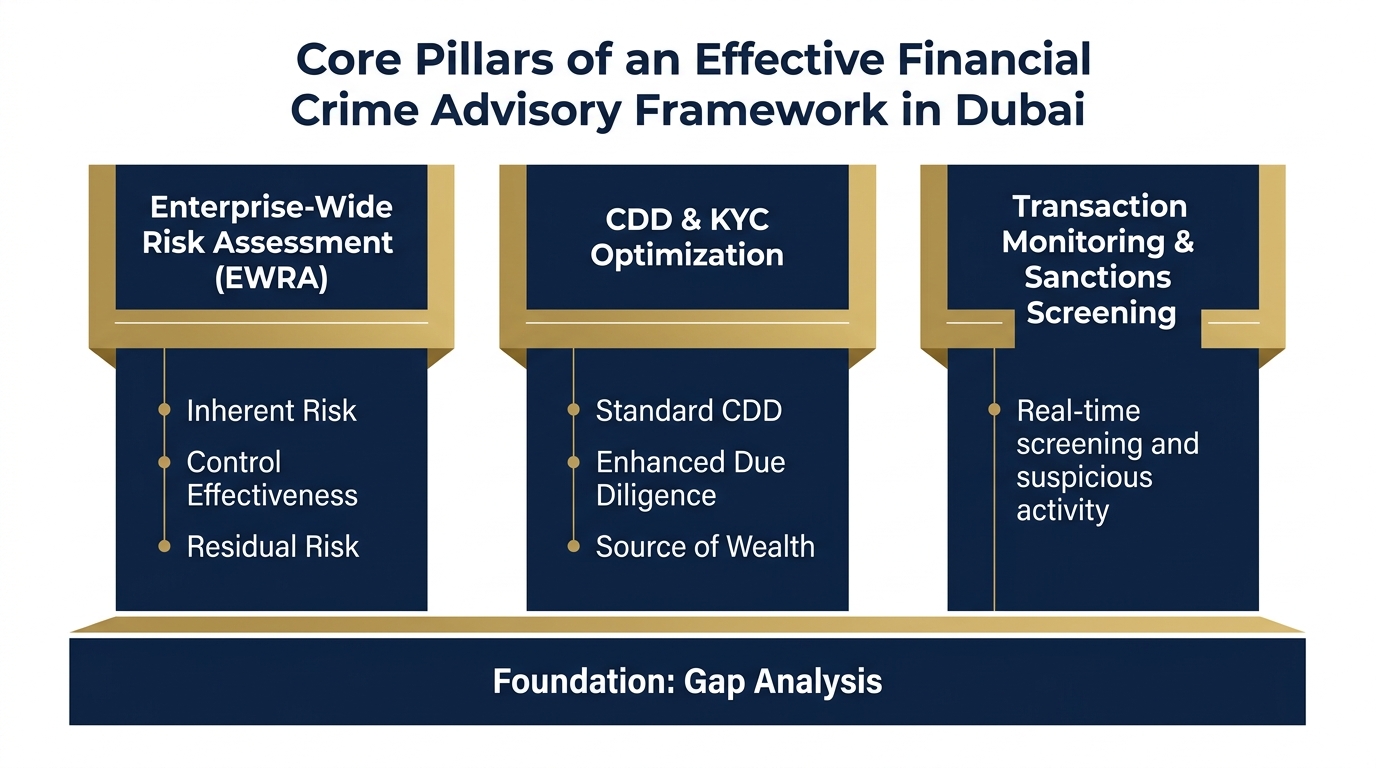
Core Pillars of an Effective Financial Crime Advisory Framework
A robust financial crime defense system is built on several interconnected pillars. When you partner with a professional advisory service, these components are customized to match your specific business model, risk appetite, and operational scale.
1. Enterprise-Wide Risk Assessment (EWRA)
An Enterprise-Wide Risk Assessment is the foundation of any compliant organization. It is a systematic process used to identify, assess, and understand the inherent financial crime risks your business faces across its customers, products, geographic locations, and delivery channels.
An effective EWRA involves:
- Inherent Risk Identification: Evaluating the baseline risk of your operations before applying any controls. This includes assessing the risk profile of your client base, the nature of your services, and the jurisdictions where you operate.
- Control Effectiveness Evaluation: Testing the strength of your existing policies, procedures, and systems to determine if they adequately mitigate identified risks. This involves reviewing internal controls, governance structures, and staff training.
- Residual Risk Determination: Calculating the remaining risk exposure to decide if additional mitigation measures are required. This helps in allocating compliance resources to the areas of highest risk.
2. Customer Due Diligence (CDD) and Know Your Customer (KYC) Optimization
Knowing exactly who you are doing business with is a fundamental regulatory requirement. Standard Customer Due Diligence (CDD) and Enhanced Due Diligence (EDD) protocols must be seamlessly integrated into your onboarding workflows to prevent illicit actors from exploiting your services.
Advisory services help optimize these processes by establishing clear thresholds for risk rating, identifying Ultimate Beneficial Owners (UBOs), screening for Politically Exposed Persons (PEPs), and implementing ongoing monitoring to detect changes in a client’s risk profile over time.
3. Transaction Monitoring and Sanctions Screening
Modern financial crime prevention requires real-time or post-event transaction monitoring to identify unusual patterns of activity that may indicate money laundering or terrorist financing. Additionally, robust sanctions screening systems must be in place to ensure your business does not inadvertently conduct transactions with designated individuals, entities, or countries subject to international sanctions.
| Compliance Component | Focus Area | Key Objective |
|---|---|---|
| Transaction Monitoring | Analyzing transactional behavior, velocity, and geographic destinations. | Detecting deviations from normal customer profiles and identifying suspicious activity. |
| Sanctions Screening | Checking customer databases and transaction counterparties against global watchlists (UN, OFAC, local UAE lists). | Preventing transactions with sanctioned individuals, entities, or prohibited jurisdictions. |
| UBO Identification | Unraveling complex corporate ownership structures to find the natural persons in control. | Ensuring transparency and preventing the use of shell companies for illicit purposes. |
Why Dubai Businesses Need Specialized Advisory Services
Many organizations attempt to manage compliance internally using generic templates or untrained staff. However, the complexity of UAE regulations makes this approach highly risky. Professional financial crime advisory provides several distinct advantages:
Regulatory Alignment and Future-Proofing
UAE regulations are updated frequently to address emerging global threats. A dedicated advisor monitors these regulatory shifts, ensuring your compliance manuals, policies, and systems are updated in real-time. This proactive approach prevents compliance gaps that could lead to regulatory penalties during unexpected audits.
Tailored Risk Mitigation for High-Risk Sectors
Certain sectors in Dubai, such as real estate, gold and precious metals dealers, and Corporate Service Providers (CSPs), are classified as DNFBPs and face heightened scrutiny. For instance, real estate transactions involving large cash amounts or virtual assets require specialized reporting. An experienced advisor understands these sector-specific nuances and designs targeted controls that protect your business without disrupting legitimate transactions.
Operational Efficiency and Cost Reduction
Over-compliance can be just as damaging to a business as under-compliance. If your KYC or transaction monitoring systems generate excessive false positives, it can alienate customers and overwhelm your compliance team. Expert advisory services help fine-tune your screening parameters, reducing false positives and streamlining the onboarding journey for low-risk clients while focusing resources on high-risk areas.
Step-by-Step: Implementing a Resilient Compliance Program
Building an institutional-grade financial crime defense program requires a structured approach. Here is the methodology recommended by leading compliance specialists:
Step 1: Conduct a Gap Analysis
Before implementing new controls, it is essential to evaluate your current compliance posture against prevailing UAE laws. A gap analysis identifies weaknesses in your existing policies, staff training, and technology systems, providing a clear roadmap for remediation.
Step 2: Draft Custom Policies and Procedures
Generic compliance manuals fail to protect businesses because they do not reflect actual operational workflows. Your compliance documentation must be tailored to your business, detailing exact roles, responsibilities, reporting lines, and escalation paths for suspicious activities.
Step 3: Deploy Advanced Screening and Monitoring Technology
Manual compliance checks are no longer sufficient in a high-velocity business environment. Implementing automated screening tools for PEPs, sanctions, and adverse media, alongside transaction monitoring systems, ensures continuous compliance and reduces human error.
Step 4: Establish a Culture of Compliance Through Training
A compliance program is only as strong as the employees executing it. Regular, targeted training sessions ensure that your front-line staff, relationship managers, and board members understand their obligations, can recognize red flags, and know how to report suspicious transactions internally.
Step 5: Independent Audits and Testing
Regular independent audits of your compliance framework are crucial. These audits verify that your controls are functioning as intended and provide independent assurance to regulators, banking partners, and stakeholders that your business is fully compliant.
The Role of Technology in Modern Financial Crime Defense
As financial crime typologies become more sophisticated, relying on manual processes is no longer viable. Technology plays a pivotal role in modern compliance programs, enabling businesses to process large volumes of data efficiently and accurately.
Automated Customer Onboarding
Digital onboarding solutions integrated with electronic identity verification (eIDV) systems allow businesses to verify customer identities in real-time. This reduces onboarding times while ensuring compliance with KYC requirements. These systems can automatically cross-reference customer data against global databases to identify PEPs and sanctioned individuals.
Artificial Intelligence and Machine Learning
Advanced transaction monitoring systems utilize artificial intelligence (AI) and machine learning (ML) algorithms to establish baseline behavioral profiles for customers. By analyzing historical transaction data, these systems can detect subtle anomalies that may indicate suspicious activity, such as structuring transactions to avoid reporting thresholds or rapid movement of funds across multiple accounts.
Data Analytics and Reporting
Robust compliance platforms provide comprehensive data analytics capabilities, allowing compliance officers to generate detailed reports on risk exposure, system performance, and alert resolution times. This data is invaluable for demonstrating compliance effectiveness during regulatory audits and internal reviews.
Key Risk Areas and Mitigation Strategies
To build a resilient compliance program, businesses must understand the specific risk areas relevant to their operations and implement targeted mitigation strategies.
Real Estate Transactions
The Dubai real estate sector is highly attractive to international investors, making it a primary target for money laundering. Key risks include high-value cash transactions, third-party payments, and the use of complex corporate structures to purchase property.
- Mitigation Strategy: Implement strict limits on cash payments, conduct enhanced due diligence on third-party payers, and verify the source of funds and source of wealth for high-risk buyers.
Corporate Service Providers (CSPs)
CSPs are vulnerable to exploitation by individuals seeking to establish shell companies or complex trust arrangements to obscure beneficial ownership.
- Mitigation Strategy: Conduct thorough UBO verification, understand the commercial purpose of the corporate structure, and perform ongoing monitoring of the entity’s activities.
Trade-Based Money Laundering (TBML)
TBML involves exploiting trade transactions to obscure the origin of illicit funds. Common techniques include over-invoicing, under-invoicing, and phantom shipments.
- Mitigation Strategy: Verify the pricing of goods against market standards, inspect shipping documentation for consistency, and conduct due diligence on all parties involved in the trade transaction.
Protecting Your Most Valuable Asset: Business Reputation
In the corporate world, trust is currency. A single association with financial crime can destroy a reputation built over decades. Banking institutions are increasingly risk-averse; if your business is suspected of having weak AML controls, banks may freeze or close your corporate accounts, effectively halting your operations.
By investing in professional financial crime advisory, you demonstrate to regulators, financial institutions, and international investors that your business operates with the highest standards of integrity. This not only protects you from legal penalties but also enhances your market credibility, facilitating smoother banking relationships and attracting premium business opportunities.
Partner with a Trusted Dubai Compliance Specialist
Navigating the complex regulatory environment of the UAE requires local expertise and global perspective. Tareq Badarin is a Dubai-based AML Compliance Specialist and Senior Compliance Analyst working within the framework of Farahat & Co. With deep expertise in regulatory advisory, KYC/CDD optimization, transaction monitoring, and Enterprise-Wide Risk Assessments (EWRA), Tareq provides tailored solutions designed to protect your business from financial crime risks while ensuring full compliance with UAE laws.
Do not wait for a regulatory audit to discover vulnerabilities in your compliance program. Contact Tareq Badarin today to secure your operations, protect your reputation, and ensure long-term business success in Dubai.
Frequently Asked Questions
What is financial crime advisory and why is it important in Dubai?
Financial crime advisory involves specialized consulting to help businesses identify, prevent, and mitigate risks related to money laundering, terrorist financing, fraud, and sanctions violations. In Dubai, it is critical because regulatory authorities enforce strict compliance standards, and non-compliance can result in severe fines, license suspension, and reputational damage.
What businesses in the UAE are classified as DNFBPs?
Designated Non-Financial Businesses and Professions (DNFBPs) in the UAE include real estate agents and brokers, precious metals and gemstone dealers, independent auditors and accountants, corporate service providers (CSPs), and legal professionals. These sectors face specific AML/CFT regulatory obligations.
What is an Enterprise-Wide Risk Assessment (EWRA)?
An EWRA is a comprehensive evaluation of the inherent financial crime risks faced by an entire organization across its customers, products, services, transactions, and geographic locations. It assesses the effectiveness of existing controls to determine residual risk and guide compliance strategy.
How does transaction monitoring help prevent financial crime?
Transaction monitoring involves analyzing customer transactions in real-time or retrospectively to detect unusual patterns, such as sudden large transfers, structuring, or transactions with high-risk jurisdictions. This allows businesses to identify and report suspicious activities to the Financial Intelligence Unit (FIU) via the goAML portal.