In the United Arab Emirates’ rapidly evolving regulatory landscape, compliance is no longer a passive administrative function. Under the oversight of the Executive Office for Control and Non-Proliferation, the Ministry of Economy (MoE), the Central Bank of the UAE (CBUAE), and various free zone authorities, businesses face unprecedented scrutiny. At the heart of a compliant organization lies the Enterprise Wide Risk Assessment UAE (EWRA)—a mandatory, structured evaluation designed to identify, assess, and mitigate money laundering and terrorism financing (ML/TF) risks.
An EWRA is not merely a document to satisfy an auditor’s checklist; it is the operational blueprint for your entire Anti-Money Laundering (AML) and Counter-Terrorism Financing (CFT) framework. Under Article 4.1 of Cabinet Decision No. 10 of 2019, financial institutions and Designated Non-Financial Businesses and Professions (DNFBPs) are legally required to conduct a comprehensive risk assessment that reflects their actual business activities. Failing to produce a robust, tailored EWRA can lead to severe administrative penalties, license suspensions, and reputational damage.
This guide provides compliance officers, risk managers, and business owners in the UAE with a practical, step-by-step methodology to design, execute, and maintain an EWRA that stands up to rigorous regulatory inspections.
Understanding the Core Purpose of a UAE EWRA
The primary objective of an Enterprise-Wide Risk Assessment is to enable a business to understand its risk profile and apply a Risk-Based Approach (RBA). By identifying where the business is most vulnerable to financial crime, management can allocate compliance resources effectively—focusing stringent controls on high-risk areas while streamlining processes for lower-risk segments.
Regulators in the UAE, including the Ministry of Economy and the Dubai Financial Services Authority (DFSA), expect your EWRA to be a dynamic, living document. It must bridge the gap between high-level regulatory requirements and your daily operational realities. A generic, off-the-shelf template will not suffice; your assessment must explicitly analyze the specific products, services, clients, geographic footprints, and delivery channels unique to your organization.
The Legal Mandate and Regulatory Framework
The regulatory landscape in the UAE is governed by Federal Decree-Law No. 20 of 2018 on Anti-Money Laundering and Combating the Financing of Terrorism and Financing of Illegal Organisations, along with its implementing regulation, Cabinet Decision No. 10 of 2019. These laws mandate that financial institutions and DNFBPs identify, assess, and understand their ML/TF risks. The EWRA is the formal mechanism through which this mandate is executed. It must be documented, kept up-to-date, and made available to relevant supervisory authorities upon request.
The Role of the National Risk Assessment (NRA)
The UAE National Risk Assessment (NRA) serves as the foundational benchmark for all individual enterprise-level assessments. The NRA identifies the overarching threats and vulnerabilities facing the country’s financial system. When conducting your EWRA, you must align your internal risk methodologies with the findings of the NRA. For instance, if the NRA identifies specific third-party payment channels or geographic corridors as high-risk, your EWRA must reflect these priorities and demonstrate how your business mitigates these national-level threats.
The Three-Pillar Methodology of a UAE EWRA
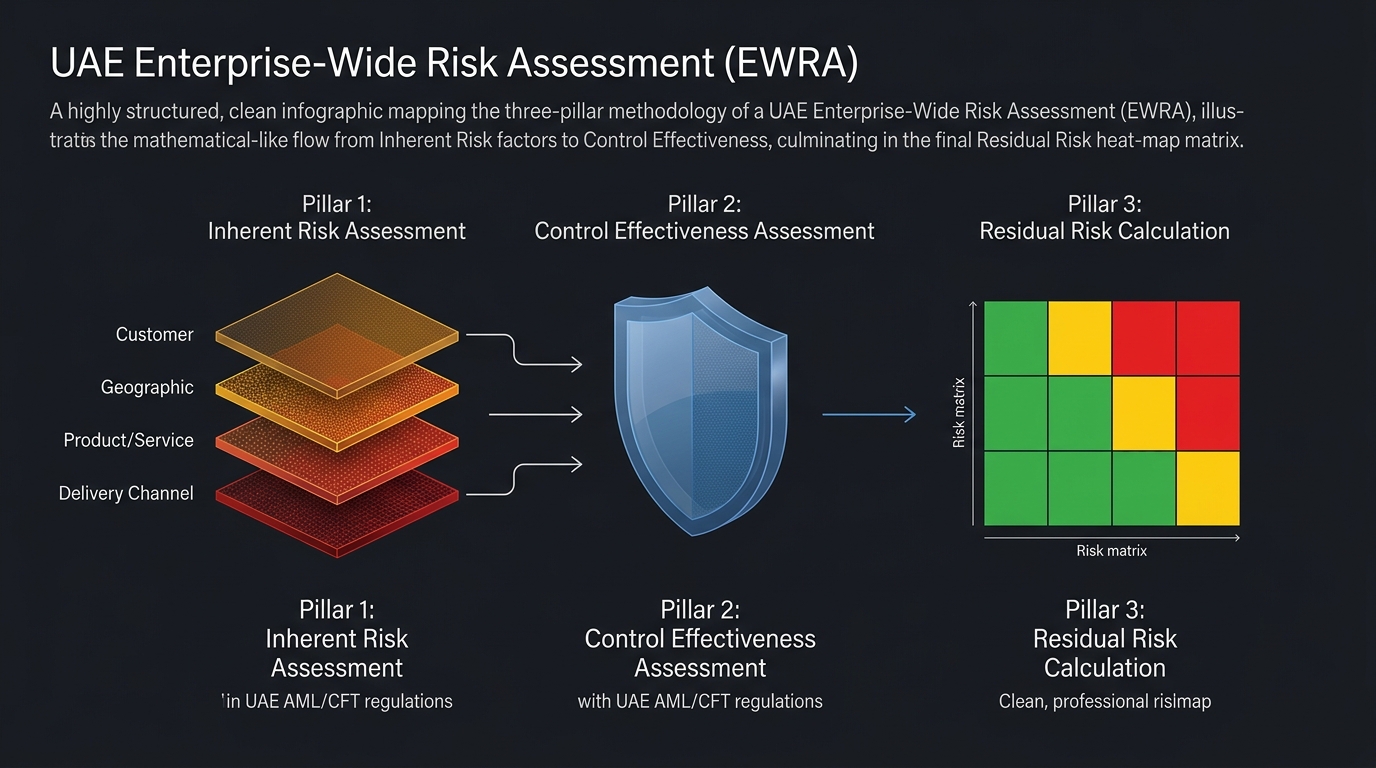
A legally compliant EWRA is built upon three fundamental pillars: Inherent Risk, Mitigating Controls, and Residual Risk. Understanding how these three elements interact is critical to building an accurate risk model.
Pillar 1: Inherent Risk Assessment
Inherent risk represents the exposure of your business to money laundering and terrorism financing threats in the absolute absence of any internal controls or mitigating factors. To calculate your inherent risk, you must systematically evaluate four primary risk categories:
- Customer Risk: Analyze your client base. Do you deal with Politically Exposed Persons (PEPs), high-net-worth individuals, non-resident clients, or complex corporate structures with opaque beneficial ownership?
- Geographic Risk: Assess the countries where your clients are based, where they source their funds, and where your business operates. High-risk jurisdictions, countries subject to international sanctions, or tax havens increase your geographic risk score.
- Product and Service Risk: Evaluate the nature of what you sell. Products that offer high anonymity, facilitate rapid cross-border transfers, or involve high-value physical assets (such as luxury real estate or precious metals) carry higher inherent risk.
- Delivery Channel and Transaction Risk: How do you acquire clients and execute transactions? Non-face-to-face onboarding, reliance on third-party intermediaries, and cash-intensive payment methods significantly elevate this risk.
Pillar 2: Control Effectiveness Assessment
Once your inherent risks are mapped, the next step is to evaluate the strength and effectiveness of your internal controls. Mitigating controls are the policies, procedures, systems, and training programs your business has implemented to prevent financial crime. Key control areas to assess include:
- Governance and Oversight: The active involvement of senior management, the appointment of a qualified AML Compliance Officer, and regular reporting structures.
- Customer Due Diligence (CDD) & KYC: The robustness of your identity verification, Ultimate Beneficial Owner (UBO) identification, and Enhanced Due Diligence (EDD) protocols.
- Transaction Monitoring & Sanctions Screening: The systems used to detect unusual transaction patterns and screen clients against local and international sanctions lists (such as the UAE Local Terrorist List and UN Security Council Consolidated List).
- Staff Training: The frequency and quality of AML/CFT training provided to employees to ensure they can recognize red flags.
- Independent Audit: The presence of regular, independent reviews of your AML compliance program to identify and remediate gaps.
Pillar 3: Residual Risk Calculation
Residual risk is the risk that remains after your mitigating controls have been applied to your inherent risks. It is calculated using a structured matrix:
Residual Risk = Inherent Risk × Control Ineffectiveness
If your inherent risk in a specific area is “High,” but your mitigating controls are evaluated as “Highly Effective,” your residual risk may be reduced to “Medium” or “Low.” However, if your controls are weak or poorly implemented, the residual risk remains high, signaling an urgent need for remediation.
| Inherent Risk Category | Inherent Risk Level | Mitigating Control Applied | Control Effectiveness | Calculated Residual Risk |
|---|---|---|---|---|
| Foreign High-Net-Worth Clients | High | Enhanced Due Diligence (EDD) & Source of Wealth Verification | Effective | Medium |
| Cash Transactions (Real Estate) | High | Strict Cash Limits & Mandatory Bank Transfer Policies | Highly Effective | Low |
| Complex Corporate Clients (CSPs) | High | UBO Registry Verification & Multi-layered Structure Mapping | Partially Effective | High (Requires Action) |
Sector-Specific Risk Nuances in the UAE
UAE regulators expect your EWRA to reflect the specific risks associated with your industry sector. DNFBPs, in particular, must address unique vulnerabilities within their assessments.
Real Estate Brokers and Developers
The UAE real estate sector is a primary target for money laundering due to the high value of transactions and the historical use of cash. When conducting an EWRA for a real estate firm, you must explicitly address:
- The volume of transactions involving cash, virtual assets, or third-party payments.
- Transactions involving politically exposed persons (PEPs) or foreign buyers from high-risk jurisdictions.
- The identification of ultimate beneficial owners behind corporate entities purchasing property.
Corporate Service Providers (CSPs)
CSPs are highly vulnerable because they facilitate the creation of corporate structures that can be misused to disguise the true ownership of illicit funds. A CSP’s EWRA must focus heavily on:
- The risk of shell companies or nominee arrangements.
- The provision of registered office services to non-resident entities.
- The complexity of multi-jurisdictional corporate structures managed by the firm.
Precious Metals and Stones Dealers (DPMS)
Dealers in precious metals and stones operate in a highly cash-intensive environment, making them susceptible to placement and layering phases of money laundering. An EWRA for a DPMS must analyze:
- The threshold of cash transactions (specifically monitoring transactions equal to or exceeding AED 55,000 as per UAE regulations).
- The origin of physical gold or gemstones, ensuring they do not originate from conflict zones or high-risk geographic areas.
- The reliance on intermediaries and brokers who may obscure the identity of the actual buyers or sellers.
Common Pitfalls That Trigger Regulatory Penalties
During regulatory audits by the Ministry of Economy or other licensing bodies, certain flaws in an EWRA frequently lead to compliance failures and fines. Avoiding these common mistakes is critical:
- Using Generic Templates: Regulators easily identify pre-packaged templates that have not been customized to the business’s actual operations. Your EWRA must contain specific data points, transaction volumes, and client demographics.
- Ignoring the National Risk Assessment (NRA): The UAE publishes a National Risk Assessment outlining the country’s primary financial crime threats. Your EWRA must align with and reference the findings of the UAE NRA.
- Failing to Calculate Residual Risk: Many businesses list their risks and their controls but fail to perform the mathematical or logical step of calculating the residual risk, leaving the assessment incomplete.
- Lack of Senior Management Sign-Off: An EWRA must be formally reviewed and approved by the board of directors or senior management. A lack of documented approval indicates poor governance.
- Treating it as a One-Time Exercise: An outdated EWRA does not reflect current risks. The document must be updated at least annually, or immediately upon significant business changes, such as launching a new product, entering a new market, or updating regulatory laws.
Step-by-Step Guide to Executing Your EWRA
To conduct an Enterprise-Wide Risk Assessment that satisfies UAE regulators, follow this structured, six-step implementation roadmap:
Step 1: Establish the Framework and Governance
Define the methodology, scoring criteria (e.g., Low, Medium, High), and risk appetite of the organization. Ensure the compliance officer has the necessary resources and access to operational data to lead the project. Document the scope of the assessment to cover all business units and legal entities within the UAE.
Step 2: Gather Operational Data
Collect quantitative and qualitative data across the business. This includes client demographics, transaction volumes, geographic locations of counterparties, payment methods used, and historical suspicious activity reports (SARs/STRs) filed via the goAML portal.
Step 3: Identify and Score Inherent Risks
Apply your scoring methodology to the gathered data. Assign risk ratings to your customers, geographic operations, products, and delivery channels. Document the rationale behind each score to provide a clear audit trail for regulators.
Step 4: Evaluate Control Design and Performance
Assess whether your existing AML policies and procedures are designed correctly to mitigate the identified risks. Next, test whether these controls are operating effectively in practice. This can be achieved through sample testing of KYC files, reviewing transaction monitoring alerts, and checking sanctions screening logs.
Step 5: Determine Residual Risk and Develop an Action Plan
Calculate the residual risk for each category. Where residual risks exceed the organization’s defined risk appetite, develop a targeted remediation plan. This plan should outline specific actions, responsible personnel, and deadlines to strengthen controls (e.g., upgrading screening software or implementing stricter EDD for specific client segments).
Step 6: Report, Approve, and Implement
Present the finalized EWRA report to senior management and the board of directors for formal approval. Once signed off, integrate the findings into your daily operations. The EWRA should directly influence your Customer Risk Rating (CRR) model, transaction monitoring thresholds, and the frequency of ongoing client reviews.
How Tareq Badarin Can Assist Your Business
Conducting a compliant Enterprise-Wide Risk Assessment requires deep regulatory expertise, a structured methodology, and an intimate understanding of UAE AML laws. As a Dubai-based AML Compliance Specialist working within the framework of Farahat & Co., Tareq Badarin provides comprehensive, bespoke risk management solutions tailored to your business model.
Whether you are a real estate firm, a corporate service provider, or a financial institution, Tareq Badarin offers expert advisory services to design, execute, and update your EWRA, ensuring it fully satisfies the expectations of UAE regulators. Protect your business from regulatory penalties and secure your operational integrity by partnering with an experienced compliance professional.
Contact Tareq Badarin today to schedule a consultation and ensure your compliance framework is robust, effective, and fully aligned with UAE standards.
Frequently Asked Questions
What is an Enterprise-Wide Risk Assessment (EWRA) in the UAE?
An EWRA is a comprehensive assessment that financial institutions and DNFBPs in the UAE must conduct to identify, evaluate, and understand their exposure to money laundering and terrorism financing risks. It is a mandatory requirement under Cabinet Decision No. 10 of 2019.
How often should a UAE business update its EWRA?
A business must update its EWRA at least annually. Additionally, it should be updated immediately when there are significant changes to the business model, such as launching new products, entering new geographic markets, adopting new delivery channels, or when there are major updates to UAE AML laws.
What is the difference between inherent risk and residual risk?
Inherent risk is the level of risk exposure a business faces before applying any internal controls or mitigants. Residual risk is the remaining risk that exists after the effectiveness of internal mitigating controls (such as KYC, screening, and audits) has been applied to the inherent risk.
Do UAE regulators accept generic templates for an EWRA?
No. Regulators, including the Ministry of Economy, expect a highly customized EWRA that reflects the actual operational data, client demographics, transaction volumes, and specific risk profile of the individual business. Generic templates are a common cause of regulatory audit failures.