
In the rapidly evolving financial landscape of the United Arab Emirates, regulatory compliance is no longer a reactive checklist. For financial institutions, Designated Non-Financial Businesses and Professions (DNFBPs), and corporate service providers, understanding and mitigating financial crime risks is a core operational mandate. At the heart of this mandate lies the Enterprise-Wide Risk Assessment AML Dubai framework—a comprehensive, structured methodology designed to identify, assess, and mitigate money laundering and terrorist financing risks across an entire organization.
As regulatory bodies like the Central Bank of the UAE (CBUAE), the Ministry of Economy (MoE), and the Executive Office for Control and Non-Proliferation tighten oversight, businesses must move beyond generic compliance templates. A robust Enterprise-Wide Risk Assessment (EWRA) is not just a regulatory requirement; it is a strategic shield that protects your business reputation, ensures operational continuity, and aligns your risk appetite with the stringent standards of the UAE regulatory landscape.
Understanding the Regulatory Mandate for EWRA in Dubai
The legal foundation for AML compliance in the UAE is built upon Federal Decree-Law No. 20 of 2018 on Anti-Money Laundering and Combating the Financing of Terrorism and Financing of Illegal Organisations, alongside its subsequent amendments and executive regulations. Under this framework, supervised entities are legally obligated to conduct a comprehensive assessment of their exposure to money laundering and terrorist financing (ML/TF) risks.
For businesses operating in Dubai, including those within the Dubai International Financial Centre (DIFC) and various free zones, the EWRA serves as the primary document that regulators review during audits. A deficient EWRA is often the first indicator of systemic compliance failures, potentially leading to severe administrative penalties, financial fines, or license suspensions.
The Role of Supervisory Authorities
Different sectors in Dubai fall under the jurisdiction of specific regulatory bodies, each emphasizing the critical nature of a tailored EWRA:
- The Central Bank of the UAE (CBUAE): Oversees banks, exchange houses, and other financial institutions, requiring highly sophisticated, quantitative risk assessment methodologies.
- The Ministry of Economy (MoE): Regulates DNFBPs, including real estate brokers, precious metals dealers, auditors, and corporate service providers (CSPs).
- The Dubai Financial Services Authority (DFSA): Governs firms operating within the DIFC, mandating risk assessments that align with international best practices.
The Core Components of an Enterprise-Wide Risk Assessment
An effective EWRA must be holistic, structured, and inherently dynamic. It is not a static document created during incorporation and shelved; rather, it is a living methodology that must be updated at least annually or whenever significant changes occur in the business environment. A standard EWRA is divided into two primary dimensions: Inherent Risk and Control Effectiveness, culminating in the determination of Residual Risk.
1. Inherent Risk Assessment
Inherent risk represents the exposure of an organization to ML/TF threats in the absence of any mitigating controls. To accurately measure inherent risk, businesses must analyze several key risk factors:
- Customer Risk: Assessing the profile of the client base. High-risk categories include Politically Exposed Persons (PEPs), clients from high-risk jurisdictions, complex corporate structures, and cash-intensive businesses.
- Geographic Risk: Evaluating the risks associated with the countries where the business operates, where its clients are based, and where transactions originate or terminate. This includes monitoring lists from the Financial Action Task Force (FATF) and local UAE sanctions lists.
- Product, Service, and Transaction Risk: Analyzing the vulnerability of the specific products or services offered. For instance, private banking, international wire transfers, and real estate transactions inherently carry higher ML/TF risks than standard retail deposits.
- Delivery Channel Risk: Assessing how products and services are delivered to clients. Non-face-to-face onboarding, online platforms, and the use of third-party intermediaries significantly elevate delivery channel risk.
2. Control Effectiveness Evaluation
Once inherent risks are identified, the next step is to evaluate the strength and effectiveness of the internal controls designed to mitigate these risks. These controls typically include:
- Governance and Oversight: The involvement of senior management and the board of directors in approving AML policies and receiving regular compliance reports.
- Customer Due Diligence (CDD) and Enhanced Due Diligence (EDD): The procedures for verifying client identities, identifying Ultimate Beneficial Owners (UBOs), and conducting deeper investigations into high-risk clients.
- Transaction Monitoring and Sanctions Screening: The systems and processes used to detect unusual transaction patterns and screen names against international and UAE local terrorist lists.
- AML Training and Awareness: Regular, documented training programs for employees to ensure they can recognize red flags and understand their reporting obligations.
- Independent Audit Function: Periodic, independent reviews of the AML compliance program to test its operational effectiveness.
3. Determining Residual Risk
Residual risk is the remaining risk after mitigating controls are applied to the inherent risks. The relationship can be expressed simply as:
Residual Risk = Inherent Risk × Control Deficiencies
If the residual risk exceeds the organization’s defined risk appetite, senior management must implement additional controls or modify business strategies to bring the risk back within acceptable parameters.
Step-by-Step Methodology for Conducting an EWRA in Dubai
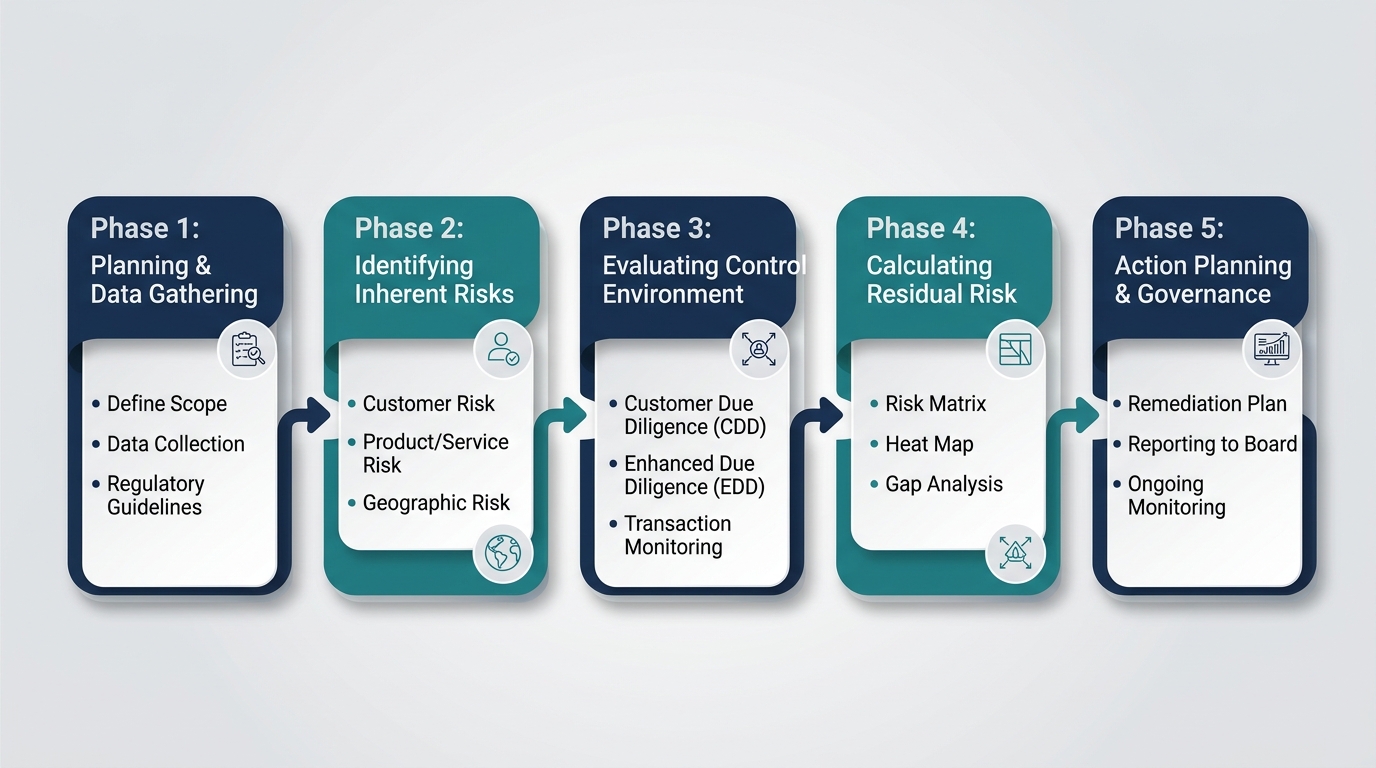
Implementing a successful Enterprise-Wide Risk Assessment AML Dubai framework requires a systematic approach. Below is a practical, step-by-step methodology designed to meet the expectations of UAE regulatory authorities.
| Phase | Key Activities | Deliverables / Outputs |
|---|---|---|
| Phase 1: Planning & Scope | Define the scope of the assessment, identify stakeholders, and gather business data (products, geographies, client demographics). | Project charter, data collection templates, and stakeholder alignment. |
| Phase 2: Risk Identification | Identify inherent risks across customers, products, geographies, and delivery channels. | Comprehensive Risk Register detailing all identified ML/TF threats. |
| Phase 3: Control Assessment | Review existing AML policies, procedures, systems, and training records to evaluate control design and operational effectiveness. | Control Gap Analysis and control effectiveness ratings. |
| Phase 4: Risk Analysis & Scoring | Calculate inherent risk, evaluate control strength, and determine the residual risk rating for each business segment. | Risk Matrix and Residual Risk Heat Map. |
| Phase 5: Reporting & Action Plan | Document the findings, present the EWRA to senior management for approval, and develop a remediation plan for identified gaps. | Final EWRA Report, Board approval minutes, and AML Action Plan. |
Phase 1: Planning and Data Gathering
Before beginning the assessment, establish a clear scope that encompasses all business units, subsidiaries, and operational branches. Gather quantitative data, such as the total number of active clients, the volume and value of transactions, the percentage of high-risk clients, and the geographic distribution of transactions. This data-driven foundation ensures the assessment is objective and reflective of actual business operations.
Phase 2: Identifying Inherent Risks
Conduct workshops and interviews with key department heads (sales, operations, IT, and legal) to identify specific vulnerabilities. For example, a real estate firm in Dubai must identify risks associated with high-value cash transactions, third-party payments, and foreign buyers from jurisdictions subject to increased monitoring.
Phase 3: Evaluating the Control Environment
Assess whether your current policies and procedures are aligned with the latest UAE cabinet decisions and regulatory circulars. Test the operational effectiveness of your controls. For instance, do not simply verify that a sanctions screening tool is in place; test whether it correctly flags names on the UAE Local Terrorist List and the UN Consolidated List.
Phase 4: Calculating and Mapping Risk
Using a standardized scoring model (e.g., Low, Medium, High), calculate the scores for inherent risk and control effectiveness. Plot these scores on a risk matrix to visually represent the areas of highest residual risk. This visual representation helps senior management prioritize resource allocation and compliance budgeting.
Phase 5: Action Planning and Governance
The final EWRA report must be presented to, reviewed by, and formally approved by the Board of Directors or senior management. If the assessment reveals gaps—such as outdated transaction monitoring thresholds or insufficient training for front-line staff—the report must include a detailed remediation plan with specific owners and deadlines.
Deep Dive: Sector-Specific Risk Scenarios in Dubai
To make the Enterprise-Wide Risk Assessment AML Dubai framework actionable, it is essential to look at how specific sectors in Dubai experience and manage these risks. The risk profile of a real estate brokerage in Dubai Marina differs fundamentally from a corporate service provider in the DIFC or a financial technology startup in the Dubai Future District.
Real Estate Firms in Dubai
The Dubai real estate market is one of the most dynamic globally, attracting significant foreign direct investment. However, this high volume of international transactions makes it a primary target for money laundering. Key risk scenarios include:
- High-Value Cash Transactions: Buyers attempting to purchase luxury properties using physical cash or virtual assets without clear proof of funds.
- Third-Party Payments: Transactions where the funds originate from an account holding a different name than the buyer listed on the Unified Title Deed.
- Rapid Reselling (Flipping): Properties purchased and quickly resold multiple times within a short period, sometimes at artificial valuations, to obscure the origin of illicit funds.
Mitigating these risks requires robust Customer Due Diligence (CDD) on both buyers and sellers, strict verification of the Source of Funds (SoF) and Source of Wealth (SoW), and immediate reporting of suspicious activities via the goAML portal.
Corporate Service Providers (CSPs)
CSPs in Dubai play a critical role in company formation, trust administration, and nominee services. Because they act as gatekeepers to the UAE financial system, they face unique vulnerabilities:
- Complex Corporate Structures: Clients requesting the establishment of multi-layered offshore entities, shell companies, or trusts that obscure the identity of the Ultimate Beneficial Owner (UBO).
- Nominee Directorships: Requests to provide nominee shareholders or directors, which can be exploited to hide the true controlling minds behind an entity.
- Jurisdictional Arbitrage: Setting up entities across multiple free zones and onshore jurisdictions to exploit perceived regulatory gaps.
CSPs must implement rigorous UBO verification procedures, conduct ongoing monitoring of corporate structures, and ensure that the business activities of the established entities align with their declared purpose.
The Critical Role of Technology in EWRA
In the modern regulatory environment, manual compliance processes are no longer sufficient to manage the volume and complexity of financial transactions in Dubai. Integrating advanced technology into your EWRA framework is essential for maintaining compliance and operational efficiency.
Automated Risk Scoring
Implementing specialized compliance software allows organizations to automate the risk scoring process. By feeding quantitative data—such as client demographics, transaction volumes, and geographic connections—into a centralized system, businesses can generate real-time risk profiles. This reduces human error and ensures that high-risk entities are flagged instantly for Enhanced Due Diligence (EDD).
Transaction Monitoring and Sanctions Screening
Automated transaction monitoring systems use predefined rules and machine learning algorithms to detect unusual patterns, such as structuring (splitting large transactions to avoid reporting thresholds) or rapid movement of funds. Furthermore, real-time sanctions screening tools ensure that all clients and counter-parties are continuously checked against updated local and international watchlists, including the UAE Local Terrorist List and the OFAC sanctions list.
Common Pitfalls in Dubai EWRA Implementations
Many organizations in the UAE struggle to design and execute an EWRA that satisfies regulatory scrutiny. Recognizing these common pitfalls can help your business avoid regulatory criticism and potential penalties:
- Using Off-the-Shelf Templates: A generic risk assessment template downloaded from the internet cannot capture the unique risk profile of your specific business, products, or client base. Regulators easily identify and reject non-customized assessments.
- Lack of Quantitative Data: Relying solely on qualitative opinions rather than hard data leads to subjective and often inaccurate risk ratings. Your EWRA must be backed by transaction volumes, client statistics, and geographic data.
- Treating EWRA as a One-Time Project: An EWRA must be updated continuously. Significant triggers for an immediate update include launching a new product, entering a new market, experiencing a merger or acquisition, or major changes in local AML laws.
- Siloed Compliance Ownership: If the EWRA is written solely by the Compliance Officer without input from business front-line units, it will fail to reflect the actual operational realities of the firm.
How Professional Advisory Elevates Your Compliance Posture
Designing and executing a regulatory-compliant Enterprise-Wide Risk Assessment AML Dubai framework requires deep expertise in both local UAE regulations and international financial crime standards. For many businesses, maintaining an in-house team with this specialized knowledge is operationally challenging.
Partnering with an experienced AML compliance specialist ensures that your EWRA is robust, data-driven, and fully aligned with the expectations of supervisory authorities like the Ministry of Economy and the CBUAE. Professional advisory services provide:
- Tailored Methodologies: Developing risk scoring models specifically calibrated to your industry, whether you operate in real estate, corporate services, or financial technology.
- Independent Objectivity: Providing an unbiased evaluation of your control environment, identifying hidden gaps that internal teams might overlook.
- Regulatory Alignment: Ensuring your compliance framework is updated in real-time to reflect the latest regulatory changes, such as the evolving mandates from the Executive Office for Control and Non-Proliferation.
- Audit Readiness: Preparing your team and documentation to confidently face regulatory inspections and independent AML audits.
Secure Your Business with Expert AML Advisory
In Dubai’s competitive and highly regulated business environment, compliance is a cornerstone of sustainable growth. A weak risk assessment exposes your business to financial crime, reputational damage, and severe regulatory penalties. Conversely, a robust, professionally designed Enterprise-Wide Risk Assessment empowers your business to navigate risks confidently and seize new opportunities safely.
Tareq Badarin, working within the established framework of Farahat & Co., provides comprehensive, high-quality AML compliance and financial crime advisory services across the UAE. With specialized expertise in KYC/CDD optimization, transaction monitoring, and Enterprise-Wide Risk Assessments, we help real estate firms, corporate service providers, and financial institutions build resilient compliance frameworks.
Contact us today to schedule a consultation and ensure your business is fully aligned with the latest UAE AML standards.
Frequently Asked Questions
What is an Enterprise-Wide Risk Assessment (EWRA) in AML?
An EWRA is a comprehensive assessment designed to identify, analyze, and mitigate the money laundering and terrorist financing risks faced by an entire organization. It evaluates inherent risks (customer, product, geography, and delivery channel) against the effectiveness of internal controls to determine the residual risk.
How often should a business in Dubai update its EWRA?
Under UAE AML regulations, businesses should review and update their EWRA at least annually. Additionally, an immediate update is required if there are significant changes to the business, such as launching new products, entering new markets, or major regulatory updates.
Who is required to conduct an EWRA in the UAE?
All financial institutions and Designated Non-Financial Businesses and Professions (DNFBPs)—including real estate brokers, corporate service providers, auditors, and precious metals dealers—are legally required to conduct and maintain an EWRA under UAE AML laws.
What are the penalties for not having a valid EWRA in Dubai?
Failure to maintain a robust, updated EWRA can result in severe administrative and financial penalties from supervisory authorities like the Ministry of Economy or CBUAE, including substantial fines, suspension of business licenses, or public censure.