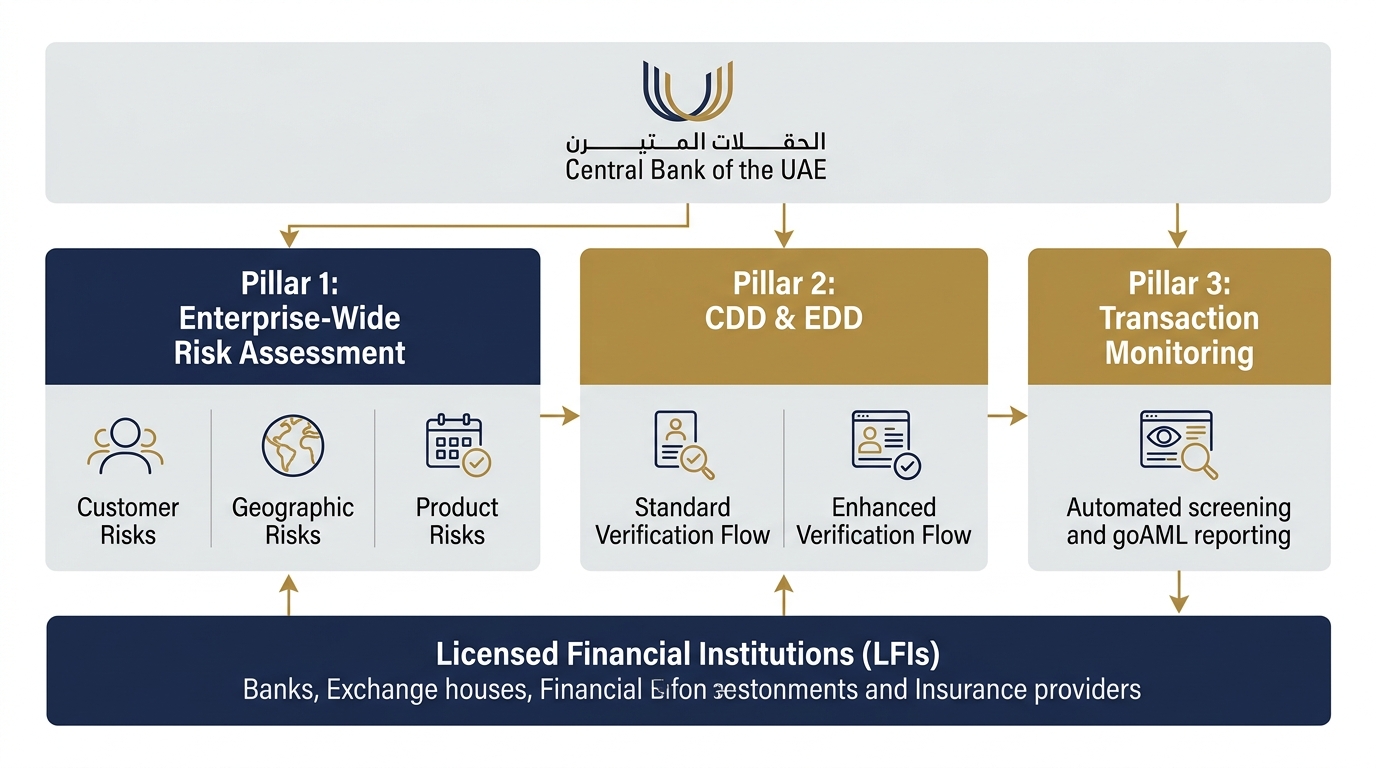
The United Arab Emirates has established itself as a premier global financial hub, attracting significant foreign investment and international business operations. To safeguard this sophisticated financial ecosystem from illicit financial flows, the Central Bank of the UAE (CBUAE) enforces a rigorous regulatory framework. For Licensed Financial Institutions (LFIs) operating in the country, compliance with CBUAE AML regulations is not merely a statutory obligation but a fundamental pillar of operational integrity and risk management.
This comprehensive guide explores the core components of the CBUAE Anti-Money Laundering and Combating the Financing of Terrorism (AML/CFT) regulatory framework. It provides compliance officers, risk managers, and financial executives with the practical insights needed to align their operations with the latest regulatory expectations, mitigate financial crime risks, and maintain robust compliance programs.
The Legal and Regulatory Framework of CBUAE AML
The foundation of the UAE’s AML/CFT regime is built upon federal legislation, which is further detailed through specific regulations, standards, and guidelines issued by the Central Bank. Understanding this hierarchy is essential for any LFI designing or updating its compliance framework.
Key Federal Legislation
The primary legislative instruments governing AML/CFT in the UAE include:
- Federal Decree-Law No. 20 of 2018 on Anti-Money Laundering and Combating the Financing of Terrorism and Financing of Illegal Organisations. This law establishes the legal definitions of money laundering and terrorist financing, outlines criminal penalties, and mandates the creation of supervisory authorities.
- Cabinet Decision No. 10 of 2019 on the Implementing Regulation of Federal Decree-Law No. 20 of 2018. This executive regulation provides detailed operational requirements for implementing the primary law, including customer due diligence, risk assessment, and reporting obligations.
- Federal Decree-Law No. 10 of 2025, which introduces updated standards to further align the UAE’s legal framework with evolving international standards, including those of the Financial Action Task Force (FATF).
CBUAE-Specific Regulations and Guidelines
While federal laws apply nationwide, the CBUAE acts as the primary supervisory authority for LFIs. The Central Bank issues specific regulations, standards, and guidance notes that translate federal laws into actionable requirements for the financial sector. These include:
- The CBUAE AML/CFT Procedures for Licensed Financial Institutions.
- Specific guidelines on transaction monitoring, sanctions screening, and suspicious transaction reporting.
- Sector-specific guidance for banks, exchange houses, finance companies, and insurance providers.
Who Must Comply? Scope of CBUAE Supervision
CBUAE AML regulations apply strictly to all Licensed Financial Institutions operating within the jurisdiction of the Central Bank. This includes institutions operating in mainland UAE as well as those in non-financial free zones, excluding the financial free zones (such as the Dubai International Financial Centre – DIFC, and the Abu Dhabi Global Market – ADGM, which have their own independent financial regulators).
LFIs subject to CBUAE supervision include:
- Commercial and investment banks.
- Exchange houses and money transmitters.
- Finance companies and microfinance institutions.
- Insurance companies, brokers, and agents.
- Stored-value facility providers and electronic payment service providers.
It is important to distinguish LFIs from Designated Non-Financial Businesses and Professions (DNFBPs), such as real estate brokers, corporate service providers, and precious metal dealers, which are supervised by the Ministry of Economy. While both sectors must comply with federal AML laws, LFIs are held to the highly detailed and stringent standards set directly by the CBUAE.
Pillar 1: Enterprise-Wide Risk Assessment (EWRA)
A fundamental requirement of CBUAE AML regulations is the adoption of a risk-based approach. LFIs cannot apply a one-size-fits-all compliance strategy; instead, they must identify, assess, and understand their specific money laundering and terrorist financing risks through an Enterprise-Wide Risk Assessment (EWRA).
Key Components of an EWRA
An effective EWRA must evaluate risk across several distinct dimensions:
- Customer Risk: Assessing the risk profiles of different customer segments, such as Politically Exposed Persons (PEPs), high-net-worth individuals, non-resident customers, and cash-intensive businesses.
- Geographic Risk: Identifying risks associated with the countries where the LFI’s customers reside, do business, or from which they transfer funds, with particular focus on high-risk jurisdictions.
- Product and Service Risk: Evaluating the inherent risks of specific financial products, such as private banking, wire transfers, trade finance, and anonymous prepaid cards.
- Delivery Channel Risk: Assessing how products and services are delivered, such as online banking, mobile applications, third-party intermediaries, or face-to-face interactions.
Documenting and Updating the EWRA
The CBUAE requires LFIs to document their EWRA methodology and findings thoroughly. The assessment must be approved by senior management and the board of directors. Furthermore, the EWRA is not a static document; it must be reviewed and updated at least annually, or sooner if there are significant changes in the LFI’s business model, regulatory environment, or risk profile.
Pillar 2: Customer Due Diligence (CDD) and Enhanced Due Diligence (EDD)
Customer Due Diligence (CDD) is the cornerstone of any effective AML program. Under CBUAE regulations, LFIs must verify the identity of their customers, understand the nature of their business, and identify the Ultimate Beneficial Owners (UBOs).
Standard Customer Due Diligence (CDD)
For standard-risk customers, LFIs must perform the following steps before establishing a business relationship:
- Identify and Verify the Customer: Obtain and verify official identification documents, such as a valid Emirates ID and passport for individuals, or trade licenses and constitutional documents for corporate entities.
- Identify the Ultimate Beneficial Owner (UBO): Identify any natural person who ultimately owns or controls 25% or more of the legal entity’s shares or voting rights, or who otherwise exercises control over the management.
- Understand the Business Relationship: Obtain information on the purpose and intended nature of the business relationship, including expected transaction volumes and sources of funds.
Enhanced Due Diligence (EDD)
When a customer or transaction is identified as presenting a higher risk of money laundering or terrorist financing, LFIs must apply Enhanced Due Diligence (EDD) measures. High-risk scenarios include relationships with PEPs, customers from high-risk jurisdictions, or complex corporate structures with no clear commercial purpose.
EDD measures include, but are not limited to:
- Obtaining senior management approval to establish or continue the business relationship.
- Conducting deeper investigations into the customer’s source of wealth and source of funds.
- Increasing the frequency and intensity of transaction monitoring.
- Conducting regular, ongoing reviews of the relationship.
Pillar 3: Transaction Monitoring and Sanctions Screening
To detect and prevent illicit financial activities, LFIs must implement robust systems for transaction monitoring and sanctions screening. These systems must be calibrated to the institution’s risk profile and transaction volumes.
Automated Transaction Monitoring
LFIs are expected to utilize automated transaction monitoring systems capable of analyzing transaction patterns, identifying anomalies, and flagging suspicious activities. The monitoring rules and scenarios must be regularly tuned and validated to minimize false positives while ensuring that actual high-risk activities are captured.
Key indicators that should trigger alerts include:
- Transactions that are inconsistent with the customer’s known business profile or historical behavior.
- Rapid movement of funds across multiple accounts with no apparent economic purpose.
- Structuring transactions to remain just below regulatory reporting thresholds.
Sanctions Screening and Targeted Financial Sanctions (TFS)
LFIs must implement real-time screening mechanisms to ensure compliance with Targeted Financial Sanctions (TFS) issued by the United Nations Security Council and the UAE Local Terrorist List. Screening must be conducted on:
- All new and existing customers.
- Ultimate Beneficial Owners (UBOs) and authorized signatories.
- Counterparties to transactions (both originators and beneficiaries).
Any match against a sanctions list must result in immediate action, including freezing assets and filing a Fund Freezing Report (FFR) or a Partial Name Match Report (PNMR) through the Executive Office for Control and Non-Proliferation (EOCN) portal.
Pillar 4: Suspicious Transaction Reporting (STR) via goAML
When an LFI detects a transaction or activity that it suspects may be linked to money laundering, terrorist financing, or any other criminal activity, it has a legal obligation to report it to the Financial Intelligence Unit (FIU) of the UAE.
The goAML Portal
All suspicious reports must be submitted electronically through the goAML portal, an integrated platform developed by the United Nations Office on Drugs and Crime (UNODC) and utilized by the UAE FIU. LFIs must register on the goAML portal and ensure their compliance teams are fully trained in its use.
Types of Reports
Depending on the nature of the suspicion, LFIs may submit different types of reports:
- Suspicious Transaction Report (STR): Filed when a specific transaction has occurred or is attempted, and there are reasonable grounds to suspect it involves illicit funds.
- Suspicious Activity Report (SAR): Filed when a customer’s overall behavior, background, or patterns of activity raise suspicion, even if a specific transaction cannot be isolated.
The “Tipping-Off” Prohibition
Under UAE law, it is a criminal offense to disclose to a customer or any third party that a suspicious report is being prepared, has been filed, or that an AML investigation is underway. This is known as the prohibition on “tipping-off.” LFIs must establish strict internal controls to ensure that all STR/SAR processes remain entirely confidential.
Pillar 5: Governance, Compliance Officer, and Independent Audit
A robust compliance culture starts at the top. CBUAE AML regulations place significant emphasis on the governance structure of LFIs, requiring clear accountability and independent oversight.
The Role of the Compliance Officer
Every LFI must appoint a dedicated, qualified Compliance Officer (often designated as the AML/CFT Compliance Officer or Money Laundering Reporting Officer – MLRO). The Compliance Officer must have sufficient authority, independence, and resources to perform their duties effectively. Key responsibilities include:
- Developing and maintaining the LFI’s AML/CFT policies, procedures, and controls.
- Overseeing the day-to-day operation of the compliance program.
- Acting as the primary point of contact for the CBUAE and the FIU.
- Ensuring that all staff receive regular, relevant AML/CFT training.
Independent AML Audit
To ensure the ongoing effectiveness of the AML/CFT framework, LFIs must subject their compliance programs to regular independent audits. This audit can be conducted by an internal audit function (provided it is entirely independent of the compliance and business units) or by an qualified external consultant.
The independent audit must evaluate:
- The adequacy and effectiveness of internal AML/CFT policies and procedures.
- The accuracy and completeness of the EWRA.
- The performance and calibration of transaction monitoring and screening systems.
- The quality of CDD/EDD files and record-keeping practices.
Comparing Compliance Obligations: LFIs vs. DNFBPs
To illustrate the specific rigor of CBUAE AML regulations, the table below compares the compliance obligations of Licensed Financial Institutions (LFIs) under CBUAE supervision with those of Designated Non-Financial Businesses and Professions (DNFBPs) under Ministry of Economy supervision.
| Compliance Area | Licensed Financial Institutions (LFIs) | Designated Non-Financial Businesses (DNFBPs) |
|---|---|---|
| Supervisory Authority | Central Bank of the UAE (CBUAE) | Ministry of Economy (MoE) |
| Risk Assessment | Highly detailed, documented Enterprise-Wide Risk Assessment (EWRA) reviewed annually. | Business-level risk assessment aligned with sectoral risks. |
| Transaction Monitoring | Continuous, automated real-time and post-event monitoring systems. | Manual or semi-automated monitoring based on transaction frequency. |
| Sanctions Screening | Real-time, automated screening of all transactions, customers, and counterparties. | Screening of customers and UBOs prior to transactions. |
| Reporting Tool | goAML portal (STR/SAR) and EOCN portal (TFS). | goAML portal (STR/SAR) and EOCN portal (TFS). |
| Independent Audit | Mandatory regular independent audits (internal or external). | Periodic reviews, external audits recommended based on risk. |
Common Compliance Pitfalls and How to Avoid Them
Operating within the CBUAE regulatory framework requires constant vigilance. Through professional advisory experience, several common compliance pitfalls have been identified that LFIs must actively work to avoid:
1. Inadequate UBO Identification
Failing to look through complex corporate layers to identify the actual natural persons who own or control an entity is a frequent source of regulatory findings. LFIs must ensure their compliance teams do not stop at the immediate corporate shareholder level but trace ownership back to the ultimate natural persons.
2. Static Risk Assessments
Treating the EWRA as a regulatory box-checking exercise rather than a dynamic management tool is a significant risk. An outdated risk assessment fails to protect the institution from new threat vectors, such as emerging payment technologies or shifting geopolitical risks.
3. Over-Reliance on Automated Systems
While automated transaction monitoring and screening systems are essential, they are only as good as their calibration. Failing to regularly test, tune, and validate these systems can lead to a high volume of false positives that overwhelm compliance staff, or worse, missed alerts for actual suspicious activity.
4. Insufficient Staff Training
Compliance is not the sole responsibility of the compliance department. Frontline staff, relationship managers, and operational personnel must receive regular, tailored training to recognize the red flags of money laundering and understand their role in the compliance chain.
How Professional Advisory Supports CBUAE Compliance
Navigating the complexities of CBUAE AML regulations requires specialized expertise and a deep understanding of both local regulatory expectations and international best practices. Designing, implementing, and auditing an effective AML/CFT framework can place a significant strain on internal resources.
As an AML Compliance Specialist working within the framework of Farahat & Co., Tareq Badarin provides comprehensive, tailored compliance solutions to help Licensed Financial Institutions meet their regulatory obligations. Services include:
- Regulatory Advisory & Consultation: Providing expert guidance on CBUAE notices, standards, and regulatory updates.
- Enterprise-Wide Risk Assessments (EWRA): Designing and implementing robust risk assessment methodologies tailored to your business model.
- KYC & CDD Optimization: Enhancing customer onboarding processes, UBO identification, and EDD frameworks.
- Transaction Monitoring & Sanctions Screening: Calibrating and validating automated systems to ensure effective detection and compliance.
- Independent AML Compliance Audits: Conducting rigorous, independent reviews of your compliance program to identify gaps and ensure regulatory readiness.
By partnering with an experienced compliance specialist, financial institutions can protect their operations, maintain regulatory alignment, and contribute to the integrity of the UAE’s financial system.
Frequently Asked Questions
What is the primary role of the CBUAE in AML compliance?
The Central Bank of the UAE (CBUAE) acts as the primary supervisory authority for Licensed Financial Institutions (LFIs) in the UAE. It issues specific regulations, standards, and guidelines, and conducts regular inspections to ensure LFIs comply with federal AML/CFT laws.
What is the difference between an STR and a SAR in the UAE?
An STR (Suspicious Transaction Report) is filed when a specific transaction has occurred or been attempted, and there are reasonable grounds to suspect it involves illicit funds. A SAR (Suspicious Activity Report) is filed when a customer's overall behavior, background, or patterns of activity raise suspicion, even if a specific transaction cannot be isolated.
How often must an LFI update its Enterprise-Wide Risk Assessment (EWRA)?
Under CBUAE regulations, LFIs must review and update their EWRA at least annually. However, updates should be conducted sooner if there are significant changes in the institution's business model, products, services, target markets, or the overall regulatory environment.
What are the penalties for non-compliance with CBUAE AML regulations?
Non-compliance can result in severe administrative and financial penalties imposed by the CBUAE, including substantial fines, restrictions on business activities, suspension of licenses, and potential criminal prosecution for individuals involved under UAE federal laws.