
Introduction to Dubai’s AML Regulatory Landscape
The United Arab Emirates (UAE) has established itself as a premier global financial and commercial hub. With this rapid growth comes a sophisticated and highly scrutinized regulatory environment. For financial institutions, Designated Non-Financial Businesses and Professions (DNFBPs), real estate firms, and Corporate Service Providers (CSPs) in Dubai, maintaining compliance with Anti-Money Laundering (AML) and Counter-Terrorism Financing (CFT) regulations is not just a legal obligation—it is a critical pillar of operational continuity and reputational integrity.
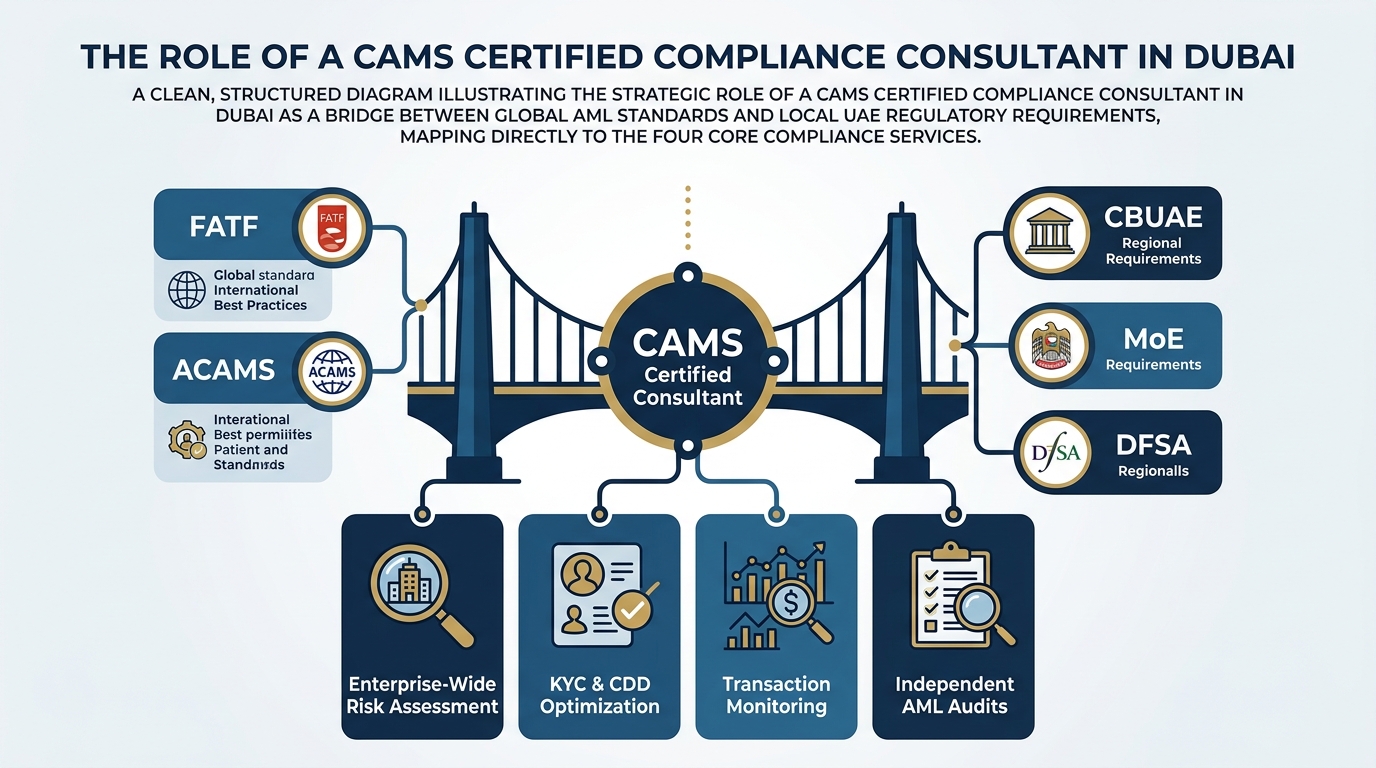
Navigating the complex regulatory frameworks enforced by the Central Bank of the UAE (CBUAE), the Ministry of Economy (MoE), and the Dubai Financial Services Authority (DFSA) requires specialized expertise. Partnering with a CAMS certified compliance consultant Dubai ensures that your business is guided by internationally recognized standards adapted to local regulatory expectations. Certified by the Association of Certified Anti-Money Laundering Specialists (ACAMS), these professionals possess the technical acumen to design, implement, and audit robust compliance programs that protect your business from financial crime risks and regulatory penalties.
As regulatory scrutiny intensifies across the UAE, businesses must move away from generic, off-the-shelf compliance templates. Regulators expect a risk-based approach that reflects the actual operational realities of the entity. A CAMS certified consultant bridge the gap between complex statutory language and practical, day-to-day business operations, ensuring that compliance acts as an enabler of sustainable growth rather than an administrative bottleneck.
Why CAMS Certification Matters in the UAE Regulatory Landscape
The Certified Anti-Money Laundering Specialist (CAMS) credential is the gold standard in financial crime compliance globally. In the UAE, where regulatory bodies are continuously aligning local laws with the Financial Action Task Force (FATF) recommendations, having a CAMS certified consultant is a significant advantage. Here is why this credential matters:
- Global Best Practices, Local Application: CAMS certified professionals are trained in international standards for detecting and preventing money laundering, terrorist financing, and proliferation financing. They translate these global frameworks into actionable strategies tailored to the UAE regulatory environment.
- Regulatory Credibility: UAE regulators, including the Ministry of Economy and the Executive Office for Control and Non-Proliferation, recognize the CAMS credential as a benchmark of professional competence. Having a CAMS certified specialist oversee your compliance framework instills confidence during regulatory inspections.
- Advanced Risk Mitigation: CAMS training equips consultants with deep analytical skills to identify emerging financial crime typologies, assess institutional vulnerabilities, and implement effective risk-mitigation controls.
- Continuous Professional Education: ACAMS requires certified specialists to earn continuing education credits, ensuring that your consultant is always updated on the latest global trends, regulatory shifts, and financial crime methodologies.
Comprehensive Services Offered by a CAMS Certified Compliance Consultant in Dubai
A structured, risk-based compliance program is essential for any business operating in high-risk sectors. A CAMS certified compliance consultant in Dubai provides a full suite of services designed to address every aspect of financial crime prevention.
1. Enterprise-Wide Risk Assessments (EWRA)
An Enterprise-Wide Risk Assessment (EWRA) is the foundation of any effective AML/CFT program. It allows businesses to identify, assess, and understand their specific inherent risks across various categories, including customers, products, services, transactions, delivery channels, and geographic locations.
A certified consultant conducts a thorough EWRA by executing the following structured steps:
- Inherent Risk Identification: Analyzing the business model, target market, and operational footprint to identify inherent risk factors without considering internal controls.
- Control Effectiveness Evaluation: Evaluating the design and operating effectiveness of existing internal controls, such as policies, automated systems, and staff training.
- Residual Risk Calculation: Calculating residual risk levels (Inherent Risk minus Control Effectiveness) and recommending targeted mitigation strategies to bring residual risk within the company’s risk appetite.
- Reporting and Documentation: Documenting the assessment in a comprehensive report that meets the expectations of UAE supervisory authorities and serves as a strategic roadmap for the board of directors.
2. KYC and CDD Optimization
Know Your Customer (KYC) and Customer Due Diligence (CDD) are critical front-line defenses against financial crime. Inefficient KYC processes can lead to regulatory non-compliance or cause friction in the customer onboarding experience.
Optimizing these processes involves:
- Designing Robust Customer Identification Programs (CIP): Establishing clear verification protocols using reliable, independent source documents, data, or information, including digital ID systems approved in the UAE.
- Risk-Rating Methodologies: Implementing risk-rating methodologies to categorize clients into low, medium, or high-risk profiles based on objective risk factors.
- Simplified vs. Enhanced Due Diligence: Establishing clear procedures for Simplified Due Diligence (SDD) for low-risk scenarios and Enhanced Due Diligence (EDD) for high-risk clients, including Politically Exposed Persons (PEPs) and clients from high-risk jurisdictions.
- Technology Integration: Integrating automated KYC software to streamline verification, ultimate beneficial ownership (UBO) identification, and ongoing monitoring.
3. Transaction Monitoring and Sanctions Screening
To prevent illicit funds from entering the financial system, businesses must monitor transactions in real-time or post-event and screen all parties against international sanctions lists.
A CAMS certified consultant assists in:
- Rule Calibration: Developing transaction monitoring rules and scenarios tailored to the business’s specific risk profile, reducing false positives while capturing suspicious patterns.
- Sanctions System Configuration: Configuring sanctions screening systems to screen against the UAE Local Terrorist List, the UN Security Council Consolidated List, and other international watchlists (such as OFAC, EU, and UK lists).
- Investigation Protocols: Establishing clear protocols for investigating alerts, documenting findings, and filing Suspicious Activity Reports (SARs) or Suspicious Transaction Reports (STRs) via the national goAML portal.
4. Independent AML Compliance Audits
Regular independent audits are a mandatory requirement under UAE AML laws for many regulated entities. An independent audit provides an objective evaluation of the adequacy and effectiveness of your AML/CFT program.
The audit process includes:
- Policy Review: Reviewing internal AML policies, procedures, and controls to ensure alignment with current UAE laws and cabinet decisions.
- Sample Testing: Testing the operational effectiveness of KYC/CDD files, transaction monitoring alerts, and sanctions screening logs on a sample basis.
- Governance and Training Evaluation: Evaluating the compliance training program, the resources allocated to the compliance function, and the knowledge level of staff.
- Remediation Roadmap: Providing a detailed audit report with prioritized recommendations for remediation, helping management address gaps before regulatory inspections.
Tailored Compliance Solutions for Key Sectors in Dubai
Different industries face distinct financial crime risks. A one-size-fits-all compliance program is ineffective and often fails to meet regulatory standards. A specialized consultant designs bespoke frameworks for key sectors in the UAE:
| Sector | Key AML/CFT Risks | Essential Compliance Requirements |
|---|---|---|
| Real Estate Firms | High-value cash transactions, third-party payments, complex ownership structures (UBOs). | Strict CDD on buyers/sellers, reporting of high-value cash transactions, screening against sanctions lists. |
| Corporate Service Providers (CSPs) | Shell companies, nominee arrangements, concealment of Ultimate Beneficial Owners (UBOs). | Robust UBO verification, ongoing monitoring of corporate structures, understanding the source of wealth. |
| Financial Institutions | Cross-border wire transfers, rapid movement of funds, correspondent banking risks. | Automated transaction monitoring, complex sanctions screening, detailed regulatory reporting (goAML). |
Real Estate Firms in Dubai
Dubai’s real estate sector is a major driver of the economy but is also highly targeted for money laundering due to the high value of transactions. Real estate brokers and developers are classified as DNFBPs and must comply with strict AML regulations. A CAMS certified consultant helps real estate firms implement robust CDD procedures, identify Ultimate Beneficial Owners (UBOs), and report suspicious transactions related to property purchases. This includes setting up systems to identify and report transactions involving physical cash or virtual assets above the thresholds set by the Ministry of Economy.
Corporate Service Providers (CSPs)
CSPs facilitate company formation, provide nominee services, and manage corporate structures. These activities carry inherent risks of facilitating anonymous corporate vehicles. Consultants help CSPs establish rigorous UBO identification frameworks, verify the source of funds, and ensure that all corporate entities managed remain compliant with UAE transparency laws. This prevents the misuse of legal persons and ensures that accurate, up-to-date beneficial ownership information is maintained and accessible to regulatory authorities.
The Regulatory Framework in the UAE: Key Laws and Authorities
Operating a business in Dubai requires a clear understanding of the local regulatory architecture. The UAE has enacted comprehensive legislation to combat financial crime, which is actively enforced by several key authorities:
- Federal Decree-Law No. 20 of 2018: The primary legislation on anti-money laundering and combating the financing of terrorism in the UAE.
- Cabinet Decision No. 10 of 2019: Provides the implementing regulations for the Federal Decree-Law, detailing the specific obligations of financial institutions and DNFBPs.
- The Ministry of Economy (MoE): The supervisory authority responsible for regulating DNFBPs, including real estate agents, precious metals dealers, auditors, and corporate service providers.
- The Executive Office for Control and Non-Proliferation (EOCN): Oversees the implementation of Targeted Financial Sanctions (TFS) and ensures compliance with international sanctions regimes.
- The Financial Intelligence Unit (FIU): Receives, analyzes, and distributes reports on suspicious transactions (STRs/SARs) submitted through the national goAML portal.
Step-by-Step Implementation of an AML Compliance Framework
Building a resilient AML compliance framework requires a systematic approach. A CAMS certified compliance consultant in Dubai guides your organization through each phase of implementation to ensure seamless alignment with regulatory expectations.
Phase 1: Gap Analysis and Assessment
The first step is to evaluate your existing compliance posture against current UAE laws and guidelines. The consultant reviews your current policies, procedures, and systems to identify any compliance gaps. This phase includes interviewing key personnel, reviewing historical transaction data, and assessing the overall compliance culture within the organization.
Phase 2: Policy Development and Customization
Based on the findings of the gap analysis and the Enterprise-Wide Risk Assessment, the consultant drafts or updates your AML/CFT policies, procedures, and controls. These documents must be customized to your specific business operations, defining clear roles and responsibilities for the Board of Directors, senior management, and the Compliance Officer or Money Laundering Reporting Officer (MLRO).
Phase 3: System Integration and Calibration
In this phase, the consultant assists in selecting, implementing, and calibrating technology solutions for KYC, transaction monitoring, and sanctions screening. Proper calibration is essential to ensure that systems generate high-quality alerts, minimizing operational fatigue caused by excessive false positives while ensuring that actual risks are not missed.
Phase 4: Staff Training and Capacity Building
A compliance program is only as effective as the people executing it. The consultant designs and delivers tailored training programs for employees at all levels. Frontline staff learn how to identify red flags, compliance teams learn how to investigate alerts, and senior management learns about their governance and oversight responsibilities under UAE law.
Phase 5: Ongoing Monitoring and Independent Testing
Once the framework is live, the consultant helps establish mechanisms for ongoing monitoring and periodic independent testing. This ensures that the compliance program adapts to changes in the business environment, emerging financial crime typologies, and updates to UAE regulations.
Common Compliance Pitfalls and How to Avoid Them
Many organizations in Dubai face challenges during regulatory inspections due to common, avoidable pitfalls. Understanding these risks allows businesses to proactively strengthen their compliance frameworks.
Using Generic Templates
One of the most common mistakes is adopting generic AML policy templates downloaded from the internet or copied from other industries. Regulators expect policies to be tailored to the specific risks, products, and customer base of your business. A CAMS certified consultant ensures your documentation reflects your actual operations.
Inadequate UBO Verification
Identifying the ultimate beneficial owner (UBO) is a core requirement of UAE AML regulations. Failing to trace ownership structures down to the natural person who owns or controls 25% or more of the legal entity is a frequent source of regulatory findings. Consultants implement robust verification protocols to trace complex corporate chains effectively.
Neglecting Staff TrainingEven the most sophisticated compliance software cannot replace vigilant employees. Failing to conduct regular, documented AML training for staff can lead to missed red flags and regulatory penalties. Training must be updated annually and tailored to the specific roles of the employees.
Poorly Documented Investigations
When transaction monitoring or sanctions screening systems generate alerts, the investigation process must be thoroughly documented. If an alert is closed without a clear, written rationale explaining why it was deemed non-suspicious, regulators may view this as a failure of internal controls. Consultants establish structured alert-disposition protocols to ensure audit-ready documentation.
How to Choose the Right AML Compliance Consultant in Dubai
Selecting the right compliance partner is a critical decision that impacts your business’s regulatory standing and operational efficiency. Consider the following factors when choosing an AML consultant:
Professional Credentials
Ensure the consultant holds recognized professional certifications, such as CAMS (Certified Anti-Money Laundering Specialist). This guarantees a baseline of technical knowledge and adherence to a professional code of ethics.
Local Regulatory Experience
The UAE regulatory environment has unique nuances. Your consultant must have practical experience dealing with UAE regulators, understanding local inspection processes, and navigating the goAML portal and TFS requirements.
Industry-Specific Expertise
An AML program for a real estate developer differs significantly from one designed for a payment service provider. Choose a consultant who understands the operational realities and specific risk typologies of your industry.
Practical, Risk-Based Approach
Avoid consultants who offer generic, templated compliance manuals. Your compliance framework should be customized to your business’s size, risk profile, and operational complexity, ensuring compliance without unnecessarily hindering business growth.
Partner with Tareq Badarin for Expert AML Compliance Advisory
Maintaining regulatory compliance in Dubai’s dynamic business environment requires proactive, expert guidance. Tareq Badarin is a highly qualified AML Compliance Specialist and Senior Compliance Analyst working within the framework of Farahat & Co. As a CAMS certified professional, Tareq provides comprehensive, risk-based AML, CTF, and financial crime advisory services tailored to the unique needs of businesses in the UAE.
Whether you are a real estate firm seeking to optimize your KYC processes, a Corporate Service Provider requiring an independent AML audit, or a financial institution updating your Enterprise-Wide Risk Assessment, Tareq Badarin delivers practical, compliant, and robust solutions. Protect your business reputation, ensure regulatory compliance, and foster sustainable growth by partnering with a trusted compliance expert.
Contact Tareq Badarin today to schedule a consultation and strengthen your compliance framework.
Frequently Asked Questions
What is a CAMS certification and why is it important in Dubai?
CAMS (Certified Anti-Money Laundering Specialist) is an internationally recognized credential that denotes a high level of expertise in detecting and preventing money laundering and financial crimes. In Dubai, it is highly valued by regulators as a trust signal, ensuring the consultant understands both global best practices and local UAE AML/CFT regulations.
Which businesses in Dubai are required to have an AML compliance program?
All financial institutions and Designated Non-Financial Businesses and Professions (DNFBPs)—including real estate brokers, corporate service providers, auditors, and dealers in precious metals and stones—are legally required to establish and maintain a robust AML compliance program under UAE law.
What are the penalties for AML non-compliance in the UAE?
Non-compliance with UAE AML/CFT regulations can lead to severe penalties, including substantial financial fines, suspension or revocation of business licenses, and potential criminal prosecution for individuals involved.
How often should a business conduct an independent AML audit?
Generally, regulated entities and DNFBPs in the UAE should conduct an independent AML audit annually or bi-annually, depending on their specific sector regulations, risk profile, and supervisory authority guidelines.