
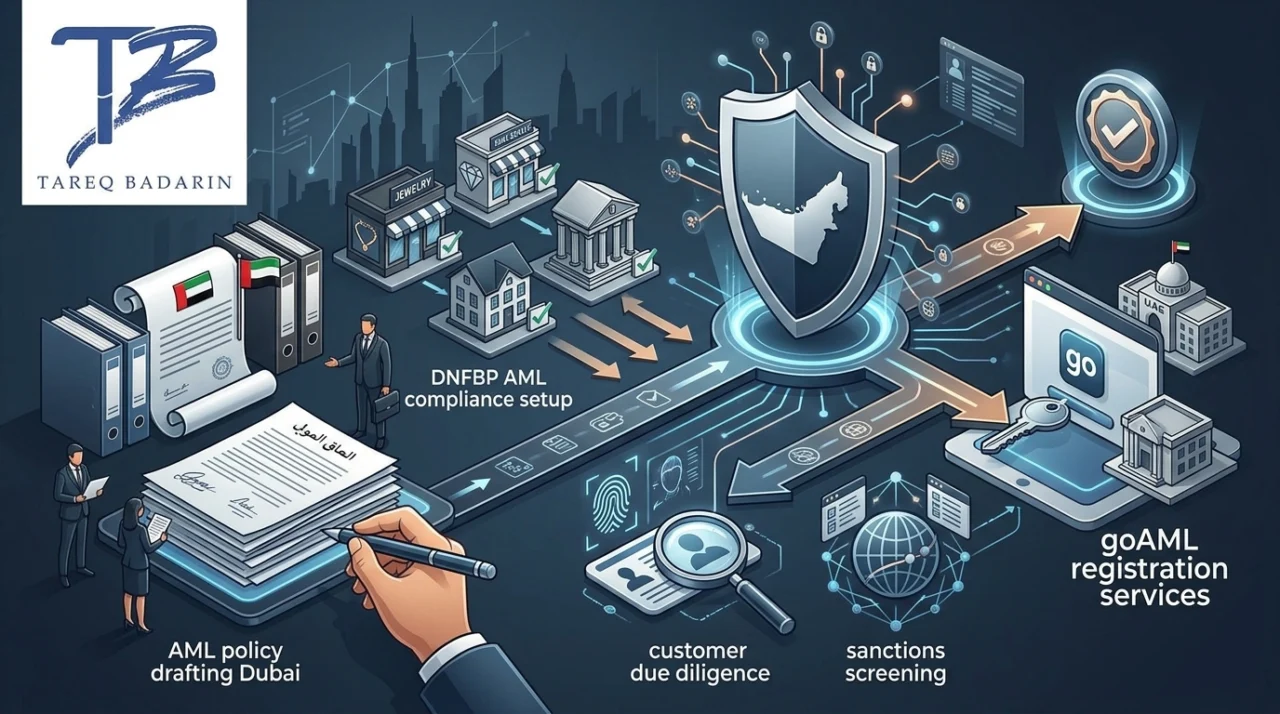
Quick Summary
Establishing an Anti-Money Laundering (AML) framework in the UAE requires structured governance, robust risk assessment, and precise operational alignment with Ministry of Economy, CBUAE, DFSA, and FSRA mandates. Professional AML setup services guide financial institutions, Corporate Service Providers (CSPs), and Designated Non-Financial Businesses and Professions (DNFBPs) through Enterprise-Wide Risk Assessments, policy drafting, goAML and EOCN integration, UBO identification, and employee training to construct audit-ready compliance programs that mitigate financial crime risks.
Establishing a compliant operational framework is one of the most vital strategic steps for financial institutions, Corporate Service Providers (CSPs), Virtual Asset Service Providers (VASPs), and Designated Non-Financial Businesses and Professions (DNFBPs) operating within the United Arab Emirates. As regulatory authorities—including the Central Bank of the UAE (CBUAE), the Ministry of Economy (MoE), the Dubai Financial Services Authority (DFSA), the Financial Services Regulatory Authority (FSRA) in ADGM, and the Virtual Assets Regulatory Authority (VARA)—escalate supervisory oversight, businesses must transition from reactive measures to structured, institution-wide AML architecture. Professional AML setup services provide the technical blueprint and operational guidance required to construct, register, and operationalize a fully compliant internal AML function from day one.
Setting up an Anti-Money Laundering framework is far more complex than acquiring off-the-shelf policy templates or installing standalone screening software. In the UAE regulatory ecosystem, every entity must align its operational workflows with national laws, notably Federal Decree-Law No. (20) of 2018 on Anti-Money Laundering and Countering the Financing of Terrorism and Financing of Illegal Organisations (AML/CFT Law), its implementing executive regulations under Cabinet Decision No. (10) of 2019, Cabinet Decision No. (109) of 2023 regarding Ultimate Beneficial Ownership (UBO), and subsequent supervisory circulars. A comprehensive AML setup ensures that an organization can accurately assess risk, perform proper Customer Due Diligence (CDD), monitor transactions effectively, and fulfill mandatory reporting obligations via national portals such as goAML and the Executive Office for Control and Non-Proliferation (EOCN).
The Strategic Value and Objectives of Professional AML Setup Services
When an enterprise engages expert AML setup services, the primary objective is to construct an adaptable, resilient compliance infrastructure engineered specifically for the company’s business model, customer base, geographic reach, and risk profile. Rather than imposing generic administrative burdens that impede commercial growth, a tailored setup balances regulatory alignment with operational agility, guaranteeing that internal controls facilitate legitimate commerce while systematically intercepting illicit activity.
An effective AML setup framework achieves five primary operational objectives:
- Regulatory Registration & Alignment: Securing immediate, error-free onboarding across state portals, including registration on the Financial Intelligence Unit’s (FIU) goAML platform and the automated reporting system for Targeted Financial Sanctions (TFS).
- Governance & Structural Role Definition: Establishing explicit compliance leadership structures, appointing a qualified AML Compliance Officer / Money Laundering Reporting Officer (MLRO), and defining reporting channels directly to the Board of Directors or Senior Management.
- Customized Risk Framework Development: Formulating a defensible Enterprise-Wide Risk Assessment (EWRA) methodology along with tailored AML/CFT policies, controls, and procedures (PCPs) grounded in quantitative and qualitative risk drivers.
- Technical Workflow & Software Integration: Deploying practical Know Your Customer (KYC), Ultimate Beneficial Owner (UBO), politically exposed person (PEP), and sanctions screening workflows integrated into core transaction processing systems.
- Operational Capability Building: Conducting role-specific compliance training for front-line personnel, operations teams, and executive management to foster an alert institutional compliance culture.
Core Components of a Complete UAE AML Setup Blueprint
Building an audit-ready compliance ecosystem requires an integrated, multi-phased approach. Each layer of the compliance architecture plays a distinct role in protecting the organization against regulatory penalties, operational disruptions, financial losses, and reputational damage.
1. Enterprise-Wide Risk Assessment (EWRA) Framework
The foundation of any defensible compliance program is the Enterprise-Wide Risk Assessment (EWRA). Before drafting procedural documentation or selecting technology vendors, a business must evaluate its exposure across mandatory risk categories defined by national regulators and international standards established by the Financial Action Task Force (FATF). A sound EWRA methodology evaluates risk along two dimensions: inherent risk (the exposure present before applying internal controls) and residual risk (the remaining risk after implementing controls).
| Risk Category | Assessment Focus Area | Typical UAE Business Exposure Example | Standard Mitigation Control |
|---|---|---|---|
| Customer Risk | Evaluation of client legal structure, ownership complexity, PEP exposure, operating history, and net worth sources. | Onboarding non-resident high-net-worth individuals, shell companies, or complex offshore trusts. | Enhanced Due Diligence (EDD), independent proof of Source of Wealth (SoW), senior management sign-off. |
| Geographic Risk | Analysis of jurisdictions involved in customer activities, funding sources, and ultimate beneficial ownership. | Handling funds originating from high-risk, uncooperative, or FATF-monitored jurisdictions. | Geographic risk matrix integration, automated country risk scoring, enhanced transaction monitoring. |
| Product & Service Risk | Risk associated with high-value transactions, cash intensity, non-face-to-face engagements, or high velocity. | Real estate acquisitions using physical cash, virtual assets, or third-party bank transfers. | Mandatory Real Estate Activity Reports (REAR), cash limits, strict third-party payment restrictions. |
| Delivery Channel Risk | Methods through which products or services are distributed and accessed by clients. | Fully remote digital onboarding without live liveness detection or biometric document verification. |
2. Customized Policy Drafting and Procedural Architecture
Policy manuals must reflect actual operational routines rather than generic theoretical statements. During an AML setup, compliance advisors translate regulatory requirements into clear Standard Operating Procedures (SOPs) that guide employees step-by-step through daily operations. Key documentation created during the setup phase includes:
- AML/CFT/CPF Policy Manual: Overarching document establishing management commitment, risk appetite, governance structures, MLRO responsibilities, and internal audit requirements.
- Standard Operating Procedures (SOPs): Granular instructions for operational staff covering client onboarding, identity verification, risk scoring, file reviews, and record-keeping routines.
- Targeted Financial Sanctions (TFS) & Counter Proliferation Financing (CPF) Manual: Explicit instructions for daily screening against the UAE Local Terrorist List and UN Security Council Consolidated Lists, defining mandatory 24-hour reporting timelines and asset freezing protocols.
- PEP & High-Risk Management Guidelines: Clear escalation workflows for handling Politically Exposed Persons, high-risk sector accounts, and non-cooperative jurisdictions requiring Senior Management approval.
- Internal Whistleblowing & Reporting Directives: Clear procedures enabling staff to report potential compliance breaches or internal misconduct without fear of retaliation.
3. System Registration and Regulatory Integrations
A crucial milestone in setting up an AML framework in the UAE is establishing functional connections with official state compliance infrastructure. Financial institutions and DNFBPs—including real estate brokers, developers, dealers in precious metals and stones, corporate service providers, auditors, accountants, and law firms—must execute two vital integrations during setup:
- goAML Portal Registration: Managed by the UAE Financial Intelligence Unit (FIU), goAML is the central reporting platform for submitting Suspicious Transaction Reports (STRs), Suspicious Activity Reports (SARs), Real Estate Activity Reports (REARs), High-Risk Country Reports (HCRs), and Partial Name Match Reports (PNMRs).
- Executive Office for Control and Non-Proliferation (EOCN) Registration: Registration on the EOCN notification portal enables businesses to receive instant automated alerts regarding sanction list additions, modifications, and deletions, facilitating immediate asset-freezing actions.
Detailed Step-by-Step AML Setup Implementation Roadmap
Executing an AML setup requires a logical sequence to ensure all structural and technical elements are fully operational before commercial onboarding begins. The standard implementation roadmap follows six distinct phases:
Phase 1: Diagnostic Gap Analysis & Business Profile Assessment
The process begins with a detailed assessment of the organization’s current or proposed commercial activities, corporate structure, customer acquisition channels, and technology platforms. Advisors evaluate the exact regulatory scope (CBUAE, MoE, DFSA, FSRA, VARA) and identify regulatory overlaps to determine necessary licensing conditions and compliance mandates.
Phase 2: Governance Structure & MLRO Appointment
Regulators require entities to formally designate a qualified AML Compliance Officer / Money Laundering Reporting Officer (MLRO). During setup, compliance specialists define the role’s scope, establish direct reporting lines to the Board, create the MLRO charter, and verify that the appointee meets regulatory criteria regarding autonomy, competence, and access to organizational records.
Phase 3: Customer Due Diligence (CDD) & UBO Framework Construction
Identity verification and ownership transparency form the core of operational AML controls. The setup service creates practical workflows tailored to varying risk tiers:
- Simplified Due Diligence (SDD): Streamlined verification protocols applied exclusively to verified low-risk entities, such as public sector bodies or publicly traded companies listed on recognized stock exchanges.
- Standard Customer Due Diligence (CDD): Standard protocols for collecting, verifying, and documenting primary identity documents (Emirates ID, passports, commercial licenses, Memorandum of Association, register of shareholders).
- Ultimate Beneficial Ownership (UBO) Identification: Deep-dive analysis protocols designed to trace multi-tiered, cross-border corporate structures to identify any natural person who ultimately owns or controls 25% or more of the capital or voting rights, or who exercises ultimate managerial control.
- Enhanced Due Diligence (EDD): Rigorous investigation protocols triggered by high-risk indicators, requiring corroborated evidence regarding the client’s Source of Funds (SoF) and Source of Wealth (SoW), senior executive approval, and ongoing close monitoring.
Phase 4: Sanctions Screening & Transaction Monitoring Deployment
Manual screening process models are vulnerable to human error and operational bottlenecks. AML setup services assist in selecting, configuring, and testing screening systems that check client databases, directors, and UBOs against global watchlists, PEP databases, and sanctions lists. Advisors calibrate screening rules and fuzzy-matching thresholds to ensure true hits are identified while minimizing unnecessary false positives.
Phase 5: Operationalization of Reporting Workflows (goAML)
Setting up reporting routines involves configuring internal communication channels so that operational employees can easily submit Internal Suspicious Activity Disclosures to the MLRO. The setup service establishes evaluation protocols for the MLRO to review internal alerts, conduct independent investigations, document decision-making logic, and submit formal STRs/SARs via the goAML portal when reasonable grounds for suspicion exist.
Phase 6: Staff Capability Training & Cultural Alignment
A compliance policy is only as effective as the employees tasked with executing it. Comprehensive setup services include practical, role-based training programs aimed at building functional operational skills:
- Front-Line Staff: Training focused on identifying behavioral red flags, verifying identity documentation, recognizing suspicious payment flows, and avoiding tipping-off violations.
- Compliance & Operational Teams: Deep-dive technical training covering goAML navigation, screening hit adjudication, EDD investigations, and sanction execution.
- Senior Leadership & Board Members: Governance-level briefings covering personal liabilities, regulatory supervision expectations, resource allocation, and annual compliance reporting routines.
Tailoring AML Setup Services to Specific UAE Industry Sectors
Regulatory requirements and operational realities vary significantly across business sectors. Generic compliance frameworks fail to address sector-specific vulnerabilities. Professional AML setup services customize controls based on unique sectoral risk profiles.
Real Estate Developers, Brokers, and Agencies
Due to high cash flows and international buyer interest, the UAE real estate sector operates under close regulatory oversight by the Ministry of Economy and local land departments. Real estate AML setup involves specialized controls, including:
- Automated submission of Real Estate Activity Reports (REAR) on goAML for cash transactions equal to or exceeding designated statutory thresholds, or payments involving virtual assets.
- Screening buyers, sellers, corporate representatives, and UBOs before accepting booking deposits or executing sale contracts.
- Rigorous source of funds verification when purchase payments are remitted by third parties or foreign offshore corporate entities.
Corporate Service Providers (CSPs) and Company Formation Agents
CSPs face inherent risks because they form corporate structures, establish bank accounts, and provide nominee services that could potentially be misused to obscure ownership. AML setup for CSPs prioritizes:
- Multi-layered corporate structure unraveling to identify natural person UBOs across complex, multi-jurisdictional holding structures.
- Ongoing monitoring of nominee director, nominee shareholder, and registered office arrangements to prevent structural misuse.
- Assessing customer business model viability and economic substance prior to incorporating legal entities or providing business addresses.
Dealers in Precious Metals and Stones (DPMS)
DPMS businesses face heightened risk due to the liquidity, portability, and high value of precious metals and gems. AML setup for DPMS operations includes:
- Establishing clear thresholds for identifying walk-in customer cash transactions and executing mandatory Customer Due Diligence.
- Configuring goAML reporting channels for high-value cash transactions and unusual purchasing behavior.
- Inventory and supplier due diligence workflows to ensure precious metals are sourced from responsible, non-conflict origins.
Financial Institutions and Virtual Asset Service Providers (VASPs)
Financial institutions, payment service providers, fund managers, and VASPs require advanced compliance infrastructures tailored to dynamic transaction volumes. AML setup for these sectors includes:
- Configuring real-time transaction monitoring systems that track transaction velocity, unexpected geographic hops, and behavioral anomalies.
- Implementing automated Travel Rule compliance engines for crypto asset transfers, ensuring sender and receiver data accompanies transfers above regulatory thresholds.
- Dynamic customer risk-scoring engines that automatically adjust client risk levels and update Re-KYC cycles based on real-time transactional activity.
Common Implementation Pitfalls and Risk Mitigation Strategies
Businesses setting up internal AML operations often encounter implementation challenges that expose them to regulatory penalties during Ministry of Economy or CBUAE inspections. Proactively addressing these pitfalls is vital for operational continuity.
| Implementation Pitfall | Root Operational Cause | Regulatory / Business Impact | Mitigation Strategy |
|---|---|---|---|
| Using Uncustomized Policy Templates | Adopting generic manuals found online or copied from foreign entities. | Immediate non-compliance notices during inspections; policies fail to reflect actual business practices. | Develop customized policies directly mapped to the company’s specific EWRA and operational processes. |
| Incomplete goAML Configuration | Registering on goAML without establishing internal escalation workflows. | Inability to file STRs/SARs within mandatory timelines, leading to statutory non-compliance. | Document and test internal disclosure handling from operational staff to the MLRO before launch. |
| Superficial UBO Identification | Accepting corporate records without verifying ultimate natural person controllers. | Severe regulatory fines for failing to maintain accurate UBO registers under Cabinet Decision No. (109) of 2023. | Implement mandatory ownership tracing steps down to natural persons owning/controlling 25%+ of the entity. |
| Static One-Time KYC | Treating onboarding due diligence as a single, static event. | Failure to detect changes in customer risk profiles, expired identity documents, or new sanction hits. | Establish automated trigger events and structured Re-KYC review cycles (e.g., annual for high-risk, 3-year for low-risk). |
| Inadequate Documentation of Decisions | Clearing screening alerts or closing internal flags without written notes. | Inability to prove compliance during regulatory audits or independent reviews. | Mandate written audit trails explaining the rationale for dismissing flags or approving high-risk profiles. |
Maintaining Compliance Integrity Post-Setup: Operational Life Cycle
Completing the initial AML setup creates the operational framework, but compliance requires continuous maintenance. To maintain regulatory alignment, organizations must follow a structured operational lifecycle that incorporates periodic reviews and operational updates.
| Operational Frequency | Mandatory Compliance Activity | Operational Scope & Objective |
|---|---|---|
| Daily | Sanctions & PEP Screening Updates | Screening customer databases and incoming/outgoing transactions against updated local and international sanctions lists. |
| Monthly / Quarterly | Internal Alert Audits & Trend Analysis | Reviewing internally generated flags and MLRO decisions to evaluate screening system performance and adjust alert thresholds. |
| Annually | Enterprise-Wide Risk Assessment Update | Re-evaluating the institutional risk profile to account for new product lines, expanding markets, or updated regulations. |
| Annually | Independent Compliance Audit | Engaging an qualified independent auditor to review policies, procedures, workflows, and goAML reporting records. |
| Annually | Staff Re-Training & Capability Refresher | Delivering updated training modules incorporating recent regulatory changes, industry typologies, and internal SOP updates. |
Structuring a Resilient AML Compliance Framework with Expert Advisory
Navigating the complex regulatory requirements of UAE financial crime legislation demands specialized domain expertise and practical execution capacity. Designing an audit-ready compliance infrastructure requires aligning technical legal standards with everyday operational routines, ensuring business activities remain fully protected against regulatory sanctions and financial crime exploitation.
Tareq Badarin, an experienced CAMS and PMP certified AML compliance expert working in association with Farahat & Co., provides professional guidance to help companies across Dubai and the UAE establish robust, regulatory-aligned AML operational functions. From initial institutional gap analysis and EWRA design to customized policy manual drafting, goAML and EOCN onboarding, UBO framework implementation, and staff training, expert advisory ensures your organization maintains an efficient, defensible, and fully compliant operational foundation.
Frequently Asked Questions
What are AML setup services for UAE businesses?
AML setup services involve designing, establishing, and operationalizing a full Anti-Money Laundering framework tailored to a business. This includes conducting Enterprise-Wide Risk Assessments (EWRA), drafting custom policies and procedures, registering on regulatory portals like goAML, establishing UBO/CDD workflows, and training internal staff.
Which UAE businesses are required to have an AML framework?
All Financial Institutions (FIs) and Designated Non-Financial Businesses and Professions (DNFBPs)—including real estate developers and brokers, dealers in precious metals and stones, corporate service providers, lawyers, and auditors—are legally required to establish and maintain a compliant AML framework.
What is goAML registration and why is it part of the AML setup?
goAML is the official reporting portal administered by the UAE Financial Intelligence Unit (FIU). Registering on goAML is mandatory for all regulated entities to submit Suspicious Transaction Reports (STRs), Suspicious Activity Reports (SARs), and required sectoral reports.
How long does it take to complete a full AML setup in the UAE?
The duration depends on business complexity and scope, but a standard AML setup process for a DNFBP or corporate service provider typically takes between two to four weeks from initial risk assessment to policy approval and portal registration.
