

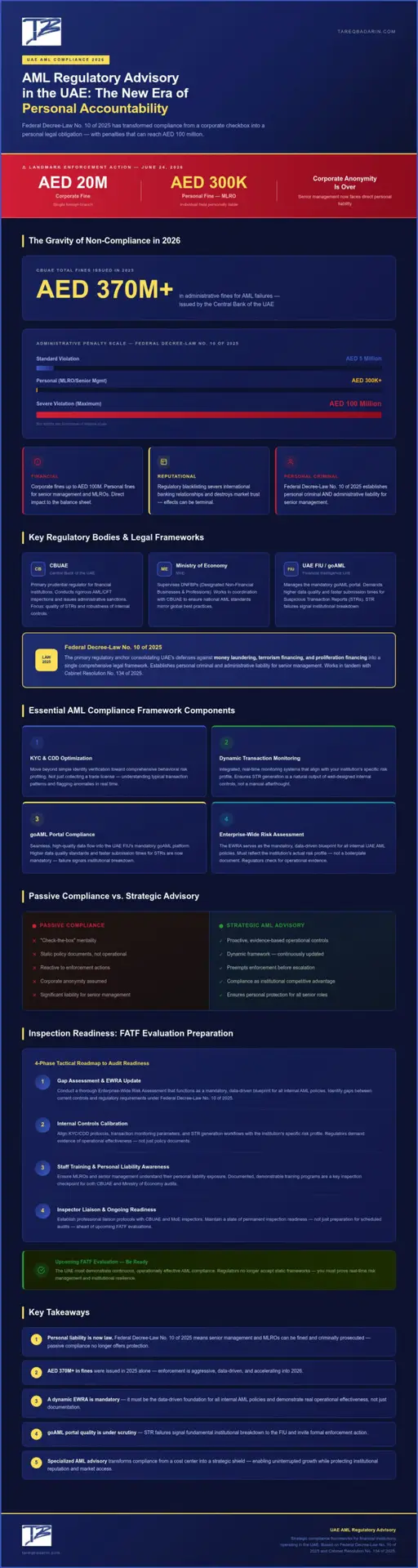
On June 24, 2026, the Central Bank of the UAE imposed an AED 20 million fine on a single foreign branch while simultaneously holding the individual MLRO personally liable for AED 300,000. This landmark enforcement action confirms that the regulatory environment has shifted from corporate oversight to direct personal accountability. It’s understandable if the intricate requirements of Federal Decree-Law No. 10 of 2025 feel like an insurmountable barrier to your firm’s strategic objectives. You shouldn’t have to compromise operational momentum to avoid administrative penalties that can now reach AED 100 million for severe violations.
This article provides an authoritative blueprint for securing your institution through elite AML regulatory advisory in the UAE, positioning your compliance framework as a sophisticated shield against risk. We’ll explore the technicalities of Cabinet Resolution No. 134 of 2025 and the methodology for optimizing KYC and CDD processes to reduce friction. By the end of this guide, you’ll possess the strategic insights necessary to master Enterprise-Wide Risk Assessments and maintain a state of permanent inspection readiness in the face of the upcoming FATF evaluations.
Key Takeaways
- Understand the critical implications of Federal Decree-Law No. 10 of 2025 and why passive compliance no longer protects senior management from personal liability.
- Optimize institutional defenses by integrating dynamic transaction monitoring and sophisticated AML regulatory advisory Dubai into your core operational framework.
- Establish a robust Enterprise-Wide Risk Assessment (EWRA) that functions as the mandatory, data-driven blueprint for your internal UAE AML policies.
- Prepare for rigorous CBUAE and Ministry of Economy inspections with a tactical roadmap designed to ensure seamless audit readiness and professional liaison.
- Leverage the synergy between specialized AML expertise and the institutional strength of Farahat & Co to secure long-term regulatory alignment and market access.
The Imperative of AML Regulatory Advisory in the UAE Landscape
In the current fiscal climate, AML Regulatory Advisory is no longer a peripheral administrative cost but a core strategic partnership essential for risk mitigation. As the UAE enters 2026, the regulatory landscape has transitioned from a period of rapid legislative development to one of aggressive, data-driven enforcement. Engaging with specialized AML regulatory advisory Dubai ensures that an institution’s compliance framework isn’t merely a static document but a dynamic shield. This partnership transforms regulatory obligations into a strategic advantage, safeguarding institutional reputation while facilitating uninterrupted growth in a high-stakes environment.
Passive compliance, characterized by a “check-the-box” mentality, has become a significant liability for national enterprises. Regulators now demand evidence of operational effectiveness and real-time risk management. An expert advisor acts as a vigilant guardian, interpreting complex legal shifts and ensuring that every internal protocol aligns with the highest international expectations. It’s no longer enough to possess a policy; you must demonstrate its active application and resilience against evolving financial threats.
The Gravity of Non-Compliance in 2026
The financial consequences of oversight have reached unprecedented levels. During 2025, the Central Bank of the UAE (CBUAE) issued over AED 370 million in administrative fines for AML failures. Under the current framework, corporate penalties for severe violations can range from AED 5 million up to AED 100 million. Strategic AML regulatory advisory Dubai provides the necessary foresight to preempt these risks before they escalate into formal enforcement actions. Beyond the balance sheet, the impact of regulatory blacklisting can be terminal, severing vital international banking relationships and destroying market trust. Perhaps most critically, Federal Decree-Law No. 10 of 2025 establishes personal criminal and administrative liability for senior management. A recent precedent on June 24, 2026, saw a compliance officer personally fined AED 300,000, signaling that the era of corporate anonymity is over.
Regulatory Bodies and National Frameworks
The CBUAE and the Ministry of Economy (MoE) lead the national mandate to uphold the integrity of the UAE financial system. These bodies work in coordination with the National Committee for Combating Money Laundering to ensure that local practices mirror global anti-money laundering (AML) standards. Their supervision is rigorous, focusing on the quality of Suspicious Transaction Reports (STRs) and the robustness of internal controls. Federal Decree-Law No. 10 of 2025 serves as the primary regulatory anchor, consolidating the nation’s defenses against money laundering, terrorism financing, and proliferation financing into a single, comprehensive legal framework.
Essential Components of a Sophisticated AML Compliance Framework
A sophisticated compliance framework functions as the primary barrier against the infiltration of illicit capital into the UAE financial system. In the 2026 regulatory environment, this structure must transcend basic documentation. It requires an integrated ecosystem where Know Your Customer (KYC) and Customer Due Diligence (CDD) protocols serve as an active intelligence gathering mechanism. Engaging with professional AML regulatory advisory Dubai allows firms to transition from reactive responses to a proactive stance, ensuring that every institutional defense is calibrated to the specific risk profile of the business.
The efficacy of these defenses relies on the seamless flow of data into the goAML portal. This mandatory system, managed by the UAE’s Financial Intelligence Unit (FIU), now demands higher data quality and faster submission times for Suspicious Transaction Reports (STRs). Failure to maintain these standards doesn’t just invite scrutiny; it signals a fundamental breakdown in institutional integrity. A robust framework ensures that reporting isn’t an afterthought but a natural output of well-designed internal controls.
KYC and CDD Optimization
Modern optimization requires moving beyond simple identity verification toward comprehensive behavioral risk profiling. It’s no longer sufficient to collect a trade license; you must understand the typical transaction patterns of a client to identify deviations. Central to this is the rigorous verification of Ultimate Beneficial Ownership (UBO), as mandated by Cabinet Decision No. 109 of 2023. Identifying the natural persons who ultimately control a corporate entity is a non-negotiable requirement for transparency. For high-risk jurisdictions or Politically Exposed Persons (PEPs), institutions must implement Enhanced Due Diligence (EDD) measures that include verifying the source of wealth and source of funds with granular precision. Establishing these bespoke UAE AML policies ensures that your growth isn’t compromised by unidentified high-risk associations.
Transaction Monitoring and Sanctions Screening
Static, rule-based systems are increasingly inadequate for detecting sophisticated money laundering schemes. Dynamic transaction monitoring is now a regulatory expectation, requiring real-time analysis of cross-border flows and complex corporate structures. This must be paired with rigorous sanctions screening against both United Nations and UAE local terrorist lists, as outlined in Cabinet Decision No. 74 of 2020. While AI-driven RegTech tools are essential for processing the vast volume of modern trade, automated monitoring must be balanced with expert human oversight to interpret the nuance of high-stakes financial activity. This synergy ensures that “false positives” don’t impede legitimate commerce while genuine “red flags” are identified with surgical precision. Utilizing AML regulatory advisory Dubai helps bridge the gap between technological capabilities and the qualitative judgment required for high-level compliance.
The Strategic Edge: Enterprise-Wide Risk Assessment (EWRA)
The Enterprise-Wide Risk Assessment (EWRA) serves as the foundational architecture of a resilient compliance program. It’s not a mere periodic obligation but a high-stakes strategic document that dictates the efficacy of your entire AML regulatory advisory Dubai strategy. While many institutions focus solely on individual customer risk, the EWRA shifts the lens to institutional vulnerabilities. It analyzes the inherent risks of your specific business model, including the products you offer, the delivery channels you utilize, and the jurisdictions where you operate. By establishing this baseline, firms move from a reactive posture to a state of strategic vigilance.
A robust EWRA informs the intelligent allocation of compliance resources. It ensures that budgets and personnel are deployed where they can most effectively mitigate real threats rather than being wasted on low-risk administrative tasks. When the Central Bank of the UAE or the Ministry of Economy conducts an inquiry, the EWRA acts as your primary defense. It provides the documented rationale for your internal controls, demonstrating that your compliance decisions are data-driven and deliberate rather than arbitrary. Without this document, an institution lacks the logical framework required to justify its risk-based approach to regulators.
Identifying and Mitigating Institutional Vulnerabilities
To be effective, an assessment must scrutinize every geographic touchpoint and service line. Digital-first delivery channels often present higher anonymity risks compared to traditional face-to-face interactions, necessitating different control weights. A thorough gap analysis is essential here to identify hidden weaknesses in current protocols before they are exploited. These findings must then be codified into tailored UAE AML policies that reflect the specific operational realities of the firm. A generic policy is a liability; a bespoke one is a shield that protects institutional integrity.
Scaling Compliance with Confidence
Growth should not lead to increased regulatory exposure. A well-maintained EWRA allows for sustainable expansion by identifying the risk thresholds of new markets or products before they’re launched. As the UAE prepares for the mid-2026 regulatory milestones and FATF-related assessments, periodic reviews of the EWRA are mandatory to account for shifting market dynamics and emerging financial crime typologies. Aligning internal controls with the findings of a current enterprise-wide assessment ensures that your institution remains robust. This methodical approach provides the institutional strength needed to navigate the complexities of the UAE’s evolving legal framework with unwavering integrity.
Navigating Regulatory Inspections: A Tactical Guide to Audit Readiness
A regulatory inspection by the Central Bank of the UAE (CBUAE) or the Ministry of Economy (MoE) is not a routine administrative review; it’s a high-stakes assessment of your institution’s integrity. These examinations, whether conducted as a physical on-site visit or a remote “desk-based” review, scrutinize the operational reality of your internal controls. Engaging specialized AML regulatory advisory Dubai provides a critical advantage during these periods of intense scrutiny. Your advisor functions as a sophisticated liaison, translating complex regulatory inquiries into actionable internal requests and ensuring that every response is technically accurate and strategically sound.
One of the most frequent pitfalls during an inspection is the failure to document the “compliance culture” or the “tone at the top.” Regulators look for evidence that senior management is actively involved in oversight, rather than merely delegating responsibility to a siloed compliance department. An adverse finding often stems not from a lack of policy, but from a lack of documented rationale for why certain risks were accepted or why specific transactions weren’t deemed suspicious. Demonstrating a proactive, vigilant mindset is as important as presenting the files themselves.
Preparing the Defense: The Pre-Audit Checklist
True readiness begins long before the regulator issues an inspection notice. Conducting rigorous mock inspections allows your team to stress-test internal procedures under simulated pressure, identifying gaps in data retrieval or logic before an official auditor finds them. It’s vital to ensure that all Suspicious Transaction Reports (STRs) and Suspicious Activity Reports (SARs) are fully documented with a clear audit trail of the investigation process. Staff training is equally paramount; employees at all levels must be coached to communicate with inspectors with confidence, providing precise information without volunteering irrelevant data that could broaden the scope of the audit. To ensure your firm is fully prepared for the next round of CBUAE scrutiny, secure expert AML inspection support today.
Managing the Inspection Process
During the active phase of an inspection, the speed and quality of data delivery are decisive. You must provide immediate access to requested transaction samples and risk assessments while carefully maintaining legal privilege over sensitive internal communications. Addressing inspector concerns in real-time is a powerful strategy to mitigate potential findings; if a misunderstanding arises regarding a specific protocol, it’s often possible to clarify the logic immediately rather than waiting for the draft report. The post-inspection remedial action plan is the final, critical opportunity to demonstrate a proactive commitment to closing identified gaps before they trigger formal administrative penalties.
Securing Your Institutional Integrity with Tareq Badarin’s Advisory
Tareq Badarin operates as a specialized division within the robust infrastructure of Farahat & Co, an institution with a professional legacy in the UAE dating back to 1985. This elite positioning allows us to offer more than just administrative support. We provide a strategic alliance that merges specialized technical expertise with a broad understanding of the regional commercial environment. Relying on generic, one-size-fits-all software often leads to a false sense of security. True institutional resilience requires the sophisticated judgment that only AML regulatory advisory Dubai can provide, ensuring your defenses are as unique as your business model.
Our commitment to unwavering integrity and regulatory excellence serves as a shield for your organization in an increasingly volatile legal environment. Proactive consultation is the only way to stay ahead of the aggressive enforcement trends seen in 2026. We don’t just react to changes; we prepare your leadership to lead with compliance as a core competency. This steady, briefing-style approach ensures that every stakeholder understands their personal and corporate responsibilities under the latest federal mandates.
A Methodology Rooted in Expertise
The methodology we employ focuses on translating the intricate clauses of Federal Decree-Law No. 10 of 2025 into actionable business intelligence. We draw upon decades of UAE-specific regulatory intelligence to ensure your internal protocols are both legally compliant and operationally efficient. By identifying and mitigating vulnerabilities early, we help you maintain a “low-risk” profile during official evaluations. This status is essential for preserving institutional trust and ensuring that your organization remains a preferred partner for international banking and trade. We bridge the gap between theoretical knowledge and field experience to provide a defense that is both academic in its precision and practical in its application.
Commencing Your Strategic Compliance Journey
Your journey toward strategic alignment starts with a detailed AML health check and discovery session. This initial assessment identifies immediate gaps in your KYC/CDD optimization and transaction monitoring systems. We tailor our AML regulatory advisory Dubai for diverse sectors, including real estate, financial institutions, and DNFBPs, recognizing that each industry faces distinct typologies and risk levels. Our goal is to transform your compliance function from a cost center into a strategic protector of your institutional legacy. We ensure that your growth is built on a foundation of stability and meticulous attention to detail.
Secure your UAE business with elite AML advisory services.
Securing Your Strategic Position in the 2026 Regulatory Landscape
The 2026 regulatory environment in the UAE demands a definitive transition from passive adherence to a state of strategic vigilance. We’ve explored how Federal Decree-Law No. 10 of 2025 has redefined the stakes, elevating personal liability for senior management and increasing corporate penalties to as much as AED 100 million for severe violations. A robust Enterprise-Wide Risk Assessment isn’t just a regulatory requirement; it’s the foundational blueprint for institutional survival. By optimizing KYC processes and dynamic transaction monitoring, your organization can effectively navigate the heightened scrutiny of the CBUAE and Ministry of Economy during the upcoming FATF evaluations.
Navigating these complexities requires more than just automated tools; it demands a strategic ally who understands the local landscape’s gravity. As a specialized division of the Farahat & Co professional infrastructure, Tareq Badarin provides elite AML regulatory advisory Dubai to ensure your business remains a low-risk entity. Our expertise in high-stakes inspection support and Federal Decree-Law compliance serves as a definitive shield for your reputation. Consult with Tareq Badarin for Authoritative AML Advisory to secure your institutional legacy. You’ve built a successful enterprise; now is the time to protect its future with unwavering integrity.
Frequently Asked Questions
What are the main requirements of Federal Decree-Law No. 10 of 2025 for UAE businesses?
Federal Decree-Law No. 10 of 2025 mandates that all regulated entities implement a comprehensive framework to combat money laundering, terrorism financing, and proliferation financing. It introduces heightened expectations for data-driven risk management and establishes stringent personal liability for compliance officers and senior management. Businesses must now demonstrate the operational effectiveness of their internal controls rather than merely proving the existence of a written policy.
How often should a business conduct an Enterprise-Wide Risk Assessment (EWRA)?
A business should conduct an Enterprise-Wide Risk Assessment (EWRA) at least annually to remain compliant with UAE standards. However, the 2026 regulatory guidance emphasizes that an EWRA must be a living document, updated immediately following significant changes to your product lines, geographic footprint, or the broader market risk environment. This ensures your AML regulatory advisory Dubai strategy remains aligned with actual institutional vulnerabilities as they evolve.
What is the difference between KYC and CDD in the UAE regulatory context?
KYC refers to the specific identification and verification of a customer’s identity at the initial onboarding stage. In contrast, Customer Due Diligence (CDD) is a broader, continuous process that involves evaluating the nature of the customer’s business, their source of wealth, and their expected transaction patterns. While KYC establishes who the client is, CDD provides the necessary context to identify suspicious deviations from normal behavior throughout the relationship.
When is a business required to register with the goAML portal?
Registration with the goAML portal is mandatory for all Financial Institutions and Designated Non-Financial Businesses and Professions (DNFBPs) upon the commencement of their operations. This system serves as the exclusive channel for submitting Suspicious Transaction Reports (STRs) to the UAE Financial Intelligence Unit. Delaying registration is a serious regulatory breach that signals a fundamental lack of readiness to fulfill mandatory reporting obligations under federal law.
What are the potential penalties for failing a CBUAE AML inspection in 2026?
Potential penalties for failing a CBUAE inspection in 2026 include administrative fines ranging from AED 50,000 to AED 5 million per individual violation. For severe or systemic failures, corporate fines can escalate to AED 100 million. Recent enforcement actions have also seen individual compliance officers personally fined up to AED 300,000, highlighting a definitive shift toward personal accountability for institutional lapses during high-stakes audits.
How can an external AML consultant help during a Ministry of Economy audit?
An external consultant provides a protective layer during a Ministry of Economy audit by serving as the primary technical liaison between your firm and the regulators. They ensure that all requested data is presented accurately and within the proper legal context, which prevents minor administrative errors from being interpreted as systemic failures. Their presence often instills confidence in inspectors that the institution is committed to maintaining professional excellence and integrity.
What specific industries are classified as DNFBPs under UAE law?
Designated Non-Financial Businesses and Professions (DNFBPs) include real estate brokers, dealers in precious metals and stones, independent accountants, and legal professionals. These sectors are considered high-risk for potential illicit capital flows and are subject to the same rigorous AML/CFT/CPF standards as traditional banking institutions. Utilizing AML regulatory advisory Dubai is particularly critical for these businesses to navigate their specific sectoral vulnerabilities and maintain market access.
Does my business need an independent AML audit every year?
Most regulated entities in the UAE are required to undergo an independent AML audit on an annual basis to verify the robustness of their internal controls. This audit serves as an objective validation of your compliance framework’s effectiveness and is a key document requested during CBUAE or Ministry of Economy inspections. It provides the necessary assurance to regulators and stakeholders that your risk mitigation strategies are functioning as intended and are updated for 2026 standards.

Article by
Tareq Badarin
Tareq Badarin is a dedicated Anti-Money Laundering (AML) and Compliance Manager based in the UAE. As a Certified Anti-Money Laundering Specialist (CAMS) and Project Management Professional (PMP), Tareq leads compliance initiatives and regulatory frameworks for Farahat & Co. and HHS Lawyers. He writes about the evolving landscape of financial security, corporate integrity, and effective compliance management.